

The Circus
A Day in the Presidency, Continued Previously: The Presentation. The Wife. The Vice President. The Transmission.

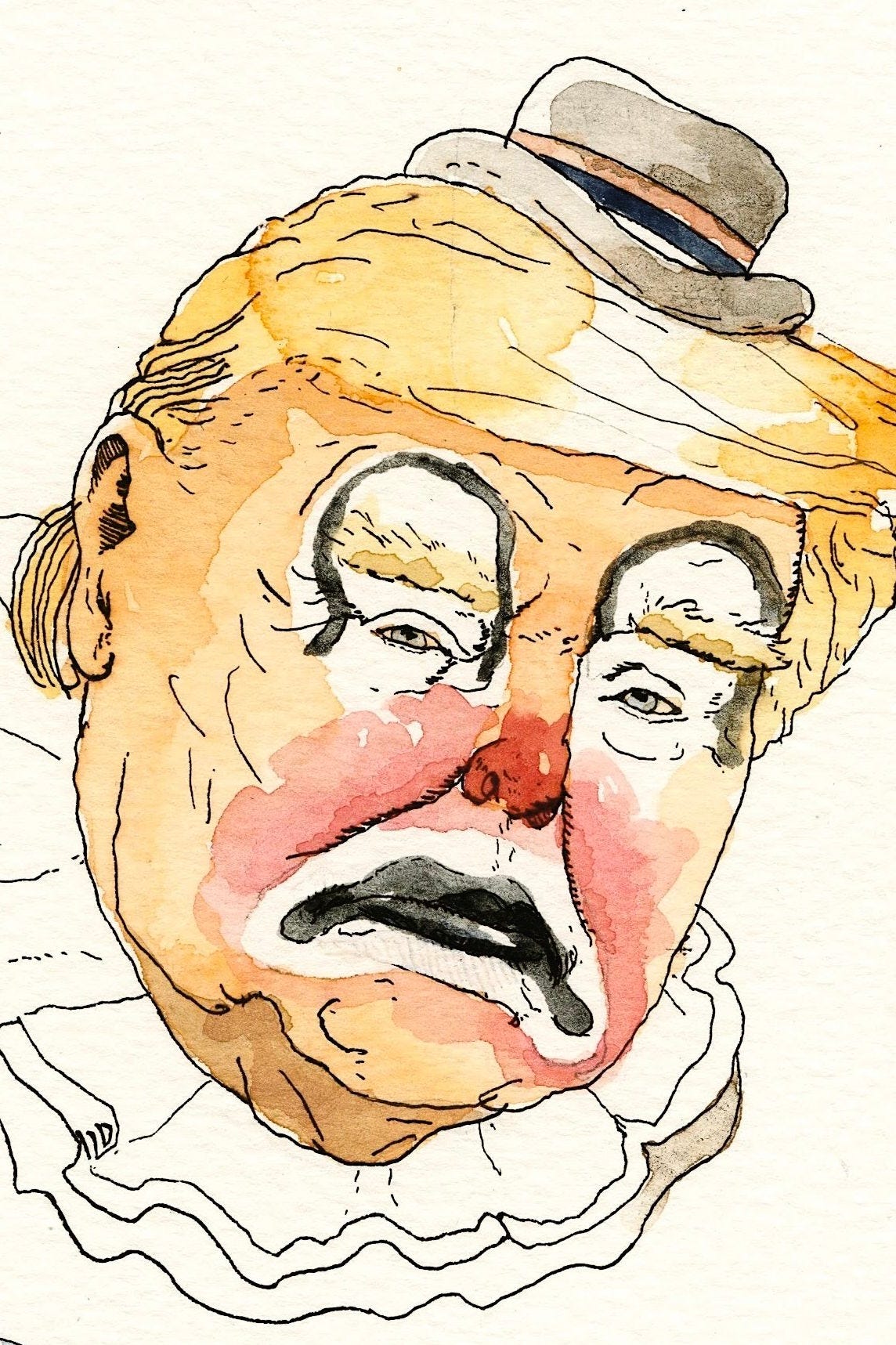
The President of the United States performed as a clown in a Romanian circus on a Thursday afternoon and by Friday it had not happened.
This is how it works now.
Except it did happen. It happened in front of two hundred and thirty-one people, four of whom filmed it, three of whom posted it before the calls started coming, and one of whom,a retired schoolteacher from Bethesda named Carol…began crying during the bucket routine, though she would later struggle to explain exactly why.
The Photo Op
The Girl Scouts had been waiting since 11 a.m.
There were fourteen of them, ages nine through twelve, wearing their sashes and merit badges and the expressions of determined patience that children adopt when adults have broken a promise but everyone is pretending they haven’t. They had driven three hours from Fredericksburg. One of them, a nine-year-old named Madison, had sold seven hundred and twelve boxes of Thin Mints. This was a troop record. Madison had been practicing what she was going to say to the President for six weeks and had it down to ninety seconds, which was professional.
The staff had told them fifteen minutes. Then thirty. Then an hour.
Bex, aged nine, had discovered that pressing your face against the window and pushing sideways made your cheek do something extraordinary. This occupied five of them for eleven minutes and would have occupied them longer except the young man in the expensive suit asked them please to stop.
The young man had said please three times this afternoon about three different things. None of the things had stopped.
The President had taken his Adderall at 7:45. By 2 p.m. it was metabolized and gone and what remained was the gray fog that arrived when the medication left, the cotton behind the eyes, the words in a language that required slow translation. He was tired. The tired had its own texture now. It lived in his bones and his brain and it was not the kind of tired that sleep fixed, though they scheduled sleep every afternoon anyway, two hours in the residence, because by early afternoon exhaustion made everything worse and worse was the thing they could not afford.
The holding room had a chair. A television. A Diet Coke that was warm because someone had forgotten.
He was looking at the warm Diet Coke with the philosophical grievance of a man who has forgotten he could ask for a cold one when the television…tuned to a friendly channel, always tuned to something friendly, they controlled this the way they controlled everything…cut to footage from the National Mall.
A tent. Red and yellow stripes. Enormous. People streaming toward it. Lights even in the afternoon. And music… he had to lean toward the television to hear it properly…a tuba. A cymbal crash. A tuba again.
He had always loved a tuba.
The deputy chief of staff looked in at 2:10 to tell him ten minutes, sir. He nodded. He said right. The deputy left.
He looked at the tent on the television.
He looked at the door.
The door, it turned out, was not locked. Nobody had thought to lock it because nobody had thought this was a door he would use, because nobody had thought he would go anywhere, because the architecture of his days had been so thoroughly managed for so long that spontaneous movement had stopped being something they planned for.
This was a mistake.
The Gap
The East Colonnade has twelve doors. On a normal Thursday afternoon in October, eight of them are staffed. The gaps exist in spreadsheets as “flexible coverage zones.” They are gaps.
He found one at 2:17 p.m. and walked through it with the unhurried confidence of a man following a tuba.
The security footage shows him crossing the South Lawn at a pace that the deputy chief of staff would later describe as “not running but purposeful in a way that, in retrospect, we should have flagged.” His hair…Mrs. Kern’s daily architectural achievement…was already beginning its afternoon migration southward on the left side, the extensions making their slow journey toward his ear. His face, still carrying the morning’s makeup, had settled into the combination of orange and beige that photographers had learned to correct for in post.
He looked, the footage confirmed, not unlike a man in greasepaint.
This was going to be relevant.
Circul Fantastic București
The Circul Fantastic București had been on American soil for eleven days. The permits had required four months and three federal agencies. They had eleven performers, a large man named Gheorghe who did everything else, two elderly horses, a tiger of contested temperament, and one clown.
The clown’s name was Petru. Petru had a face of extraordinary mobile sadness…the kind of sadness so complete, so committed, so without hope of remedy that it became funny. He had performed with the circus for nineteen years. He wore a white face, an orange wig of considerable structural ambition, a suit too large in every dimension, and shoes too large in every dimension plus several dimensions that Euclidean geometry had not yet addressed.
At 1:45 p.m. Petru had eaten something from a cart near the Smithsonian that had immediately and comprehensively betrayed him, and he was currently in a bathroom at the Natural History Museum with no plans to leave.
The circus was due to begin at 3 p.m.
At 2:23 p.m., Gheorghe came out of the tent looking for Petru and found, standing at the perimeter rope, a large orange-faced man in a suit whose hair was doing something meteorological. This was not Petru. Gheorghe knew this. Gheorghe also knew that he had thirty-seven minutes until showtime, that Petru had been green around the mouth since noon, that the American promoter was already sending texts, and that the man at the rope had an orange face and chaotic hair and was standing at the entrance of a circus tent with the expression of someone who believed he was supposed to be there. Gheorghe made the calculation that practical men make under pressure: close enough. He could be wrong later. Right now he needed a clown.
Gheorghe spoke English the way a man speaks a language learned from subtitles and one night class: with total confidence and approximate accuracy.
“You are late,” he said. “We look for you one hour.”
The President looked at him. No one had spoken to him this directly in months. No careful tone. No management. Just a large Romanian man with sawdust on his boots telling him he was late, which assumed he was supposed to be somewhere, which assumed he was capable of being late, which was almost a form of respect.
“I was watching,” the President said, and pointed at the tent.
“Yes, yes, the tent is yours also, come now. Mădălina is very angry.”
“Who’s Mădălina?”
Gheorghe was already walking. “Come. I show you everything. You remember mostly, yes? Is like riding bicycle.”
The President followed. He followed the way he had not followed anyone in years…not being guided, not being managed, not being steered toward a document or a camera or a chair…but actually following, because the man ahead of him had sawdust on his boots and a purpose and a tent with a tuba in it.
“Sure,” the President said. “Like a bicycle.”
Inside the Tent
Backstage smelled of sawdust and animal and a canvas smell that was somehow both musty and exciting, a smell that had no equivalent in any room he had been in for the last four years, all of which smelled of carpet cleaner and the specific anxiety of managed power.
A woman in sequins appeared and handed him a red foam nose.
He looked at it.
She pointed at her own nose. Pointed at him. Made a putting-on gesture. Looked at her watch.
He put on the nose.
Something happened. Something in his chest, light and strange. He touched the nose with one finger. It squeaked.
He squeaked it again.
The sequined woman…her name was Ioana, she had been doing aerial silk since age seven, she had performed in eight countries…looked at him with fresh evaluation. Americans were strange. But this one had something.
Gheorghe reappeared carrying shoes. Enormous shoes. Shoes that belonged in a different taxonomy of footwear, shoes that were to regular shoes what aircraft carriers are to rowboats.
“Petru’s shoes,” Gheorghe said. “You are same size, mostly.”
The President sat down and put on the shoes.
He stood up.
He took a step and the shoes went in a direction that was related to but distinct from the direction he’d intended. He took another step. The left shoe caught on the right shoe. He lurched, grabbed a prop table, steadied, looked down at his feet with the expression of a man encountering a fascinating problem.
“The shoes,” he said. “There’s a trick to it.”
“Yes,” Gheorghe said. “You practice. You remember.”
“I remember,” the President said, though he did not remember, had never known, was operating entirely on instinct and enthusiasm, which had always been his primary methodology anyway.
He took three more steps. Better. The trick was to lift the toes. He lifted the toes. He made it across the backstage area without falling.
“Good,” Gheorghe said, with the approval of a man whose standards are calibrated to the bottom. “Very good. Now the bucket.”
The Bucket
The bucket was a prop. It was designed to look full of water and was in fact full of glitter…silver and gold, theater-grade…so that when you threw it at the audience they screamed in anticipation of being soaked and then were instead covered in sparkle, which was funnier.
Gheorghe demonstrated. He threw the glitter at a stagehand. The stagehand, who had been through this many times, still flinched, still laughed at himself for flinching.
“You see?” Gheorghe said. “They think water. Is not water. Is funny.”
The President picked up the bucket. He looked at it. He looked at Gheorghe. Something was moving behind his eyes…
not the vague fog of recent months but something older, something from before the management, something that recognized a setup and a punchline.
“They think it’s water,” he said.
“Yes.”
“But it’s not water.”
“Glitter.”
“And they scream.”
“Every time.”
A beat.
Gheorghe clapped him on the shoulder. “You are ready.”
The President squeaked his nose.
“Yes,” he said. “I’m ready.”
The Performance
Two hundred and thirty-one people were in the tent when the lights went down.
The show opened with the horses, who were old and moved with the dignified resentment of professionals who had been doing this too long and knew it. Then Mădălina on the trapeze, who was extraordinary. Then Florin, who did something with three chairs stacked on a table that made the audience go quiet in the particular way audiences go quiet when they are genuinely afraid. Then the tiger, who sat on a platform and looked at everyone with the flat assessment of a creature that has made its peace with captivity but reserves the right to reconsider.
Then Gheorghe walked to the center of the ring, picked up a microphone, and announced, in heavily accented English, that the circus was pleased to welcome tonight a very special clown, a man of extraordinary talent, a man who had driven a very long way to be here.
This was not technically accurate on any count but Gheorghe had always been an improviser.
He gestured toward the entrance.
The President of the United States walked into the ring.
He was wearing the foam nose, the enormous shoes, and his suit, which in the circus lighting looked less like a presidential suit and more like a very expensive clown suit, which is perhaps the same thing. His hair, backlit by the spots, created a halo of synthetic gold fiber. His face, under the lights, was a shade of orange that required no additional makeup.
He waved.
The audience applauded.
He waved with both hands.
They applauded more.
Something turned on behind his eyes like a light in a long-dark room.
He picked up the bucket.
He walked toward the front row. An eight-year-old boy in a red jacket watched him come with the total focus of a child who has identified the most important thing in the room. The President stopped in front of him. He hefted the bucket. He looked at the boy. The boy pressed back in his seat.
The President threw the glitter.
The boy screamed. Then stopped. Looked down at himself, covered in silver and gold. Looked up. Started laughing. Laughed the way children laugh when they’ve been perfectly fooled…helplessly, generously, without self-consciousness.
The President squeaked his nose.
The tent erupted.
He had not heard a sound like this in years. Not the managed applause of events, the polite laughter at jokes that staffers had told him were funny. This was two hundred people laughing because something was genuinely funny, because they had been surprised and delighted, because the man in the enormous shoes had gotten them and they knew it and didn’t mind.
He did it again. Different row. Different kid. Same scream, same stop, same explosion.
He was walking differently now. The enormous shoes had stopped fighting him. He was working with them, rolling forward on each step, and the roll had become part of a walk that was itself funny, that suggested a man making progress toward a goal that kept rearranging itself.
He found a woman in the fourth row who was bracing herself, who had seen the bucket twice now and knew it was coming and was determined not to react. He walked past her. She relaxed. He walked back. She tensed. He walked past again. She relaxed again. He stopped. Looked at the audience. Looked back at her. She had her arms crossed and was smiling at her own preparedness.
He threw the bucket of glitter over her head at the entirely unprepared man directly behind her.
The tent lost its mind.
The woman, covered in reflected glitter from the man behind her, was laughing so hard she was holding the arm of the stranger next to her. The man behind her was standing and spreading his arms and showering himself with the rest of it, hamming for the people around him.
The President took a bow. He took it slowly, deliberately, holding it, milking it, and then looked up at the audience upside-down through his legs, which made his hair…already compromised, now catastrophic…hang in a way that sent the front rows into fresh hysterics.
Then he straightened, looked around the ring with great seriousness, walked to a prop bucket that was empty, picked it up, and threw nothing at a man in the second row who screamed and then felt absolutely insane about screaming.
The President pointed at him. The audience lost whatever remained of its composure.
The Realization
It took eleven minutes for anyone to notice he was gone.
Eleven minutes is a long time for the President to be missing. It is not a long time if you are watching him throw glitter at strangers and do a pratfall over a prop chair that is funny enough that even Mădălina, who has not voluntarily laughed at anything Petru has done in four years, laughs.
The personal aide found the empty holding room at 2:28 p.m. She stood in the doorway for four seconds looking at the empty chair and the warm Diet Coke. She used a word on the radio she was not supposed to use.
She used it twice.
“Say again?” said the Secret Service lead.
She said it again.
The next seven minutes were, in the honest assessment of the deputy chief of staff, who had survived three administrations: “the most concentrated and total institutional panic I have witnessed in twenty-two years of federal service.”
The chief of staff took the call in a closet full of mops. He said “How” once, as a philosophical position rather than a question. He said “Do not let this reach the press secretary” and the press secretary got it three minutes later from her assistant.
The Vice President received the news with an expression that his senior aide, who kept a private journal, noted as “the look of a man who has rehearsed receiving this kind of news and is now doing the rehearsed version.” He said “Find him” twice, the second time with more drama, then went to his office to wait.
The Secret Service lead, Agent Farris, sixteen years in the service, reviewed forty-seven camera feeds in six minutes and found the President on feed thirty-nine, camera seven, positioned in the center ring of a Romanian circus in front of two hundred people, covered in glitter, taking a bow through his own legs.
Farris watched this for four seconds.
He put on his jacket. He drove to the Mall. He considered, in the car, his options:
Enter through the main entrance, extract the President, spend the rest of his career being the agent from the circus thing.
Enter through a side entrance, extract the President quietly, still spend the rest of his career being the agent from the circus thing, but with marginally less paperwork.
Continue driving. New state. New name. Start fresh.
Option three was not actionable. He parked. He went in through the side.
What Farris Found
The bucket routine had given way to something that had not been in any rehearsal and was not in the program and which Gheorghe, watching from the wings, was too delighted to stop.
The President had found a bicycle. It was a prop bicycle, extremely small, designed for a previous act involving a trained dog who had retired to a farm in New Jersey. It was roughly the size of a large cat. The wheels worked. The President was attempting to ride it.
He could not ride it. This was funny. He knew he could not ride it and kept trying anyway, which was funnier. He got on and immediately fell off to the right. Got on, fell off to the left. Got on, made it three feet, hit a prop table, fell off forward in a way that suggested the table had personally betrayed him, turned and looked at the table with a sorrow so complete it looped back around into comedy.
The audience was screaming.
He looked at the bicycle. He looked at the audience. He looked back at the bicycle with the expression of a man who has identified his mortal enemy and has decided to make peace.
He got on.
He made it six feet. Seven. He was doing it. The audience was with him now, audibly with him, willing him forward in the way audiences will a man they’ve decided to root for.
Eight feet. Nine.
He hit Florin’s three-chair tower, which had been left onstage from the earlier act.
All three chairs went in different directions. One of them rolled out of the ring and into the front row, where it was caught by a man who stood up and took a bow as if he’d planned it, which got its own laugh.
The President lay on the ground.
He lay there for a beat. Two beats. The audience went quiet with him, not with concern, but with the particular silence of a crowd that knows they’re in the hands of someone who knows what they’re doing.
He sat up. Looked at the bicycle. Looked at the chairs. Looked at the audience.
He squeaked his nose.
The tent came off its foundation.
It was at this precise moment that Agent Farris stepped into the ring.
The Extraction
Farris walked at a pace he had calibrated as “purposeful but not alarming.” He crossed the ring while the laughter was still peaking. He reached the President. He leaned down. He spoke quietly.
“Sir. We need to go.”
The President looked up at him from the ground. He was covered in glitter from the bucket routine. One side of his hair had fully detached and was resting at an angle that suggested a separate gravitational system. His foam nose was slightly crooked.
He was, Farris thought, and would spend years trying to unthink: happier than he’d looked in months.
“I’m in the middle of something,” the President said.
“Sir.”
“The bicycle bit isn’t finished.”
“Sir, we need to…”
“You interrupted my bit.” He said this with genuine aggrievance. “You came in during the bit and now the bit doesn’t have an ending.”
“Mr. President.” Farris said it quietly, officially, with the full weight of the title.
Something moved across the President’s face. The light that had been on dimmed. Not all the way. But it moved.
He looked out at the audience. Two hundred people looking back at him. Some of them had phones out and he knew what that meant, had always known what that meant, even now. Some of them had started to shift with the not-quite-right feeling of a crowd that has noticed that something has changed, that the fourth wall they thought was a performance has turned out to be something else.
He looked at the bicycle. He looked at Farris.
He stood up.
He was a large man, and he stood slowly, and as he stood he caught himself against Farris’s arm…not the guided dependency of recent months, when he was steered like furniture, but the instinctive catch of a man who was tired and used the nearest solid thing. Farris held his arm. Held it without the managing condescension. Just held it.
The President straightened.
He turned to face the audience. He squeaked his nose one final time.
Then he took a bow. Slow. Deliberate. He held it. And when he came back up his hair..,the remaining half of it…swung forward and covered his face completely, which was, structurally speaking, the perfect button.
Two hundred and thirty-one people gave him a standing ovation.
He walked out of the ring in the enormous shoes, with Farris at his side, and backstage Gheorghe was waiting with his enormous hands clasped and an expression that was pure professional admiration.
“Petru could not do the bicycle,” Gheorghe said. “In nineteen years, Petru could not do the bicycle.”
The President looked at him.
“The bicycle,” he said, “was rigged against me from the start.”
Gheorghe laughed. A real one, the kind that can’t be produced on command.
The President took off the foam nose. He held it for a moment. Set it carefully on the prop table.
“You keep that,” he said. “I won’t be needing it.”
He paused.
“I have my own.”
Gheorghe did not understand this. He nodded anyway. He put out his hand. The President shook it…a real shake, the grip of a man who remembered what his hands were for before they only signed things.
“Come back,” Gheorghe said. “Baltimore, next week. We need second clown.”
“I’ll check my schedule,” the President said.
Farris steered him toward the exit.
The Debrief
At 5:15 p.m. the chief of staff sat with three deputies, the Secret Service lead, and something in a glass that was not water, and worked through what had happened and what had not happened and what the story was.
“He went for a walk,” the deputy chief of staff said.
“He went for a walk,” the chief of staff agreed.
“Fresh air before a public event.”
“He enjoys the Mall.”
A silence.
“He performed,” Farris said. “As a clown. In a circus. In front of two hundred and thirty-one people and an unknown number of cameras.”
Another silence.
“How was he?” someone asked.
Everyone looked at them.
“Asking for the record,” the person said.
Farris considered this with the expression of a man choosing his words very carefully.
“He did the bucket bit three times,” Farris said. “Audience got him every time. He was on the bicycle for approximately four minutes. He fell off eight times. Each fall was different.”
A pause.
“He got a standing ovation.”
The deputy chief of staff put her head on the table.
“The videos,” the press secretary said.
“We’re working on it.”
“There were phones…”
“We’re aware.”
“If even one of those…”
“We’re aware,” the chief of staff said. “What are we saying?”
“Local performance artist,” someone tried.
“Deeply committed to infrastructure outreach.”
“Method presidency.”
“The President has always been a man of the people,” the press secretary said, slowly, feeling out each word like stones across a river. “Today he demonstrated that connection in an unexpected and deeply human way. His ability to bring joy to ordinary Americans…”
“He fell off a small bicycle eight times,” Farris said.
“His willingness to embrace vulnerability as a metaphor for the American spirit…”
“The bicycle was the size of a golden retriever.”
“…is a testament to his authentic connection with…”
“He got glitter on the tiger.”
Everyone stopped.
“He got near the tiger?” the chief of staff said.
“The tiger was in the second ring. The glitter drifted.”
“How did the tiger respond?”
Farris looked at his notes.
“Indifferently,” he said. “The tiger is apparently a professional.”
The Girl Scouts
Madison was nine and had sold seven hundred and twelve boxes of Thin Mints and she had been waiting four and a half hours and she had not come this far to blow it.
The President came through the door at 4:47 p.m. He had been cleaned up. Mrs. Kern had performed an emergency field reconstruction in a White House bathroom that she would describe later, to no one, as the hardest thirty minutes of her professional life. His suit had been sponged. The glitter was mostly gone. His hair was back, approximately, to the authorized configuration.
He looked different, Madison thought. Like a substitute teacher who’d done something interesting over the weekend and hadn’t told anyone.
“You’re the one,” he said, and pointed at her.
“Yes sir,” she said. “Seven hundred and twelve boxes.”
“How’d you do it.”
Madison had her remarks prepared. She had written them out and practiced them and timed them at ninety seconds. She abandoned them immediately because he was asking a real question and real questions got real answers.
“I set up outside the Safeway four Saturdays in a row,” she said. “The first Saturday I sold eleven boxes. The second Saturday I sold forty. The third Saturday I sold ninety-three. By the fourth Saturday people were coming specifically because they knew I’d be there.”
He was looking at her the way she looked at math problems she actually wanted to solve.
“What changed between the first Saturday and the second.”
“I stopped asking if they wanted to buy cookies,” she said. “I started telling them the cookies were really good. Because they are. And once they tried one they bought more.”
He nodded slowly.
“I also,” Madison said, “gave free samples to the Safeway manager so he’d let me set up near the entrance instead of the parking lot. The parking lot has no foot traffic.”
A pause.
“How old are you,” he said.
“Nine.”
He looked at her for a moment with an expression she couldn’t quite name. Like someone recognizing a place they hadn’t been in a long time.
“That’s a very good operation,” he said.
“Thank you, Mr. President,” Madison said. “I also have a spreadsheet.”
He laughed. The real one. The troop leader, standing nearby, felt the hair on her arms stand up because she’d been watching him for forty minutes and hadn’t seen that yet.
He took a photo with all fourteen of them. In the photo, which would run in the troop newsletter, which Madison would keep in a frame until she left for college, he is grinning.
The troop leader, shaking his hand on the way out, noticed a faint smear of silver glitter in his left eyebrow and said nothing, because some things are better left as questions.
The Night
At 10 p.m. he was in the residence. The evening medications had been given. The television was on something safe. The night nurse was in the hallway with her magazine.
He was not sleeping.
He was in the chair by the window. He was looking at his hand. On his palm, in the crease at the base of his thumb, too deep for the cleaning to have reached: a trace of silver glitter. Barely there. A fact.
He pressed his thumb against it. Felt it. Evidence of somewhere he had been.
He thought about the bicycle. About the fall,the real one, not the first fall, but the fourth or fifth one, when he had stopped anticipating the landing and had just gone over, loose, the way you fall when you’ve stopped being afraid of falling. There was something in that. Something he knew the name of once.
He thought about the eight-year-old in the red jacket screaming, then laughing. About the woman with her arms crossed who thought she was ready. About standing up from the ground and knowing, without checking, that they were still with him.
He thought about two hundred and thirty-one people on their feet.
When had that last happened and no one had arranged it.
Tomorrow Mrs. Kern would come. The pills in the silver container. The briefing that was not a briefing. The document he would not read, the signature that was all they needed, the teleprompter, the careful scheduled window of the Adderall, the performance of a man performing his own life.
But tonight there was silver glitter on his palm that no one had put there and that he had gotten himself, riding a bicycle the size of a large cat into a tower of chairs, and two hundred people had stood up for it, had given him that, had laughed the real laugh, the one you can’t manage.
He fell asleep in the chair, which the night nurse noted in her log, and dreamed something he would not remember by morning, which was the same as not dreaming.
In the West Wing the lights were on. Tomorrow’s schedule was being finalized. The videos were being handled through channels. A man named Gheorghe, in a hotel on New York Avenue, was on the phone with his wife in Bucharest. She asked about the American clown. He thought about this longer than she expected.
“Sad,” he said finally. “Very sad man. But he doesn’t know. That’s the worst part. He thinks the bicycle is the problem.”
She asked what the real problem was.
“He has been falling for years,” Gheorghe said. “In that ring was the first time anyone laughed.”
The Morning
It is 6:47 a.m. and someone is shouting about the television.
The chief of staff stands in the hallway. He waits. The shouting stops.
“He’s up,” the chief of staff says.
The aide brings the Diet Coke. Mrs. Kern arrives with her bag. The pills come in the silver container. Three of them: the one for focus, the one for blood pressure, the one that does nothing but must be given because stopping it would mean admitting something they are not ready to admit.
“Your vitamins, Mr. President.”
He takes them dry.
The hair is rebuilt. Mrs. Kern works from the foundation up, clips and adhesive and the three shades of synthetic fiber, the architecture of the familiar silhouette assembled from almost nothing. He sits in front of the mirror. He does not look at what she is doing.
He is looking at his palm.
The glitter is gone. His hands have been washed and the crease cleaned and whatever the hand remembered, the hand has been cleaned of it. The morning is the morning. The morning is always the morning.
“Beautiful day,” the aide says. “Sun’s out.”
He picks up the Diet Coke.
His hands shake. He does not spill.
Small victories.
On the National Mall, the striped tent is coming down. Gheorghe is coiling rope with the patience of a man who has done this a thousand times. The tiger is in its crate. The horses are complaining. Ioana is already asleep in the van.
On the prop table, in a plastic bag, wrapped in tissue paper: a red foam nose.
Gheorghe had cleaned it. Had wrapped it carefully. Had set it aside.
In case the American clown comes back.
If this reached you, it reached you for a reason. Everything here is built on the people who share it and the subscribers who make the work possible.
$8/month or $80/year. All the pieces. The ones that take longer to write than this one.
Are those around him letting him "perform" in public, in increasingly outrageous ways, to keep our attention diverted...while they loot and plunder our country?
Hey Tom!
Darn you, you almost make that clown seem human, deserving of a bit of empathy.
Fun story, this one, gotta say!
Cheers,
revel.