

My Book Is Finally Out
Nine Miles is here. Here's what it is, why it took thirteen years to get here, and why it reads differently as a whole book than it ever did one post at a time.

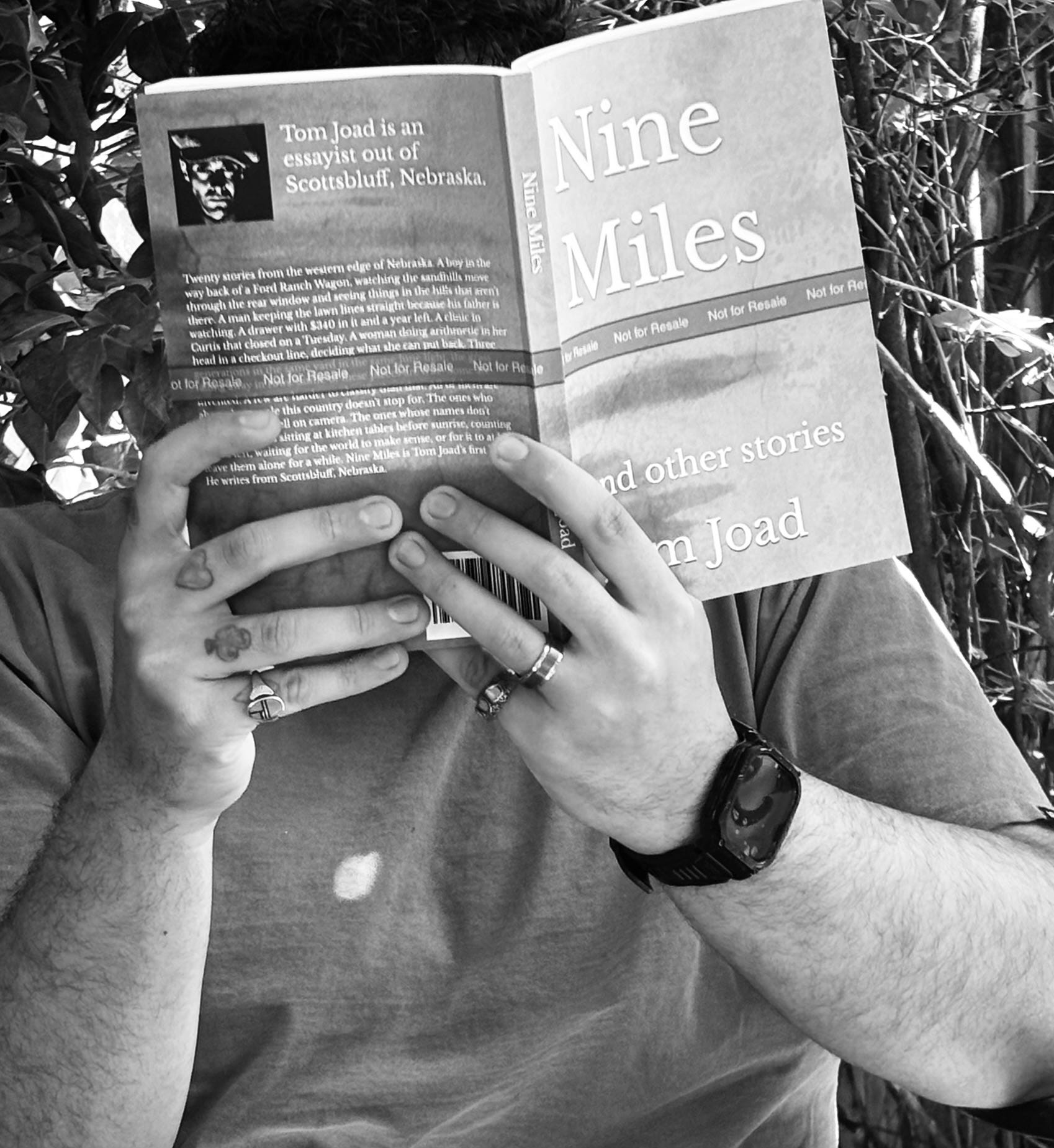
I don’t send announcements like this often, so I’ll try to make this one count.
My book, Nine Miles, is out now. Twenty stories and essays, some true exactly as I’ve described them and some invented because I needed a person to exist in order to say something true that no single real person had handed me whole. I tell you which is which in the front of the book, because I’d rather lose a little mystery being honest about that than gain a little drama by hiding it.
I want to be direct about something before I go further: most of what’s in this book, you’ve read pieces of here already, in one form or another. I’m not going to pretend otherwise. What the book gives you that the newsletter never could is the whole thing, together, in the order it was built to be read in, which turns out to matter more than I expected it to. A book does something a scattered feed of posts can’t: it lets one piece lean on the one before it. Read in order, twenty pieces add up to something that no single post, read on its own months apart from the others, could ever add up to. That’s not a small difference. That’s the actual argument of the book, and you can only get the full shape of it between two covers.
You can get it here, right now, for less than the cost of two coffees:
https://www.amazon.com/dp/B0H7F46R91
Here’s the rest of the story, if you want it.
It took thirteen years longer than I expected it to. I started a novel back in 2011. I still haven’t finished it. Somewhere along the way, instead of forcing that one long argument to completion, I started writing shorter, truer things: about my father, about a woman ahead of me in a checkout line, about a nephew who ranches nine miles from here and votes in a way I don’t understand and love him anyway. I wasn’t building a book on purpose. I was just writing down one true thing, then another, until someone I trusted told me the twenty pieces I’d collected already were a book, whether I’d meant to write one or not.
I want to tell you plainly what makes this collection different, because I think it’s a fair question to ask before you spend money on it.
Most writing about rural America comes at it from one of two directions. Either it romanticizes the working man from a comfortable distance, or it studies him like a specimen, explaining him to readers who’ve never met one. I didn’t want to do either. I’m not a journalist who parachuted in for six weeks to explain this place to you, and I’m not selling you a book on the strength of a name you already knew from somewhere else. I’m just a man who spent thirty years in finance, then spent evenings after work writing down what actually happened to the people around him. I wrote this from inside the life, not about it, from a kitchen table in Scottsbluff, Nebraska, after a career that never made me rich and never asked me to pretend I understood people I hadn’t actually met.
What I think sets it apart isn’t really the politics, though the politics are in there, argued honestly rather than hidden behind metaphor. It’s the discipline I tried to hold myself to: fairness in both directions. A nephew who votes for a man I call an idiot still gets his full economic logic laid out on the page before I push back on any of it. I don’t think anyone in this book, including me, gets to be a strawman. That’s harder to pull off than it sounds, and I don’t always know if I succeeded, but it was the standard I was writing toward the whole time.
There’s also a device that runs through nearly every piece, one a reader pointed out to me after the fact, more clearly than I’d seen it myself: instead of telling you someone is struggling, I try to hand you the actual number. The grocery receipt. The note payment. The exact dollar figure that finally, quietly, breaks a person’s back. I’ve come to believe a number does more honest work than an adjective ever could. “Devastating” is a claim. Fifty-six thousand dollars, the note payment on a rancher’s land, is a fact, and the reader gets to feel the difference on their own, without me telling them how to feel it.
If there’s one thread holding all twenty pieces together, it’s this: nearly every person in this book is carrying a cost that got decided somewhere else, by someone who will never have to watch them pay it. A grandson getting evicted over a policy written in a different building entirely. A rancher squeezed by a tariff he never voted for. My own father, working and traveling and never quite sitting still, carrying whatever he carried and never once telling us what it weighed. I didn’t set out to write that book. I set out to write down what actually happened to people I love, mostly, and it turned out that was the book the whole time.
I’m not going to pretend I know whether Nine Miles is a good book in the way critics mean that word. I know it’s an honest one. Thirteen years of paying closer attention than I used to, to the people who taught me what actually matters: a father I didn’t fully understand until he was gone, a wife who’s read my face for thirty years without needing me to explain it, a nephew, a sister, a dog, a garden bed, all of them teaching me some version of the same lesson from different directions. That the smallest true thing, written down carefully, outlasts the biggest unfinished plan.
The novel file is still sitting on my laptop, unfinished, thirteen years running. I don’t think that’s a failure anymore. I think some things get built the slow way, a paragraph at a time, and some things get built by walking away and building twenty other things first. I couldn’t have written a single piece in this collection without everything that unfinished file taught me about sitting still long enough to actually notice what was in front of me.
If you’ve read this far, you’re exactly the reader this book was written for. Not someone who needs to be convinced rural America matters. Someone who already knows that and wants it written about honestly instead of romanticized or explained down to you.
Nine Miles is available now, and it’s the only way to read the full collection in the order it was built to be read, as one continuous argument instead of scattered posts months apart. Here’s the link again, so you don’t have to scroll back for it:
https://www.amazon.com/dp/B0H7F46R91
(I know Amazon isn’t everyone’s first choice, and I get why. Right now it’s where the book lives. If enough people ask, I’ll look into getting it onto other platforms too.)
If you’ve read this newsletter for any length of time, you already know whether this book is for you. I’m asking you plainly, not politely dancing around it: buy it. Today, if you can. Early sales in the first weeks matter more than almost anything else for a book like this, and you, the people who’ve been reading me for free this whole time, are the ones who can actually make that happen.
That’s the whole ask. If you get to it and it means something to you, a review helps more than you’d guess, and so does passing it to one person who’d connect with it. But the book itself comes first. Everything else can wait until you’ve actually read it.
Thank you for reading this far, and thank you, especially, for reading me long before there was a book to sell you. That’s the part I’ll remember longest. Now go get the book.
https://www.amazon.com/dp/B0H7F46R91
Tom
Wow, I didn’t think I would get such a great response on the first few days of the book being out!! Thank you to all of you that have brought a book!! If you can please make a comment on the Amazon site. I’m shocked we have done so well!!
I would very much like to purchase your book as I have enjoyed your stories on substack. However, I will not buy through Amazon for the simple reason that I will not put any money into a company that treats it's employees and the people of this country as dupes who Bezos believes need him. He is everything wrong in our country.
If you have another way for me to purchase your book I would gladly do so.