

What's Left Over
Twenty thousand tons for a data center. Thirty tons a week for the shop that fixes your gate. This is the full accounting: the steel, the subsidies, the seven hundred billion dollars, and the man left

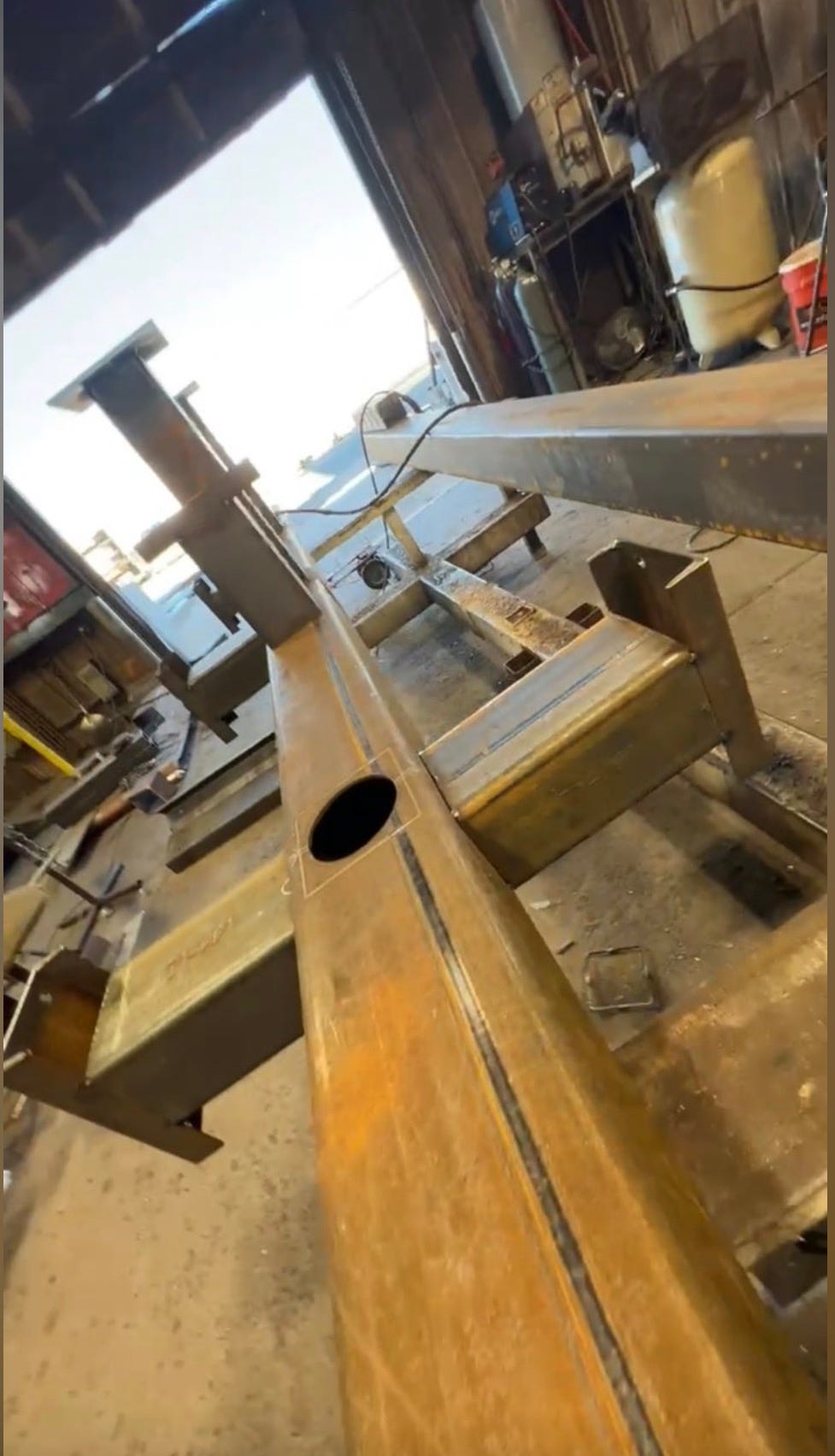
I was driving my son-in-law Luiz to the bank to cash his check when he told me about it, both of us in the truck, him still in his work clothes, his knuckles black from welding, the kind of black that soap only ever gets halfway out of. He’s not a man who complains. He’s the kind of man who fixes the problem himself and tells you about it after, if he tells you at all, usually sideways, in the middle of talking about something else entirely. So when he brought it up at a stoplight, almost like an afterthought, I knew it had been sitting on him longer than he was letting on.
The shop he works for had three jobs lined up for the month, jobs he was working on the floor alongside the rest of the crew. A gate repair for a rancher out past Minatare. A load-bearing repair on a grain bin for a family whose name I’d recognize if he’d said it, a repair their engineer had already drawn up and their architect had signed off on. And a set of custom brackets for a piece of irrigation equipment that, if it didn’t get fixed before the next watering cycle, was going to cost somebody a real chunk of their season. All three jobs needed steel. Not exotic steel. Not some specialty alloy for a spacecraft. Plain structural steel, the kind that’s supposed to be about as available as gravel.
The shop couldn’t get it. Not at the price they’d quoted three weeks earlier, and in one case, not at all, not from their usual supplier, not from the two backups the shop manager called after that, or so Luiz heard secondhand, the way most of what happens in a business like that reaches the guys actually holding the torches. Luiz works for a local welding outfit, seven welders on the floor and him one of them, an architect and an engineer on staff for the bigger custom jobs, even a robot welder they brought in a couple years back for the repetitive runs. It’s a small shop by headcount, but it doesn’t act small. On a normal week they move something like sixty thousand pounds of steel through that yard, thirty tons, structural work for grain operations and ag equipment and commercial jobs across three counties. That’s the kind of operation that’s supposed to have enough weight of its own to not get pushed around by a bad month. The shop ended up sourcing a partial order out of Cheyenne that still left them short on the grain bin job, and the rancher out past Minatare is going to have to wait until August for his gate, which means driving an extra six miles around his own property every single day until then.
I asked Luiz what he thought was going on, right there at the light, before it turned green. He said what welders say when the answer isn’t simple: “hell if I know Everybody’s telling me something different.” The guys said the supplier was blaming tariffs. Somebody at the steel yard was blaming China. But when I asked what the boys on the floor were actually saying amongst themselves, the seven of them living the same shortage from the inside, he didn’t hesitate. They all knew. It wasn’t a rumor passed around like a guess, it was closer to a fact everybody on that floor had already settled into, the way you settle into knowing which way the wind usually blows in April. The steel’s going to AI. It’s going to the data centers. Nobody had to convince them of that. They’d watched their own order timelines slip, month over month, right alongside every headline about another hyperscale campus breaking ground somewhere they’d never see.
I went looking, because that’s what I do, and because I owed him a real answer instead of a shrug. What I found was more specific, and in some ways stranger, than anything Luiz had been told.
Here’s the plain version. Data centers, the massive buildings full of servers that run the AI systems everybody’s suddenly talking about, have become one of the strongest sources of demand for steel in this entire country, arguably the strongest. A single one of these hyperscale facilities, the biggest kind, the kind the big tech companies are building right now across the country, can require up to twenty thousand tons of steel. Not for a whole campus. For one building.
And that’s before you count the steel that goes into everything inside it, server racks, cable trays, cooling infrastructure, equipment enclosures, all of which adds up to significantly more steel than the building frame alone. Steel buyers and mills have been telling anyone who’ll listen that data center construction is the strongest performing sector for steel consumption they’ve seen in years, and companies tied to that construction have already been booking out their orders for most of this year, ahead of everybody else standing in line behind them.
That’s the broad demand story, and it matters, but it isn’t actually the sharpest part of what’s happening. The sharpest part, the part that I think explains what happened to Luiz better than “AI is eating the steel supply” does, is a much narrower shortage in one very specific kind of steel: the grain-oriented electrical steel used to build the cores of high-power transformers. There is exactly one company making this material domestically in the entire United States. One. Cleveland-Cliffs, with two plants, one in Pennsylvania and one in Ohio. That’s it. That’s the whole domestic supply chain for a material every electrical grid upgrade and every new data center connection in this country needs in order to actually get power.
Analysts have said plainly that if something went seriously wrong at either of those two facilities, this country’s domestic supply of that particular steel would drop to zero, overnight, with nothing standing behind it. Up to half of the entire planned data center construction pipeline in America right now is at risk of delay simply because the transformers those buildings need can’t be built fast enough, because the steel that goes into those transformers doesn’t exist in the quantities anyone needs.
I don’t think the shop’s grain bin steel and Cleveland-Cliffs’ electrical steel are the exact same material. They’re not. But they’re pulling from the same overstretched world, the same mills, the same trucking capacity, the same finite number of people and furnaces trying to serve a demand curve that went essentially vertical in about eighteen months. When the biggest, best-funded buyers in the country start booking out capacity a year in advance for transformer steel, that pressure doesn’t stay contained to transformer steel. It ripples sideways into every other kind of steel those same mills and distributors also handle, and eventually it ripples all the way down to a seven-man welding shop in the Nebraska Panhandle trying to fix a rancher’s gate.
I’m not going to pretend I’m neutral on this, and I don’t think pretending would serve anybody. Google, Microsoft, Amazon, Meta, OpenAI. Those are the names behind the demand curve that’s eating this country’s steel, and behind those company names are men whose fortunes make Luiz’s shop’s entire annual revenue look like a rounding error. Jeff Bezos is worth somewhere north of two hundred billion dollars. Sam Altman built a personal fortune in the billions running a company, OpenAI, valued at over seven hundred billion, without owning a single share of it, just early bets on other people’s ideas that paid off before the AI boom ever needed a single ton of steel.
I know that’s a lot of zeroes to put in front of somebody all at once, and I don’t move past them quickly on purpose. Sit with them a second. These aren’t abstractions called “the market.” These are specific men, running specific companies, making specific decisions to book out a mill’s entire capacity a year in advance because they can, fully aware that every ton they lock up is a ton that doesn’t reach anyone who can’t pay the same premium or sign the same size of contract. That’s not an accident of the market. That’s the market working exactly as these men built it to work, with them and the companies they run at the front of every line it creates, and a welding shop in Scottsbluff standing wherever’s left over once they’re done.
Luiz wasn’t thinking about any of that in the truck. He didn’t know Jeff Bezos’s net worth off the top of his head, and I doubt it would have changed much for him if he had. He was thinking about a gate that needed fixing and a supplier who kept not calling back. I only bring the numbers in now because I think he deserves to know the actual size of what he’s up against, even if knowing it doesn’t fix anything by itself.
This doesn’t require a smoke-filled room to be worth being angry about. Nobody at Amazon or Google or OpenAI sat down and specifically decided to hurt a seven-man welding shop in Scottsbluff, Nebraska, or a rancher out past Minatare who now has to drive six extra miles a day around his own fence line because a gate repair got pushed to August. They didn’t have to. That’s what should bother people more, not less. The distance between Sam Altman’s office and that gate is so vast, and men like him so thoroughly unaccountable to anything happening at that distance, that the gate never even had to register as a cost worth weighing. That’s the whole pattern I keep writing about, in one form or another, in nearly everything I put in front of you. A whole industry gets to want something badly and all at once, and the actual weight of that wanting lands on people who were never in the room, never got a vote, and in Luiz’s shop’s case, never got so much as a heads-up.
We’d pulled into the bank parking lot by then, Luiz still turning the check over in his hands like it might tell him something the shortage hadn’t. He didn’t get out right away. He just sat there a second, looking at the dashboard, and said, “So it’s not that there’s no steel. It’s that there’s steel, just not for us.” Then, quieter, almost to himself: “Feels like I’m losing a fight I didn’t know I was in.” I didn’t have anything to say back to either one yet. I hadn’t done the reading.
There’s a tariff layer sitting on top of all this too. Section 232 tariffs on imported steel, raised to fifty percent, were meant to protect domestic steel production, and there’s a real argument for that: American steelworkers have watched their industry get hollowed out by cheap imports for decades, and keeping more of that production on American soil isn’t unreasonable on its face. But those same tariffs make it harder and more expensive to import steel or finished transformers from anywhere else when domestic capacity can’t keep up on its own, which is exactly the situation we’re in right now. Protective in theory, constricting in practice, at the exact moment the country needed more flexibility instead of less. That’s a real trade-off, the kind politicians rarely admit to out loud, protecting one set of workers today at a real cost to a different set, the seven welders on Luiz’s floor among them.
This isn’t only an American story either. The whole world is short on this particular grade of steel right now, Europe, Mexico, Southeast Asia, India, all of them squeezed by the same four things landing on the same narrow supply base at once: aging grids, new renewable hookups, the AI buildout, and tighter efficiency rules that demand a higher grade of steel than a lot of existing mills can even make. Some transformer orders overseas are already scheduled out to 2029. I mention that only so you know Luiz isn’t caught in some uniquely American mess. He’s caught in the same mess as everybody else standing at the bottom of it, everywhere.
I thought about both of those lines, sitting there in that bank parking lot, for a long time after I’d read through all of this. I wanted him to know it wasn’t just him, and it wasn’t just his shop, and it wasn’t some invisible thing happening to them personally for no reason. But he’d already said it better than I could. There’s steel. Just not for us. I think that’s about as precise a summary of the whole situation as anyone, expert or otherwise, has managed to give me.
Luiz doesn’t get to decide any of this, not at any level of it. He doesn’t decide what steel the shop orders or when. That’s the owner’s call, and the owner’s hands are just as tied as anyone’s by whatever a distributor two states away is willing to sell him this month. Luiz just shows up, does the work in front of him, and finds out what’s possible the same way the rest of us do, after the fact, from somebody further up the chain who found out from somebody further up than that. His life gets shaped by decisions made in an office he’s never seen, at a company he doesn’t work for, in an industry he’s never been part of. That’s not a complaint about the man who owns the shop, who’s dealing with the same squeeze from his own side. It’s just the plain shape of what it means to be a working man in a country where the steel goes wherever the biggest check is, and everybody standing under that decision, shop owner and welder alike, just has to wait and see what’s left.
The steel exists. It’s just already spoken for.
Here’s the part that I think deserves to be said plainly instead of implied: this isn’t just an accident of scale, the biggest buyer naturally elbowing past the smaller ones the way it might in any tight market. Mills and distributors are openly structuring their order books around who’s willing to commit to the largest, longest contracts first, and the hyperscalers, Bezos’s Amazon, Pichai’s Google, Nadella’s Microsoft, Altman’s OpenAI, are the ones with the balance sheets to lock in a year or two of supply in a single phone call. A shop like Luiz’s can’t make that call. They can’t promise a mill five years of standing orders the way a data center developer backed by a multi-hundred-billion-dollar fortune can, so when the steel gets allocated, American small businesses aren’t standing in the same line as Big Tech. They’re standing in the line behind it. It’s not written into law anywhere that a grain bin repair in the Nebraska Panhandle waits so a server farm in Texas can get its transformer steel on schedule, but that’s functionally what’s happening, one purchase order at a time, and nobody had to pass a bill to make it so. Nobody had to. The richest men who have ever lived just had to place an order.
Put the whole picture side by side and the imbalance stops being abstract. Amazon, Microsoft, Google, and Meta are on pace to spend something like seven hundred twenty-five billion dollars combined on AI infrastructure this year alone, up seventy-seven percent from the year before. Seven hundred twenty-five billion dollars. That’s not revenue. That’s just what they’re spending to build.
Chew on that for a second before I tell you what it means. A tiny fraction of it, a rounding error inside a rounding error, would be enough to guarantee every small welding shop, every grain elevator, every irrigation outfit in this country all the domestic steel it could ever need, at a fair price, on schedule, for a generation. Nobody’s proposing that, because nobody with that kind of money has ever had to wonder how he’s going to make payroll because a gate repair fell through.
And it isn’t only the steel market where these companies get to go first. Taxpayers are subsidizing the very buildout that’s eating Luiz’s supply. Indiana handed Amazon Data Services an estimated eight billion dollars in tax incentives for its data centers there, the largest known state subsidy package in the country. Georgia’s data center tax exemptions are projected to cost that state two and a half billion dollars in this fiscal year alone, up over six hundred percent from earlier estimates. Texas is losing more than a billion dollars a year in tax revenue to these exemptions, on pace to lose nine billion over five years. Virginia’s giving up close to two billion a year.
Here’s the detail that stopped me cold when I found it. Thirty-eight states now offer some version of these breaks, and in a survey of data center owners themselves, only about three percent said the tax incentives were even the most important reason they picked a site. They didn’t need the money. They took it anyway. North Carolina’s governor put it about as plainly as I’ve heard anyone put it: given the trillions of dollars of capital already flooding into data center construction, these companies simply do not need economic incentives to build. They’re worth hundreds of billions of dollars apiece. They’re getting billions more handed to them by the same governments that can’t seem to find a way to make sure Luiz’s shop gets its steel on time.
I keep thinking about that check still in his hand, the engine still running. None of these numbers were on his mind that day. They weren’t on mine either, not yet. It took me weeks of reading to find them. That gap, between how long it took a man losing money every week to find out why, and how long it should have taken, is its own kind of indictment.
I don’t need a law to be broken to call this what it is. A country that spent the better part of a decade talking about putting American workers first now has a steel market where a data center gets served before the local welding shop does, every single time, because that’s simply how the money sorts itself when nobody’s minding the line, and when the men whose net worth clears into eleven and twelve figures are the ones setting the terms. Elon Musk’s net worth alone, somewhere north of eight hundred billion dollars as of this year, is more money than the entire state of Nebraska’s economy produces in a year. It’s more money than every welding shop, every grain bin, every irrigation system, and every gate in this state combined will change hands for in a generation. Priority isn’t a value statement in a market like this one. It’s just whoever can pay the most, soonest, for the longest stretch of time, and right now that’s never going to be a shop with seven welders and a good reputation in a town of fourteen thousand people, no matter how many decades that reputation took to build.
I think about the arithmetic of that a lot, the same way I think about the arithmetic in nearly everything I write. A hyperscale data center needs up to twenty thousand tons of steel. Luiz’s shop moves something like thirty tons in a good week, and came up a few tons short across those three jobs alone, angle iron and flat stock they couldn’t get at any price their customers could absorb. Twenty thousand tons against a thirty-ton-a-week shop that came up short by a fraction of that isn’t really a competition. It’s not even the same order of magnitude. But the market doesn’t care about magnitude in the way you’d hope it would. It cares about who’s first in line and who can pay a premium to stay there, and right now the answer to both of those questions is a handful of the richest companies in the history of the world, not a crew of seven trying to keep a rancher’s cattle from wandering off through a broken gate.
I don’t want to make Luiz sound like a victim, because he wouldn’t want that, and it wouldn’t be true anyway. He’s resourceful in the way people who work with their hands for a living have to be. The shop found a partial order in Cheyenne. Luiz is the one reworking the grain bin job to use less material than it was originally drawn up for, some clever bracing solution he sketched out for me on the back of a deposit slip in that same bank parking lot, that I only half understood but that apparently gets the job done with what the shop could actually get its hands on. He’ll figure out the irrigation brackets too, probably by scavenging or substituting something on his own end, the way welders and ranchers and anyone else who’s had to make do out here has always figured things out when the supply chain lets them down. That’s not a new skill in this part of the country. It’s practically inherited.
But figuring it out isn’t the same as it being fine, and I don’t want to let the fact that the shop is capable let the actual situation off the hook. They’re losing money on jobs they already quoted at a fair price, because the material cost more by the time they could actually source it. They’re losing time, which for a small shop with seven welders and a payroll to make is the same as losing money twice over. They’re losing a little bit of the trust it took years to build with customers who don’t care whose fault the delay is, they just know their gate isn’t fixed and their bracket isn’t finished when they were told it would be. None of that shows up in any of the reports I read about data centers and transformer steel and Section 232 tariffs. Those reports are written for buyers and mills and purchasing managers, for people thinking in tons and market share and quarterly demand curves. They are not written with a shop like Luiz’s in mind, and I don’t think they’re supposed to be. But somebody should write the version that is, and I suppose that’s what I’ve just tried to do.
I keep coming back to what he said in that parking lot, before I’d gone and found any of this out for him. That he was losing a fight he didn’t know he was in. I’ve turned that sentence over more times than I probably need to. I think it’s close to the truest description I’ve heard of what it feels like to be the person at the bottom of one of these supply chains that stretch all the way up to decisions made in boardrooms an ocean of distance away, geographically and otherwise, from a welding shop in the Nebraska Panhandle. He wasn’t competing with a data center. He never entered that race, never wanted to, probably never thought about data centers at all before this year. But he’s losing to them anyway, a little bit, every time a supplier tells him the price went up again or the order got pushed back another two weeks, and there isn’t a single person on the other end of that transaction who did anything to him on purpose. It’s just weight, distributed the way weight always seems to get distributed in this country, downward, onto whoever has the least leverage to push back against it.
I don’t have a fix for this, and I’ve learned not to pretend I do just to give a piece a tidier ending than it’s earned. I can’t get the shop its steel faster. I can’t make Cleveland-Cliffs build a third plant, or convince the tariff structure to bend around a thirty-ton-a-week shop’s shortfall the way it currently bends around twenty-thousand-ton hyperscale orders. What I can do is what I try to do in most of what I write: say plainly what’s actually happening to somebody real, in his own words as much as I can manage, so the arithmetic of this moment doesn’t stay locked up in trade publications written for buyers who will never meet him.
Luiz got the gate repair rescheduled for the second week of August. The rancher’s been driving the extra six miles a day since the middle of June, and by the time that gate’s fixed, he’ll have put on close to four hundred extra miles just going around his own property, at whatever diesel’s running these days, all because a transformer shortage on the other side of the country pulled the whole steel market’s attention somewhere else for a while. He didn’t do anything to deserve that. Neither did Luiz. Nobody sat down and decided this should happen to either one of them specifically. It just happened, the way weight settles downhill, the way it almost always does, onto the people who were never anywhere near the room where the real decisions got made.
I asked Luiz if I could write about him. He said sure, long as I didn’t make him sound like he was complaining, because he wasn’t complaining, he was just telling me what happened. I’ve tried to honor that here. This isn’t a complaint. It’s just an accounting, the kind I trust more than any adjective I could reach for instead. Twenty thousand tons against thirty tons a week. One domestic supplier for a whole country’s transformer steel. Six extra miles a day for a rancher whose name I won’t put in print, because he didn’t ask to be part of anybody’s essay either.
That’s the whole story, as best I can tell it. Somebody, somewhere, wanted something very badly, all at once, and a welder in western Nebraska is still waiting on the leftovers.
I think about my own porch some evenings, the one I’ve written about more than once in these pages, and how far away it feels from any of this, and how close it actually is. Luiz sits on that same porch some Sundays, tired in the specific way a man gets tired from bending steel that wouldn’t cooperate with him all week, and Patricia asks him how the shop’s going, and he gives some version of the same answer he gave me on the phone. Making do. Figuring it out. He doesn’t lead with the shortage or the tariffs or the transformer plants in Ohio he’s never seen and never will. He leads with the work, because that’s what the work has always demanded of people like him out here, regardless of what’s happening a thousand miles away in a boardroom deciding, without ever having to say so out loud, that a data center’s transformer matters more than a rancher’s gate.
I don’t think that’s resignation, and I want to be careful not to let it read as some tidy moral about quiet dignity, because I think that framing lets the people at the top of this chain off too easy. He’ll fix the gate in August. He’ll finish the grain bin with whatever bracing solution he cobbled together. He’ll quote the next job a little higher, build in a little more room for the world to disappoint him again. That’s real, and it’s admirable, and it should not be necessary. A man shouldn’t have to build resilience into his pricing because the richest companies in the history of the world decided his steel could wait. I’m not interested in ending this on the comfort of his toughness. His toughness isn’t the point. It’s the cost he’s being asked to be tough about that I want you to sit with.
Somebody should keep track of what that costs him, and what it costs the next Luiz, and the one after that. I intend to keep trying, and I don’t intend to make it sound gentler than it is.
If pieces like this one are worth something to you, consider becoming a paid subscriber. It doesn’t change what I write or how often, it just means I get to keep doing it.
And if you haven’t yet, my book, Nine Miles, is out now. Same arithmetic, same attention, twenty stories instead of one. You can find it here: https://www.amazon.com/dp/B0H7F46R91
Thank you for reading this far.
Thanks, Tom. Americans call this abundance “normal” because someone else paid the bill for it.
What strikes me reading this is how completely our expectations have drifted away from the real cost of the world we move through every day. Daily hot showers, always-on electricity, cheap fuel, the sense that there will always be more steel and more concrete for whatever we decide to build next. We treat all of that as a baseline entitlement, not a choice. The ten‑dollar toaster oven at Walmart is a perfect emblem of that distance: its sticker price has almost nothing to do with what it actually costs to exist.
The highest price was paid by the people who once lived on and with the land that now furnishes the ore, the coal, the oil, the hydropower easements, the rail and highway right‑of‑way. Indigenous communities paid in dispossession, poisoning, and often in their lives, long before a single data center broke ground or a single transformer came off the line. By the time that toaster oven shows up under fluorescent lights, the violence that made it possible has been thoroughly laundered into “growth” and “jobs.”
Down at the retail end of the chain, the minimum‑wage cashier ringing it up is, perversely, near the top of the pyramid of people who actually get to touch the benefits. Everyone below that point — the hands in the mine, the refinery, the mill, the grid, the shop that can’t get its steel order filled — absorbs the weight of our expectations while remaining almost entirely invisible.
We keep calling this an economy or a market, as if it were a neutral system instead of a long‑running extraction project that burns through people and places to preserve the illusion of “normal life.” Buy low, sell high is not a moral guideline. Endless growth is the philosophy of a malignant cancer.
Your piece makes clear how unsustainable this is in the narrow sense of steel and transformers, but it’s just as unsustainable morally.
A society that trains people to expect endless cheap abundance while hiding the bodies and broken landscapes that make it possible is not actually stable; it’s just very good at postponing the bill.
I'm sixty and have always expected the bill would come due during my lifetime. I know so many people with cancer from poison Iowa water and air, and none of my children can afford to buy into this system. Microplastics and the so-called "artificial intelligence" will doubtless affect both the micro and macro environments. The supposed leaders are more and more isolated from the empathy and (perhaps more importantly) insulated from the violence.
There are people who build out of rubble, using their creativity and intelligence to craft local communities that don't adhere to the systemic expectations. This is where I pin what hope I have. Humans are social, community-based creatures. I believe our strength lies in duty to our communities and our drive to create something beautiful.
Don’t know if I’m looking at the bigger picture too simply, but … This mass-extraction event we’re living in, if it continues at the current rate, won’t it become something the market will no longer be able to correct for? By eliminating jobs and eating up resources in every sector - including their own - won’t that result in not enough customers to buy what these behemoth companies are selling? Aren’t they effectively eating their own? Capitalism operates on a balance, or so I was taught in Econ 1A. These tech bros aren’t capitalists, they’re planet-eaters.