

What Efficient Looks Like
On Denise Ames, the hospital that is quietly breaking, and the trillion dollars that finished the job

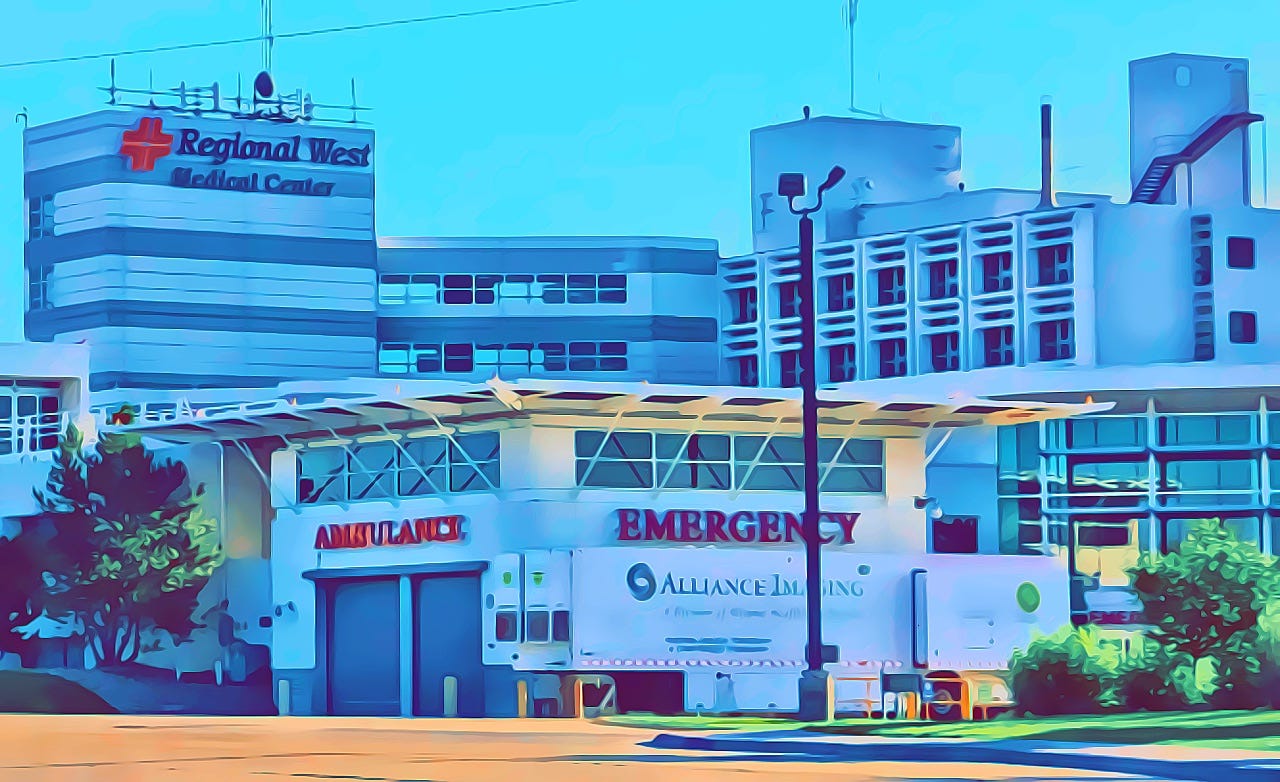
Every week a stranger walks onto the floor at Regional West and clips a badge to her scrubs and starts taking care of people in Scottsbluff, Nebraska, and in thirteen weeks she will be gone. Another stranger will come. The badge will have a different name. The patients will not always know the difference and that is the point and also the problem.
This is what a hospital looks like when it runs out of its own people.
Denise Ames spent twenty-two years building the kind of knowledge that does not appear on a badge. Which attending was on call. What he was likely to order. Whether the order was going to be right. The names of her patients’ children. She is fifty-three years old, divorced, Catholic in the way people from here are Catholic,meaning it is not a choice so much as a condition, like the weather, like the alkaline flats. She has two Bull Terriers, the kind that used to be on the Bud Light posters, all muscle and ridiculous face, and she talks about them the way some women talk about grandchildren. She is on Ozempic, same as Patricia, and the two of them have an ongoing exchange about it that functions as both complaint and solidarity. She is the funniest person on the floor, which is a specific kind of funny,the dark, dry, deadpan humor of someone who has seen enough that laughter is not a luxury but a survival strategy. She has a daughter she does not talk about at work. She goes to Mass on Sundays when she is not on shift and sometimes when she is, catching the early one before she has to be there, sitting in the back in her scrubs.
She quit in March of 2022, went to work at a garden center outside of town, and did not touch a stethoscope for fourteen months. She came back six months ago. She came back to a floor where she is the institutional memory, where she is the one the travelers ask when they cannot find something, where she is doing the work of three people who are gone and being paid the wage of one person who stayed.
The traveler next to her makes double what she makes. Patricia asked her once if that bothered her. Denise said: what bothers me is the ones who don’t know where the crash cart is. That is Denise. That is how she carries things.
I use this hospital. I want to be clear about that. I am not writing about a place I observe from a distance. I am writing about the place I will go when something goes wrong, which at sixty-six years old is no longer a theoretical proposition. Denise Ames is not a subject. She is, in the most direct sense, someone I depend on. That is a thing I have been trying to be honest about as I write this.
The pandemic killed a hundred thousand nurses. Not killed like the patients it killed,though some nurses died too, in the early days without PPE, before anyone understood what they were dealing with. Killed like a profession kills the people inside it when it asks too much for too long with too little, and then when it is over offers nothing except the same conditions that broke them, now somewhat worse.
Denise worked COVID. Without adequate protection in the early months. Without adequate staff throughout. She watched people die in the particular way COVID produced,alone, families kept out for safety, the nurse the last face, the nurse holding the phone so the family could say goodbye on a screen, the nurse carrying that moment home and putting it somewhere and going back the next day and picking up more of it and putting it somewhere and the somewhere filled up and there was nowhere left to put any of it.
She told Patricia once that she stopped dreaming. Not nightmares. Just nothing. She would close her eyes and open them and it was morning and she did not know where the night had gone. The sleep was maintenance. Barely that. She went to confession during the worst of it and told the priest she felt nothing and he told her that was not a sin and she said she knew that, it was just the only place she could think of to report it.
What she was describing, though she did not have the name for it yet, was compassion fatigue. It is different from burnout, though they travel together and are often mistaken for each other. Burnout is a tank running dry,exhaustion, a systems problem, something rest can theoretically address. Compassion fatigue is different. It is the diminished capacity to feel anything at all about the suffering of another person. The circuits that receive it stop working. You still perform the care. You still adjust the drip and turn the patient and check the chart. You do it with technical precision. What is gone is the part that made the precision feel like it mattered. The part that made you a nurse in the first place. Denise told Patricia she would find herself standing at a bedside, doing everything right, and feeling nothing. Not sadness. Not exhaustion. Nothing. That terrified her more than the sadness had. The sadness at least told her she was still there.
And underneath the compassion fatigue, quieter and harder to name, was something that goes deeper still. There is a term for it: moral injury. It is what happens when a person is forced, repeatedly, over months, to act against the values that organized their entire professional self. Denise did not become a nurse to hold a phone at the end of a bed. She became a nurse to hold a hand. She did not become a nurse to tell a family they could not come in. She became a nurse because she understood, in some way that preceded language, that the worst moments of a person’s life should not be faced alone. COVID took that from her. Not once. Every shift. For months. The rules said families could not enter and Denise followed the rules and the patients died anyway and she carried each one home and put it somewhere and went back the next day and picked up more of it and put it somewhere. That is what she walked away from in March of 2022. Not the work. The impossibility of doing the work the way the work was supposed to be done.
Her daughter was struggling. Is still struggling. There is a particular cruelty in being a nurse with a child in crisis,the knowledge of exactly what is happening, the clinical clarity that offers no comfort whatsoever, the helplessness wearing the face of expertise. Denise does not talk about this. Patricia knows because Patricia is the kind of person people tell things to at the end of a long night. The daughter is in a program now. Denise drives four hours round trip on her days off to sit in a plastic chair in a visiting room and be her mother. She does not talk about this either.
Nearly one in three nurses screened positive for PTSD symptoms after COVID. That number is not an abstraction. That number is a colleague of Denise’s named Renee, thirty-four years old, who left to sell insurance and has not come back. Another named Mike who went to pharmaceutical sales. Another named Donna who simply stopped,six months of television and being unavailable,and then moved to Arizona and took an administrative job that did not require her to touch anyone who was suffering.
PTSD is not a metaphor. It is a neurological alteration,the brain’s threat-detection system so overloaded that it stops distinguishing between what is happening now and what happened then. A sound. A smell. The particular beeping of a monitor. And the body is back in the ward in April of 2020, with inadequate PPE and too many patients and a phone held to a face that can no longer hear it. Denise told Patricia about waking one night certain she could still hear a ventilator. She was in her own bedroom. The dogs were at the foot of the bed. The ventilator was not there. Her body did not know that.
What the longitudinal research shows,the studies that followed the same nurses for two and three and four years,is that the injury did not diminish when the emergency ended. It accumulated. The nurses who worked COVID and tried to move on found that the grief they thought they had deferred had not gone anywhere. It had been waiting. The pandemic ended in the official sense in May of 2023, and the nurses who had been holding on through it found that the emergency had been doing some of the holding for them. When the emergency lifted, so did whatever mechanism had kept the full weight of it at arm’s length. What Donna found in Arizona, and what Denise found in the garden center, was not recovery. It was the weight landing.
There is a harder thing that nobody says loudly enough. Suicide rates for registered nurses are among the highest of any occupational group,the same profession organized around the instinct to save lives quietly losing its own people to despair. The nursing literature calls it a silent crisis. The word silent is doing significant work in that phrase. It is silent partly because the profession built the silence in. The same qualities that make someone a good nurse,the stoicism, the selflessness, the fierce moral code, the orientation toward the patient and away from oneself,are exactly the qualities that make it nearly impossible to say, out loud, to anyone: I am not okay. Denise has been not okay for a long time and she will not say it that way. She will say the dogs are on the couch and she is too tired to care. She will say she recommends Ozempic to nobody and then to everybody. She will say what bothers her is the ones who don’t know where the crash cart is. This is the dialect. You have to learn to hear it.
You cannot blame Donna. I have thought about what it costs a person who organized their entire self around being useful at the worst moment to walk away. What the garden center is, really. What Arizona is.
What happened is not complicated. The hospitals could not keep their people. So they went to the agencies. And the agencies sent travelers. And the travelers cost twice what a staff nurse costs, more during surges, and the hospitals paid it because there was no other choice, and the staff nurses who had stayed watched strangers rotate through every thirteen weeks for double their wage, and some of those staff nurses did the math and left to become travelers themselves, which made the shortage worse, which made the hospitals more dependent on travelers, which made the cost higher, which made the financial position of the hospital worse, which made it harder to pay the kind of wages that would bring staff nurses back.
This is not a conspiracy. This is a mechanism. It does not require anyone to be evil. It only requires a system that was never designed to hold under this kind of pressure. We knew this. There is literature going back decades documenting exactly this failure mode. We read it and we held conferences about it and we did not fix it and then the pressure came and the system did what systems do when they have not been fixed. It is worth sitting with the fact that we knew.
Someone decided that healthcare was a market. This was not an accident and it was not inevitable. It was a decision, made incrementally over fifty years, by people in rooms that Denise Ames has never entered, that the logic governing a hospital should be the same logic governing a hotel chain or a shipping company. Occupancy rates. Labor costs. Margin. The terminology of commerce applied to the room where the nurse holds the phone so the dying man’s family can say goodbye on a screen.
What that decision produced is what decisions produce: the thing you were optimizing for. The system got more efficient. It got leaner. It shed the redundancy that looked like waste and turned out to be the capacity to absorb a crisis. Hospital systems merged and consolidated and the accountants found efficiencies and the efficiencies looked like progress until they did not. The community hospital that had been built by a town for a town became a line item in a portfolio managed from a city the town had never visited. The nurses who stayed too long and knew too much and remembered the way things used to work became, in the language of that portfolio, a labor cost problem.
And then the pandemic came, and there was nothing left to absorb it with, and a hundred thousand nurses walked out and the ones who stayed broke quietly, and the hospitals that could not make the market math work began closing floors and cutting overtime and filling the gaps with strangers who rotate out every thirteen weeks.
This is what efficient looks like when the thing you are running is not a hotel.
It is not only the nurses.
The doctors are travelers too. The Latin term is locum tenens,to hold the place. Someone holds the place temporarily while the permanent person is found, or rests, or doesn’t exist. A hospitalist rotates in for thirteen weeks. A surgeon comes through on a schedule. An ER physician drives in from somewhere else to cover the weekend. The locum tenens industry is now nearly a ten-billion-dollar business serving as many as one in three American patients each year. One in three. That is not a staffing solution. That is a structural condition being managed like a staffing solution. The distinction matters. A staffing solution implies the underlying structure is sound. It is not sound.
What it means, in a town of fourteen thousand people on the High Plains, is that the accumulation of knowledge that used to live inside a physician who spent a career here,who knew which families had which histories, who knew the particular ways this population got sick, who knew the terrain of this place the way Denise knew which attending was on call and what he was likely to order,that knowledge has no permanent address anymore. It rotates out every thirteen weeks along with everything else.
Forty-six percent of rural hospitals now operate at a negative margin. Four hundred and thirty-two are listed as vulnerable to closure. Regional West is not on that list today. I do not know about tomorrow. I have chosen, in writing this sentence, not to look away from what I do not know about tomorrow.
The gossip moves the way gossip moves in a town this size,through the parking lot, through the break room, through Patricia’s kitchen on a Tuesday night. The overtime pay went down. The extra shift differential dropped. These are not dramatic announcements. They are the financial vital signs of an institution, and the nurses read them the way they read everything else, quietly, accurately, without being told what they mean. When the extra shift money shrinks, you are watching a hospital try to make the math work in the only place it has left to cut. You are watching a place decide that the people who stayed are the ones it can afford to pay less, because they are the ones who will not leave.
Denise reads the trade journals. This is a thing about Denise that Patricia mentioned and that I have been turning over since. She works twelve-hour shifts on a short floor and she comes home to dogs on the couch and feet that hurt and a phone call to make to her daughter’s program, and somewhere in what remains of her day she reads the trade journals. She knows the numbers. She knew them before she came back and she knows the new ones now and she came back anyway, and the new ones are bad in a way that has a specific author and a specific date.
The law that President Trump signed on the Fourth of July 2025 cuts more than a trillion dollars from Medicaid over the next decade. Rural hospitals,which treat the poorest and oldest populations in the country and depend on Medicaid reimbursement to stay open,will absorb the loss in a way that urban systems simply will not. More than seven hundred rural hospitals could close as a result. That is one in three rural hospitals in this country. Three hundred are at immediate risk right now.
The senators who voted for the bill held up a fifty-billion-dollar Rural Health Transformation Fund like a promise. A rural hospital fund, they said. For rural hospitals. Except that the agency that administers it,the Centers for Medicare and Medicaid Services,quietly capped the portion of that fund that can actually go toward health provider payments at fifteen percent. Fifteen percent of fifty billion, distributed across all fifty states over five years. The fund that members of Congress stood at podiums and called a lifeline for rural hospitals cannot, under the rules written to govern it, direct most of its money to hospitals at all. The senators cited the fund. The fund does not do what the senators said it does. This is not a complicated observation. It is arithmetic. Denise does arithmetic in her head while she is moving bags of mulch. She has done this arithmetic. She knows what it comes to.
What it comes to, in a state like Nebraska,or Kansas across the state line, where eighty-seven percent of rural hospitals are already in the red,is that the hospitals which were already teetering will now have their footing cut from beneath them. The people who will feel this are not the poor in the abstract. They are the specific people Regional West serves. The farmer who cannot leave his operation. The retired teacher on a fixed income. The single mother without a car that will make it an hour down the road. When a rural hospital closes, it does not only close for the people on Medicaid. There is one hospital. It closes for everyone. The safety net is not a separate system the poor use while everyone else uses the real one. In a town of fourteen thousand people, the safety net and the hospital are the same building. Cut the net and you cut the building.
Denise knows this and goes in anyway. I am not sure I would.
Nobody has an official list of what is closed. That is the thing about a hospital in this kind of trouble,the information does not come in announcements. It comes in the daily discovery of what is no longer there. A floor that was open yesterday. A service that was available last week. The staff learn it the way you learn most true things in a place like this,by showing up and finding out. Things change daily. That phrase, spoken in a certain tone of voice, in a certain parking lot, after a certain shift, is not a description of normal hospital operations. It is a woman telling you, without saying it directly, that she does not know what she is walking into tomorrow. That she is walking in anyway.
There is a Medicare issue sitting underneath all of this, separate from the Medicaid cuts, older, and almost impossible to explain in a way that makes people as angry as they should be.
A woman recovers from her hip replacement. Medically she is ready for a skilled nursing facility,the rehab, the monitoring, the transition back toward her own life. Her doctor says she is ready. Her family says she is ready. She is ready. But Medicare will only cover the skilled nursing facility if she has been admitted as an inpatient for three consecutive days. Not observation status. Inpatient. The difference between those two words, to the woman in the bed, is the difference between leaving in a reasonable time and staying in an acute care hospital for days she doesn’t need, in a bed that costs ten times the skilled nursing bed, tended by nurses who are also tending to people who are acutely ill.
The hospital classified her as observation. For billing reasons. For bureaucratic reasons that accrued over sixty years of CMS rules and insurance pressures until nobody can fully explain why the rules are what they are, only that they are. She does not know this. She knows she is ready to leave and cannot. She knows the bed she is in should be available to someone who needs it more. She knows something is wrong but not the name of it.
The name of it is a 1965 provision of Medicare that has not caught up with sixty years of how medicine actually works. Congress knows this. The provision has been criticized for decades. It has not been changed.
And Denise is the one standing between that woman and the chaos. Explaining it for the fourth time, gently, to a family that cannot understand why their mother cannot go to rehab. Managing six patients when she should be managing four because the floor is short and the short floor is partly caused by a bottleneck of patients who cannot move, beds that cannot cycle, a unit running at capacity in a way that makes every shift harder than it needs to be.
This is the financial reality underneath the staffing reality underneath the Medicare reality, with a trillion dollars in Medicaid cuts on top of all of it,all of it sitting on each other in one building in Scottsbluff, Nebraska, while the people responsible for these decisions are in rooms that Denise Ames will never enter, making calculations that do not include her name.
What she could not have predicted was that walking away would not fix it. The garden center was quiet. The hours were reasonable. Nobody died. And still, in the middle of a Tuesday morning with her hands in the dirt, she would think about a patient. A specific patient, a specific face, a specific moment when she had not been able to give what was needed, and the thought would not leave the way thoughts are supposed to leave. Moral injury does not heal in a garden center. It does not heal in Arizona. It follows you because it lives inside your idea of who you are, and you cannot leave yourself behind in the same way you can leave a job. Donna knows this too. I think about Donna knowing this in whatever administrative office she has found in Arizona, the knowing sitting quietly in the corner of every day.
Denise came back because the floor is short and she could not stop knowing it. She would be moving bags of mulch and she would think about the nurse-to-patient ratio on her old floor and do the math and the math was not survivable. Not for the patients. Not for the nurses still there running it. But underneath that practical knowing was something older and harder to name,the understanding that the only thing that might eventually quiet the injury was returning to the work and doing it the way it was supposed to be done. Not perfectly. The system would not allow perfectly. But better than nobody. Better than a stranger who does not know the patients’ names or their children’s names or which attending is on call and what he is likely to order. You go back because you cannot unknow what you know. You go back because the patients are still there and they are still alone and you are still the person who cannot live with that.
She went back to a floor that is doing more with less than it was doing with less before. She went back to work alongside travelers who are good nurses, she will tell you this, they are good nurses,who do not know where anything is, who will be gone in thirteen weeks, who are not to blame for a system that made them the answer to a question the system created. She went back knowing all of this. She went back knowing what is coming,the Medicaid cuts that will empty beds before the patients arrive to fill them, the fund that cannot legally do what it was promised to do, the floors closing because the math will no longer allow them to stay open, the list that does not yet include Regional West and the silence around what yet means in that sentence. She went back anyway.
She told Patricia she cried in her car on the third day back. Not from sadness. From the specific feeling of a person who has returned to a hard thing they chose, who is confronting the gap between what they hoped might have changed and what has not, who is going to stay anyway. That feeling does not have a clean name. It is grief and resolve at the same time. It is what you feel when you love something enough to come back to it broken.
Patricia brought her soup last Tuesday. She came home after and I was at the kitchen table with the Jameson and the laptop, which is where I am most nights when I am trying to write something I cannot quite get to. She sat down across from me. She does not drink. She has never needed to. She has always had some internal arrangement with the difficult parts of life that does not require assistance from Jameson or anyone else. I have not figured out how she does this. I have stopped asking.
She told me about Denise without me asking. That is how I know it mattered.
Denise’s feet hurt. Her feet have always hurt at the end of a shift,twenty-two years of it,and she had forgotten, in fourteen months away, how much they hurt. The dogs were on the couch where they are not supposed to be and Denise did not move them. She was too tired to have rules about the couch. One of them put his big square head in Patricia’s lap and stayed there for the whole visit.
They talked about the dogs. They talked about Ozempic the way they always do,trading notes like dispatches from the same front. Denise said it was working but that the first month felt like a flu she couldn’t call in sick for. Patricia said she knew exactly what Denise meant and that she had stood in her own kitchen one Tuesday evening genuinely unsure whether she wanted dinner or wanted to die, and Denise laughed the way you laugh when someone has named your specific experience and you thought you were the only one. I know this laugh from the other room. It is the laugh that means: finally. They talked about a movie. They talked about Denise’s daughter, briefly, the way you talk about the thing that is always present,not the full weight of it, just the acknowledgment that it is there. The program is going. One day at a time, Denise said, which is both a cliché and the most precise description of how she is living her own life right now. She said it without self-pity. Self-pity is not in her register.
They did not talk about the hospital. Denise already knew all of it. There was nothing to add. Sometimes the kindest thing is soup and a dog in your lap and someone sitting across from you who does not need you to explain yourself.
Patricia told me all of this and then she went to bed. I sat with the Jameson and thought about what it costs a person to go back. To go back to a floor that is already short and is going to get shorter. To go back knowing about the trillion dollars subtracted from the program that was keeping the building open, knowing about the fifty billion promised for rural hospitals that cannot, by the rules that govern it, actually reach them, knowing that the list does not yet include this hospital and knowing what yet means in a sentence like that. I sat with all of it and thought about Denise clipping her badge to her scrubs tomorrow morning and walking through those doors.
We let this happen. I want to be precise about the we. Not the nurses. Not the doctors rotating in from elsewhere. Not the patients in beds they cannot leave. The we is the rest of us, who understood in some general way that the healthcare system was fragile and who did not press, who accepted the theoretical without demanding the specific, who changed the subject when the subject became too large, and who watched the votes get taken and the bill get signed and the fund get quietly redirected away from the hospitals it was promised to protect and did not make the noise that might have stopped any of it. I am in that we. Most of the people reading this are in that we. This is not absolution. It is just the accounting, and the accounting matters.
Think about what it means to live in a town of fourteen thousand people on the High Plains and have your hospital become a building that strangers pass through on their way to somewhere else. Think about what it means to be the person who cannot drive an hour to the next one,the elderly woman on a fixed income, the farmer with no one to cover his operation, the single mother without a car that will make it that far, the man who waited too long because he thought he could handle it and now cannot handle the drive. The nearest large hospital is an hour away on a good day. On a winter night on a Nebraska highway it is something else entirely. There are people in this town for whom Regional West is not a preference. It is the variable that determines whether they live or die. That is not a metaphor. That is the geography.
What happens to those people when the hospital finishes hollowing out? When the floors that are closed today stay closed? When the Medicaid reimbursements drop and there is no margin left to absorb it and the travelers stop coming because there is not enough left to justify the contract? When the list changes and Regional West appears on it? We do not have a good answer for that question in this country. We have never had a good answer. We built the system to serve the places that could pay for it and we told the places that could not pay for it that the market would sort it out and the market has been sorting it out for fifty years and this is what sorted looks like.
Denise knows all of this. She reads the trade journals. She does the math. She clips her badge to her scrubs every morning and walks into a building that broke her and is quietly breaking further and she takes care of the people inside it anyway.
The travelers come and go. The badge changes. The stranger learns the floor, earns her double wage, moves on to the next assignment. This is not her fault. She is also doing the best she can inside a system that does not deserve the best anyone can do.
Denise stays.
That is not a small thing. That is a woman getting in her car every morning and driving to a building that is sorting itself out,that just had a trillion dollars quietly removed from the foundation it was standing on,walking through the door because the people inside it need her and she cannot stop knowing it.
Because she’s Denise. That’s the whole answer. That’s the only answer there is.
I am not sure it is enough. I am not sure, when the list changes and Regional West appears on it, that any of this will have mattered. I write it anyway. Denise would understand that.
I write these essays from a porch in Scottsbluff, Nebraska. No algorithm. No advertiser. No agenda except the true thing, said as straight as I can manage. If this piece stayed with you,if something in it named something you’ve been carrying,that’s what paid subscriptions make possible. Eight dollars a month keeps the porch light on. That’s the whole ask.
Outstanding writing, award winning,actually.
I worked in newspapers for 30+ years. It’s all I ever wanted to do.
I left in 2011 because I couldn’t handle the grief of knowing the industry was doomed.
So I trained into an OTA role in a hospital. I worked through COVID in a Geropsych unit where PPE was nearly nonexistent. My other OT/PT colleagues were on the medical floors along with the nurses.
It broke everyone.
During this time, the conglomerate that had purchased our Catholic NFP community hospital continued to squeeze costs.
Long-term nurses, doctors, and staff left in droves after the pandemic. I finally crashed and burned a couple of years later.
This is a long way of saying that of all the storytellers I worked with in journalism, this is one of the best-written pieces I’ve ever read.
And as someone who watched the front-line of healthcare be decimated, I can say you nailed what it was like.
Thanks for what you do.