

Two Hundred and Fifty
The storm took the windshield. He's taking the rest.

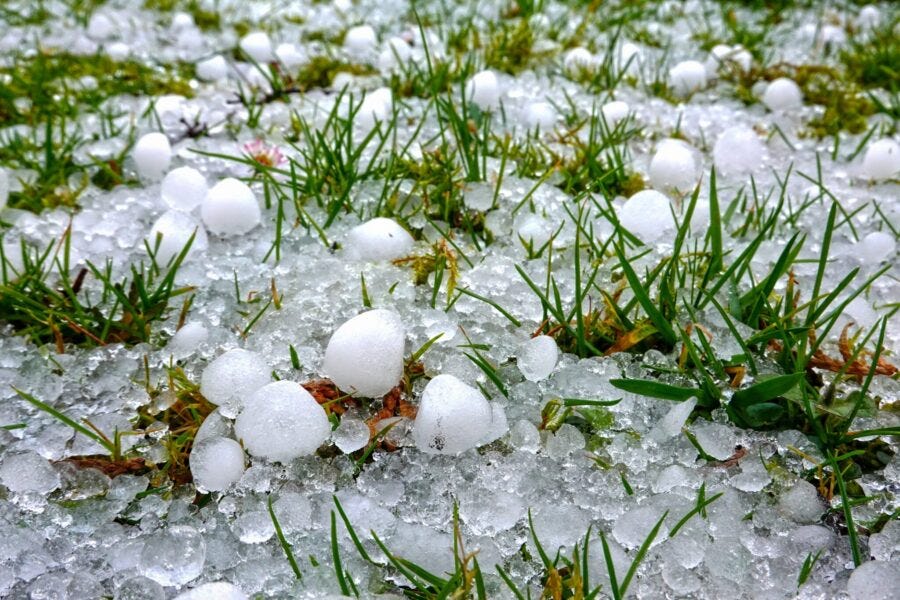
One day from now the country turns two hundred and fifty.
The loudest man in it, a man who inherited his start in life the way most of us inherit a coat that doesn’t quite fit, is telling us all how much he loves this country.
Being loud about a thing and loving it are two different things wearing the same word. This is about the difference.
Tuesday, four in the afternoon, the sky went that particular shade of green-gray that makes every dog in the county start pacing before the first drop falls.
Then it came down the size of tennis balls. Not a figure of speech.
It took out Patricia’s windshield clean through, a spiderweb crack from corner to corner. The glass guy in Gering says he can’t get to it until next week because half the county’s on his list right now.
It flattened a beer cooler I’d left out in the yard, the hard-sided kind, the kind you’d think could take a hit. Split it down the seam like a tin can.
The only thing that survived without a mark was the garden, because I’d covered it that morning on nothing more than a bad feeling and twenty minutes I didn’t think I had to spare. Bad feelings are worth listening to out here. I don’t know why I listened to that one and not some others.
I keep going back out to look at that windshield.
A crack like that doesn’t stay where it starts. It runs, finds the weak grain in the glass, follows a path that was always there waiting to be found. By the second day it had crept clean from the passenger corner to the driver’s side, a thin white line dividing the windshield into something you can still see through and something you can’t quite trust anymore.
That’s what gets me. The glass didn’t shatter outright. It kept doing its job, mostly, while being fundamentally compromised the entire time. You don’t find out how compromised until you’re forty miles an hour on a county road at dusk with a deer in the ditch and the crack is running right through your field of vision at the exact moment you need it clearest.
I think about the country the same way. Nothing’s shattered outright. The institutions still mostly function, the way a cracked windshield still lets the light through. But there’s a line running through the middle of it that wasn’t there four years ago, finding the weak grain and following it. You don’t learn how bad the damage is until the moment you most need to see clearly and can’t.
The cooler bothers me differently.
It was a good one, expensive, the kind with a lifetime warranty and a slogan about how a bear could sit on it. Hard-sided, thick-walled, built to look indestructible in a truck bed. It held up fine through every ordinary thing I ever asked of it.
Then one real blow, one storm big enough to test what it was actually made of instead of what it looked like it was made of, and it split down the seam on the first hit.
Advertised toughness and tested toughness aren’t the same thing. There’s usually no way to tell them apart until something real comes along and tests it. A man can spend a lifetime being called strong, tough, a fighter, can build a whole persona out of the word until it sounds like a fact instead of a claim, and none of that tells you what happens the one time actual pressure gets applied with no audience left to perform for.
What happens is usually the seam. The part nobody reinforced, because nobody thought the real test would come, because the whole design was built for how it looks holding beer, not for what it does under an actual storm.
We’d known it was dry since the second week of March, the way you know before anyone says it out loud.
Scot, my nephew, runs cattle and row crops nine miles south of Gering. By the middle of May he’d stopped fighting it. Wouldn’t put the seed corn and the diesel and the anhydrous into ground that didn’t have the moisture underneath to make good on the bet.
A lot of what would’ve been corn went in as sorghum instead. Some of the bean ground went to hay, because sorghum takes a beating that corn won’t and hay you can cut in pieces across the summer instead of gambling the whole year on one number in October.
Then the hail came anyway.
The sorghum wasn’t even up to the knee yet, and it turns out corn is what lays over flat and dramatic in a storm because it’s got the height to fall. Sorghum that young doesn’t fall. It just gets pounded, leaves shredded to ribbon, the growing points at the crown bruised where the stones landed hardest.
The corn and bean seed he’d already bought is sitting in bags in the shop now, paid for, no taking it back. The hope is thin but real that it holds its germination through the winter instead of turning into dead money on a shelf twice over.
This season isn’t a disaster because everything died. The sorghum will probably come back. It’s a disaster because almost nothing about it went the way it was supposed to, and a man can absorb one bad crop a lot easier than a whole year of having to guess right twice with money he’d already spent on both guesses.
The damage that matters on a stalk of sorghum isn’t the part you can see.
It’s down at the crown, low to the ground, where the growing point sits protected by everything above it, right up until a stone the size of a tennis ball finds a way through anyway.
You can walk a field the day after a storm like that and it’ll look, from a distance, almost fine, ragged but standing. It isn’t until three weeks later, when the plants that should be knee-high still aren’t, that you understand the storm reached further than the leaves. It hit the one part of the plant that decides whether there’s a future or not, and it did it quietly, below where anybody was looking, on the first pass.
That’s what four years of a man like this costs a country.
The visible damage, the fired officials, the diverted funding, the eagle with the wrong number of stars, that’s the shredded leaf. Ragged, embarrassing, and the plant can carry it and still make it.
What decides whether the whole thing recovers is happening somewhere lower and quieter, in places most people aren’t looking closely enough to see. The trust an institution takes forty years to build and four to spend. The norm that used to be so obvious nobody had to write it into law, because who would ever need a law telling a president not to do that.
You don’t find out the crown’s been hit until the season that should have brought recovery doesn’t.
The garden made it because I made a choice, ahead of time, to spend twenty minutes protecting something before I knew for certain it needed protecting.
Foresight and luck can look identical from the outside, but only one of them is a character trait. I didn’t cover the garden because I was certain the hail was coming that size. I covered it because the sky looked like something, and acting on that cost me twenty minutes I could have spent elsewhere, and I decided it was worth spending just in case.
A president makes that same calculation every day, at a scale I can’t fully picture, deciding what’s worth covering ahead of the storm and what gets left exposed to take its chances.
This one has shown you, over and over, in four hundred small decisions and a handful of enormous ones, exactly what he considers worth covering. Himself. His name on the task force. The eagle on the balcony. Never once, as far as I can find, the actual garden this country is counting on him to protect.
He’s not out of foresight. He’s out of the kind of care that makes a man spend it on someone besides himself.
All of that has me thinking about what this country actually owes the people it asks to absorb a year like this one.
I keep landing on the same man, the loudest one, the one who’s spent this entire anniversary year telling us how much he loves the place. I don’t believe him. I want to say plainly why, instead of working up to it in a smaller voice than I actually mean it in.
Three days before the country’s two-hundred-and-fiftieth birthday, the President posted a picture of a golden eagle roughly the size of a school bus, wings out flat, mounted over the Truman Balcony, and called it a gift for the White House’s two-hundred-and-fiftieth birthday.
Never mind that the White House isn’t two hundred and fifty this year. The country is. The building’s a separate math problem, since Washington picked the site in 1791 and the British burned it down in 1814. Never mind the image was AI-generated, nothing anybody actually forged or hung.
What people noticed was the eagle itself. Wings spread flat and wide the way an eagle spreads on the old German Reichsadler, not the way our own eagle gets drawn on our own money. A shield underneath ringed with eleven stars, which is either an accident or a number with its own ugly history, since eleven happens to be exactly how many states seceded to form the Confederacy.
The actual Great Seal, the one Congress signed off on in 1782 after a committee argued about it for six years, put thirteen stars over the eagle’s head in a pattern called a glory, meant to represent a new constellation. Thirteen stars for thirteen states, each one accounted for.
Whoever built the image that went out under the President’s own name didn’t bother to get that number right either, and I don’t think that’s a small thing dressed up as one. A man who actually loved this country would know the true small facts about it, the way you know your wife’s birthday, the way you know the year your parents got married.
This man doesn’t know the facts. He knows the silhouette.
Being loud about a thing has never once, in my experience, been a reliable measure of what’s underneath it.
What I want to say next is the hardest thing in this essay.
A jury found him liable for sexually abusing a woman in a civil case. That’s the polite legal noun, sexual abuse, and for years his side hid behind it, pointing out the jury hadn’t used the word rape, as if the distinction settled something.
It didn’t. The federal judge who oversaw the case, Lewis Kaplan, wrote afterward, in a formal opinion, that the trial record showed Trump had forcibly penetrated her, and said plainly that this was rape as any ordinary person would use the word, whatever New York’s narrow criminal statute requires to attach that specific label.
A judge said that. Not a headline. Not me. A federal judge, in writing, correcting the record.
And that case is not the only one attached to this pattern, not by a long distance.
Over the years, more than a dozen women have come forward publicly, on the record, with broadly consistent accounts of unwanted advances, groping, forcible kissing, going back decades, documented by reporters at outlets with a legal department and a reputation to protect, not gathered from rumor.
There’s also a recording, his own voice, caught on a hot microphone in 2005 and made public in 2016, describing in his own words how his fame let him grab women however he wanted without asking. He later dismissed it as locker room talk, as though the problem were the room and not the sentence.
I bring this up not to pile on for the sake of piling on, but because a pattern this wide and this consistent stops being a series of unfortunate incidents and starts being a worldview.
The worldview is simple enough to state in one sentence. Consent is for people who need to ask, and he has never believed himself to be one of them.
Not with women. Not, I’d argue, with a Congress that funded a bipartisan anniversary commission he redirected without asking anybody’s permission either. Not with a rural hospital system that never got consulted about whether it could survive another four years of being an afterthought.
The instinct is the same instinct wearing a different hat depending on what room he’s standing in, and the hat has never once changed what’s underneath it.
I’m not telling you this to be sensational. I’m telling you because I think it’s the truest available description of what this man actually does to anything he decides he wants and believes he’s entitled to.
He doesn’t ask. He takes what he wants, when he wants it, and when the person underneath him is hurt by it, the hurt is not his problem to manage. Somebody else cleans it up. Somebody else carries it. He walks away lighter and louder than he went in, already telling the next story about how great the whole thing was.
That’s one entry in a longer ledger, not the whole of it.
Congress appropriated a hundred and fifty million dollars for the actual, bipartisan Semiquincentennial Commission, the one created a decade ago under a different president to plan this anniversary the honest way. As of this writing, that commission has received twenty five million of it. The rest has gone missing somewhere between the Treasury and the calendar, while a separate, Trump branded operation, chaired by himself, has been raising tens of millions more from private donors with a published price list attached: half a million dollars for preferred seating, a million for a private reception with him, two and a half million or more for a speaking role on the Fourth itself. A House Democratic staff report made public this very week alleges some of those donations were even routed away from the actual commission through misdirected wiring instructions, sent to donors who thought they were giving to the nonpartisan effort. I don’t know yet how much of that will hold up. What’s already confirmed, by the commission’s own numbers, is that the anniversary got turned into an access fee before it ever became a party.
He’s declared corporate bankruptcy across his casino ventures more than once, and each time, it wasn’t him who absorbed the worst of it. It was the carpet layers and the electricians and the small vendors who’d done the actual work building his properties, left holding invoices that never got paid in full once the entity that owed them folded.
Same pattern. Take what’s useful, leave the wreckage, let somebody smaller than you clean it up.
He was friends with Jeffrey Epstein for years, through the nineties and into the two thousands, socially close enough that he once described him on the record as a terrific guy to be around. He ran for office the second time promising to release the government’s files on Epstein, framing it as proof he’d fight the powerful people he said were hiding the truth from ordinary Americans. Then, once he was actually in a position to do it, he spent most of the following year downplaying the files, resisting the release, and turning on members of his own party who kept pushing for transparency, costing himself at least one ally in Congress in the process. Even after signing the law that forced the disclosure, his own Justice Department has slow-walked it, over-redacted it, and had a federal judge order it to hand over more than it wanted to. I’m not going to tell you what’s actually in those redactions, because I don’t know, and neither does anyone shouting about it online. What I’ll tell you is that a man who promised the country the truth and then spent a year building procedural walls around it is, at minimum, doing the exact same thing he does to everything else he’s ever claimed to love. Promise access. Deliver control.
Scot filed for a hail damage assessment with the county extension office this week. Standard process, the kind of paperwork that decides whether the insurance floor actually holds under him. The office called back to say the specialist who normally handles these went from covering one county to covering three after this year’s staffing cuts, and the earliest anyone could walk his field was nine days out. Nine days, on a crown injury, when the difference between catching it early and catching it late is the difference between a stand you can still save and one you write off. I don’t know exactly which budget line that staffing cut traces back to, and I’m not going to pretend I do. I know the eagle went up the same week Scot got told to wait nine days, and I know which one moved faster.
And in the exact year he’s spent building monuments to the signing, he hasn’t spent, as far as I can find, one public sentence on the actual condition of the people that signing was supposedly for. Not the farm economy. Not the hospitals. Not the hail.
None of that is happening because anybody in Washington sat down and decided rural America should have less. That’s too tidy a villain.
It’s happening because policy gets built around where the votes and the population and the tax revenue actually sit, and a country that governs by aggregate numbers will always have a harder time seeing the people who live out past the third decimal point, the four percent, the seventeen thousand people spread across a county the size of a small European nation.
Meanwhile the Rural Mainstreet Index, the monthly survey of bank presidents across a ten-state farm belt that includes this one, has been sitting at levels the economists keep describing as “not strong,” which is banker for a slow bleed that doesn’t make the evening news because a slow bleed has no ribbon to cut.
Nobody unveils a monument to a hospital that quietly stopped delivering babies because it couldn’t staff a night shift for four deliveries a month once the young families thinned out. A congresswoman from a rural district wrote last week that federal policy keeps getting built around a city’s assumptions, what food costs, how far the nearest hospital actually is. That gap is where a lot of people I know are standing right now, doing math, nowhere near a podium.
There’s a woman I know, I won’t use her name, who is thirty-one weeks along and lives forty minutes from the clinic that used to deliver babies and doesn’t anymore. She’s started, without saying so out loud to anybody but her husband, timing how long it takes him to get the truck warmed up on a cold morning.
That’s not a statistic. That’s a stopwatch running in somebody’s kitchen this week, the same week the eagle went up.
I want to be honest about one thing before I close this out.
I have a flag. I fly it because my father flew his and it never occurred to me to stop. I think the country’s earned the right to mark two hundred and fifty years of itself. I’m not the guy with his arms crossed refusing to clap.
What I want is smaller than that. Thirty seconds, that’s all, somewhere in the coverage of the tall ships and the fireworks over the Mall, given to a farmer standing in a field that got hailed on the week of the anniversary, saying in his own words what this year has cost him and what he’s still, against the evidence, choosing to believe about the country he lives in.
I don’t expect it from him. A man who thinks the founding was a single sheet of parchment, who can’t be bothered to count the stars on his own eagle before he posts it, isn’t going to go looking for the parts of the story that happened after the ink dried.
That’s a failure of imagination before it’s a failure of policy, and the more damning of the two. Policy can be changed by people who never wrote it. A failure of imagination sitting in the man holding the microphone just gets amplified into everyone standing behind him, nodding.
On the Fourth itself we’ll do what we always do, cracked windshield and split cooler and all, because that’s another thing this country does that’s worth defending. It keeps its rituals even in years that haven’t earned them.
Trish will make her mother’s potato salad. Somebody will bring up the eagle, because somebody always does now, and the whole table will go quiet the particular way a table goes quiet when everybody already agrees and nobody wants to be the one who ruins the fireworks by saying so out loud.
Past the edge of the yard, past where the porch light gives out, the Wildcat Hills will do what they’ve done longer than any anniversary we’re capable of counting. Just stand there, holding the dark the way they held it before there was a Declaration to sign, or a hailstorm to survive.
That’s the country too. Not instead of the fireworks. Alongside them.
I’d just like, once, on the big anniversary, for somebody with a camera bigger than mine to point it here long enough to notice, and for the man holding the biggest camera of all to stop admiring his own reflection long enough to count past eleven.
If this piece was worth your time, consider becoming a paid subscriber. Writing like this, the kind that takes a week to report and revise properly and doesn’t pretend the truth is simpler than it is, only stays sustainable with real support behind it. A paid subscription costs less than a tank of diesel and goes directly toward keeping this newsletter independent, ad-free, and honest about what’s actually happening out here, instead of what’s easiest to say. If you can’t subscribe right now, sharing this with one person who needs to read it helps just as much. Either way, thank you for being here.
Great story, Tom. The heat pops windshields out from the inside, so any little break or flaw will cause the whole thing to fail. Farming has always been a risky proposition, razor-thin at best. Now that the data centers are sucking up the Ogallala aquifer, farms in the Midwest will occupy the same space as buffalo hunts. Old days stuff before greed ruined everything.
People who have not experienced Midwest weather have no idea what it's like. Blizzards that get people lost in whiteout between the barn and the house, ice storms that lock your car to the ground and make it impossible to step onto the porch, the heat like a wet wool blanket falling from the sky, and those terrifying magnificent blue-black storms that bubble across the horizon, lit from within by fantastic flashes of unimaginable power.
I lived on a farm west of Iowa City for many years. In 2006 I was watching The Green Mile with my daughter, ignoring the phone ringing off the hook. The air had a stillness that was downright weird. We heard the wail of sirens from the town seven miles away and stepped out onto the porch. I saw a black cloud the shape of Nebraska looming across the entire western sky, a curling tail spinning off the corner. The metal porch roof popped in and out like a nervous fella with a coke can, pressure make my head feel odd. The cloud was heading right for us.
I took my daughter down to the basement, which was only partly finished. We sat on chairs while we listened to the wind roar, the hail spatter, and the continuous rumble and crash of thunder.
The 2006 tornado passed directly over us and dropped into Iowa City, carving a path of devastation through the historic downtown. The Dairy Queen, a sorority house, three blocks of brick buildings, St Patrick's church and an enormous array of trees were destroyed. It took weeks and months to clean up, and some of the buildings were unsalvageable and needed to be torn down.
After I moved to Cedar Rapids, I witnessed two 500-year floods and countless storms and tornadoes, but the 2020 derecho was the peach. Here's that story, if you're interested: https://jhardycarroll.substack.com/p/derecho
Now I live on the Olympic Peninsula, largely exempt from huge weather events but subject to earthquakes and volcanoes. We're also spared the heatwave engulfing most of the US right now. Somebody joked that it's hot because the gates of hell are yawning wide to receive Mitch McConnell. Here's hoping the stay open long enough to admit a heat-stroked dictator..
Stay cool buddy
That was beautiful, Tom. Years from now, your essays will be the most heartfelt, clear eyed portrayal of how things are today. Unadorned language that hits the mark with stunning accuracy. This country was able to function year after year only because our presidents, regardless of their flaws, were generally good people who followed a moral compass. It only took one con man with no scruples to reveal the weakness of our democracy...it was built on trust.