

THE TRANSMISSION
Or: How I Learned to Stop Worrying and Love the Open Bar

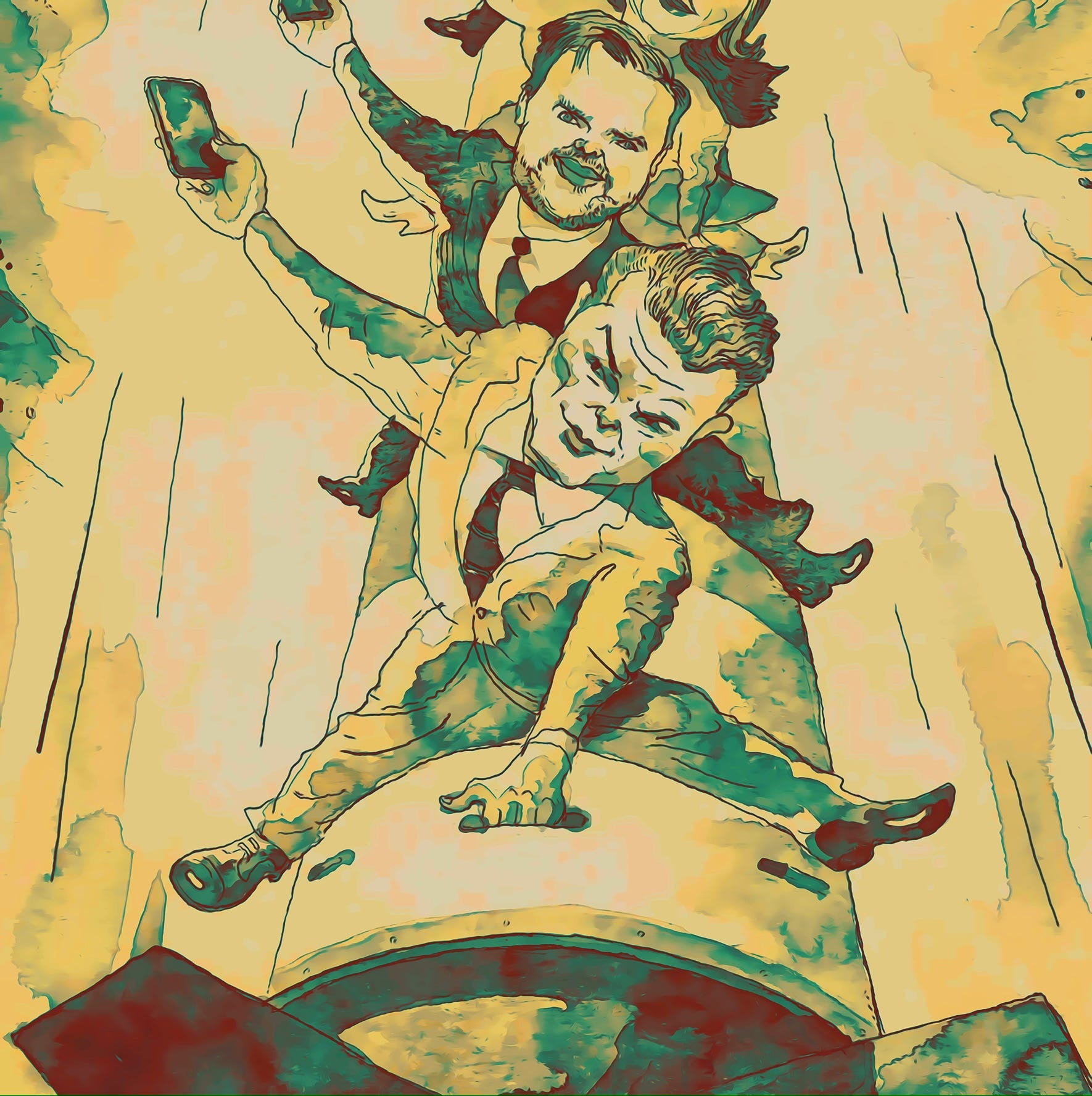
The war almost started because of a Viking.
This is true. The other thing, the thing that almost ended everything, started eleven minutes later when the Secretary of Defense reached into his breast pocket.
But start with the Viking. The Viking is where it started and the Viking is, in its way, the whole story. A man who did not know what he did not know, standing at the head of a room full of people who did, in the confident unhurried voice of a man who has never once in his life been told he was the problem.
The Viking was clip art. Horned helmet. Raised axe. Third result in an image search for the word “warrior.” The Secretary of Defense had placed it in the center of slide seven of a fourteen-slide presentation he prepared himself at 1 a.m. in his hotel room at the Steigenberger Wiltcher’s in Brussels, on a borrowed laptop, with the focused satisfaction of a man who believes he has found the exact right image for the exact right idea. This feeling is available to everyone. It does not require the idea to be correct.
Slide thirteen was titled THE RECKONING IS COMING and contained only a photograph of an eagle. Slide fourteen was blank. He had run out of ideas at slide thirteen but felt strongly that fourteen was a better number than thirteen for a presentation of this importance.
The presentation had not been requested. He had requested it himself, of himself, and granted it. The NATO foreign ministers had been informed that morning that the Secretary of Defense of the United States wished to share some thoughts before the formal agenda began. The formal agenda had been prepared by forty-seven people over three months. His thoughts had been prepared by one person over approximately ninety minutes, not counting the hour he spent selecting the Viking.
He went to sleep at 2 a.m. He woke at 7 a.m. He ordered room service. He began drinking at 9.
This is important context. By 10:15 he had been drinking for an hour and fifteen minutes, which is not enough to impair a man who drinks regularly, but is enough, combined with the altitude of his own self-regard, to produce the specific state he was in: the state of a man who is completely certain he is the most interesting person in any room he enters and has recently found significant evidence, in his own opinion, to support this view.
By 10:15 a.m. Brussels time he was at the head of the NATO briefing table explaining Charles Martel to the assembled foreign ministers and military chiefs of thirty NATO member nations, one Russian attache, and a junior press aide named Todd who was trying to record a voice memo about oat milk.
The card was not part of the presentation.
The card was in the hotel safe. He found it at 6 a.m. when he was looking for his passport. He read it once, understood approximately one word in four, decided it was part of his briefing materials, and put it in his breast pocket next to the speech notes for slide seven.
The card was not part of his briefing materials.
The card was the single most consequential object in the building that morning and he carried it in his breast pocket next to a Post-it note that said CHARLES MARTEL -732-VIKING and did not know the difference.
By 10:47 he had read six lines of it aloud.
By 10:49 a satellite belonging to no country anyone will officially acknowledge had adjusted its orbit by four degrees.
By 10:53 fourteen people in four countries and one car on the New Jersey Turnpike were all running toward the same room for different reasons and none of them knew the others were running and all of them were the wrong people to fix this and one of them was going to fix it anyway.
The Viking was clip art.
The card was not.
This is that story.
PART ONE: THE CARD
THE GENERAL-10:17 A.M., BRUSSELS
The General has served under nine Secretaries of Defense. He has seen things. He has never seen anything like this.
The Secretary of Defense is on slide seven. He has been on slide seven for eleven minutes. The Viking is on the screen behind him, axe raised, helmet horned, clip art rendered at a resolution suggesting it was designed in approximately 1997. The Secretary is explaining that Charles Martel stopped the Muslim advance at the Battle of Tours in 732 and that this is what NATO has forgotten and what he has not forgotten, and that the Viking represents the spirit of the Western warrior which is the spirit America needs to bring back and which, frankly, he sees in this room, except maybe not all of it, he’s looking at some of these faces.
He pauses here to actually look at some of these faces. The faces do not encourage him. He decides they are intimidated.
“I know,” he says, nodding. “I know. It’s a lot to take in.”
The German defense minister writes something on his notepad. He underlines it. He turns the notepad slightly so his aide cannot see it.
The Secretary moves to slide eight. Slide eight is titled IRAN and contains a map of the Middle East with a large red circle around Iran and an arrow and the word THEM in 48-point font. He has drawn the circle himself, freehand, using the drawing tool, which is why it is not quite a circle. It is more of an aggressive oval. Iran is entirely within it. So is most of Iraq, a significant portion of Saudi Arabia, and, due to an imprecision in the drawing, the lower quarter of Turkey, which is a NATO member.
The Turkish defense minister looks at the map. He looks at the circle. He looks at the lower quarter of Turkey inside the circle. He writes one word on his notepad.
The Secretary does not notice. He is explaining that the arrow means something.
“That’s the direction,” he says, pointing at the arrow. “That’s where it’s going. The direction of it.” He taps the screen. “Iran.”
The arrow is pointing at Egypt.
The General’s face contains nothing. Forty-two years of training have made his face a document that says exactly what he decides it should say. What it says right now is: I am listening. What it means is: I am counting the ways this ends badly and have reached double digits.
In the second row, the deputy assistant to the Norwegian defense minister leans to his colleague and whispers something. His colleague writes one word on his notepad and underlines it. The word is in Norwegian. It translates, approximately, as: indeed.
The Secretary moves to slide nine. Slide nine is a photograph of a wolf. The General does not know where the wolf came from or what it is meant to represent. Based on the presentation so far, the General’s best guess is that the Secretary searched for “strong” at 1:15 a.m. and selected the third result.
The Secretary looks at the wolf. The wolf looks back. The Secretary seems to feel that this is a meaningful exchange.
“Wolves,” he says. “They work together. That’s the thing about wolves. They’re a team.” He points at the room. “That’s us. We’re the wolves.”
The French foreign minister has not moved in four minutes. He has the expression of a man who has concluded that if he remains perfectly still, none of this will be happening.
The Secretary moves to slide ten. Slide ten contains a quote. The quote is attributed to Sun Tzu. The General, who has read Sun Tzu, does not recognize it. This is because the Secretary found it on a motivational website at 1:30 a.m. and did not verify it. Sun Tzu did not say it. A man named Brandon who sells supplements said it, in 2019, in a YouTube video titled WARRIOR MINDSET-ARE YOU BUILT DIFFERENT?
The Secretary reads it aloud with great solemnity.
He moves to slides eleven and twelve, which are variations on slides seven and eight respectively, and which exist because the Secretary, at 1:45 a.m., had forgotten he had already made slides seven and eight.
Then the Secretary reaches into his breast pocket.
He produces a laminated card.
The General goes very still.
He knows what a laminated card in a Secretary of Defense’s breast pocket means. There is only one laminated card a Secretary of Defense carries in a breast pocket. The General has spent forty-two years in proximity to this machinery and he knows, with the specific certainty of a man whose entire career has been organized around this single fact, that the laminated card is never read aloud. Not in a briefing. Not at a NATO meeting. Not in front of the allies of the United States of America and, by extension, their intelligence services and their recording equipment and the Russian attache who is, the General now notices, in the third row.
The Secretary is squinting at the card. He holds it at arm’s length, then closer, then at arm’s length again. He does not have his reading glasses. He did not bring his reading glasses because he does not like how he looks in his reading glasses and there were going to be cameras.
“I want to…I prepared something,” the Secretary says. “I want to read something. For context. About our posture.”
“Sir,” the General says.
The Secretary looks up.
“Sir,” the General says again, with the specific quality of a man saying one word that means: please do not do the thing you are about to do, I am asking you with everything I have, as one human being to another, do not do this thing.
The Secretary looks at him for a moment with the expression of a man who has just been mildly inconvenienced by a person whose name he cannot remember.
Then he looks back at the card.
He reads it.
Not all of it. Six lines of the twelve. Slurring slightly on the third line, which contains a word he does not recognize and so he pronounces it phonetically, with confidence, in a way that is not correct but delivered in the tone of a man who is certain it is. Confident throughout. In the voice of a man reading terms and conditions he has already agreed to, which is to say a man who is not reading them at all.
The room is very quiet.
The General writes two words on his notepad. He does not underline them because his hand is not entirely steady.
The words are: it’s out.
He stands up. He leaves the room. He is on his phone before the door closes behind him.
In the third row Dmitri Volkov is already typing.
Behind him, unnoticed, Todd’s breast pocket is recording everything.
WHAT THE CARD WAS
The card is called, in the documents that describe it, a pre-delegated release authority notification. It exists for one reason. If Washington is destroyed,if the command structure is decapitated, if the President and the Vice President and the chain of succession are gone,someone has to be able to act. The machinery cannot be left with no one to run it. So the authority is pre-delegated. Pre-positioned. Given in advance to the combatant commanders in the field, activated by a specific sequence of words read aloud by the Secretary of Defense, irreversible once transmitted, designed to function even in the chaos after a first strike.
It is designed for the end of the world. It is, in that context, entirely reasonable.
The Secretary of Defense read six lines of it to a NATO briefing at 10:47 a.m. on a Tuesday because he found it in his hotel safe and thought it was part of his briefing materials.
The carrier group commander in the Gulf of Oman heard it on a secure channel at 10:49 a.m. He is a careful man. He has spent thirty years not acting on things until he is certain. He is currently holding the phone very still and staring at the wall of his operations center and thinking about what he just heard and whether it was what it sounded like and whether the protocol that governs his response distinguishes between an intentional transmission and an accidental one.
The protocol does not distinguish between them.
He has not acted. He will not act without further confirmation. But he has the transmission. It is logged. It is real. And the clock that starts when a transmission like this is received is now running and it runs for six hours and at the end of six hours, if no counter-order has been received through the proper channels, the protocol has a next step.
The General knows this. This is why he left the room.
This is why he is running.
Three floors above the briefing room, the Secretary of Defense has returned to his suite. He has ordered a club sandwich. He is pleased with how the presentation went. He feels, specifically, that the wolf slide landed. He opens the room service menu. He studies the dessert section with the focused attention he previously brought to the image search for “warrior.”
The creme brulee looks excellent.
He makes a mental note to do more presentations.
TODD - 10:31 A.M., BRUSSELS
Todd is twenty-six. Junior press aide. Four months in. Georgetown degree. $2,400 studio in Arlington. Student loan balance he does not look at directly, like the sun.
He did not mean to record it.
He was trying to record a voice memo for a grocery list. He needed oat milk. He opened what he thought was the voice memo app. He put his phone in his breast pocket. He did not realize he had opened the video camera.
For fifty-three minutes his breast pocket recorded the Secretary of Defense explaining Charles Martel, the Viking, the map with THEM on it, a nine-minute digression about windmills, six lines of a laminated card read aloud in a slightly slurred but otherwise confident voice, and four minutes of the Secretary staring at slide thirteen -THE RECKONING IS COMING -in a silence that in retrospect had a quality that no one in the room could adequately describe afterward.
Todd discovered the video at 10:31 when he pressed stop by accident and saw the thumbnail.
He watched twenty-two seconds of it.
He texted his girlfriend: you are not going to believe this.
He sent the video.
His girlfriend watched four minutes of it and sent it to her friend Kayla.
Kayla posted thirty-one seconds of it on TikTok. The caption was: the secretary of defense is literally explaining the crusades rn?? at NATO???
The thirty-one seconds did not include the laminated card. Kayla had watched the clip art Viking and stopped there because the Viking was the funny part and Kayla, who is twenty-four and works in marketing and has a good instinct for content, correctly identified the Viking as the thing people would share.
By 11 a.m. the TikTok had been viewed by 340,000 people.
The other twenty-two minutes of the video, the part Kayla did not post, the part that contained six lines of pre-delegated release authority read aloud by the Secretary of Defense of the United States to a room containing the intelligence services of thirty NATO member nations and one Russian attache, sat on Todd’s phone in his breast pocket while he stood outside the briefing room trying to remember if he needed oat milk.
He did need oat milk.
He will not think about oat milk again for a very long time.
PART TWO: EVERYONE FINDS OUT
THE SECRETARY OF STATE-10:53 A.M., WASHINGTON
He finds out from the General at 10:53. The call is forty seconds. The General uses the correct technical language and the Secretary of State, who has been doing this job for almost two years and has made himself learn the things he needs to know, understands every word.
When the call ends he sits at his desk for eleven seconds. This is the longest he has ever sat without moving after receiving information. His deputy, in the doorway, counts the seconds without meaning to.
Then he picks up the phone.
He calls Moscow first. This is not protocol. Protocol says he calls the National Security Advisor. He calls Moscow first because Moscow’s signals intelligence heard the same transmission the carrier group commander heard and Moscow has its own clock and its own protocol and its own next step and the Secretary of State has forty-five seconds before whoever is watching that transmission in a building in Moscow decides what it means.
The Russian Foreign Minister answers on the third ring.
“Alexei,” the Secretary of State says.
A pause. The very specific pause of a man who was eating a second Danish and is now not eating a second Danish.
“You know,” Alexei Grabovitch says, “I was having a very nice morning.”
“I know,” the Secretary of State says. “I’m sorry about the morning.”
“The Danish here is excellent.”
“I believe you.”
“You have never been to this restaurant.”
“No.”
“You should come sometime. Under different circumstances.”
“I would like that,” the Secretary of State says. “Alexei. The transmission.”
A pause.
“I heard it,” Alexei says.
“I know you heard it.”
“My people heard it.”
“I know your people heard it.”
“My people’s people heard it.”
“Alexei.”
“Yes.”
“It was an error.”
A silence. The specific silence of a man who has sent three messages to Moscow and is now deciding whether to send a fourth.
“You know what I find interesting,” Alexei says, “is that the word error covers a very wide range of human experience. A man misspells a word. That is an error. A man steps off a curb. That is an error. A man reads a pre-delegated nuclear release authority to thirty NATO member nations while explaining a Viking…”
“Alexei.”
“I am making a point.”
“I know you are making a point.”
“The point is that some errors are more error-shaped than others.”
“This one,” the Secretary of State says, “is the most error-shaped error in the history of errors. He found the card in the hotel safe. He thought it was part of his briefing materials. He had a Post-it note that said CHARLES MARTEL-732-VIKING.”
A long pause.
“The Viking,” Alexei says.
“Clip art.”
Another pause. Longer.
“I saw the TikTok,” Alexei says.
“Everyone saw the TikTok.”
“Todd,” Alexei says.
“Yes.”
“He needed oat milk.”
“Yes.”
“This is,” Alexei says slowly, “either the funniest thing I have ever been involved in professionally or the most terrifying. I cannot decide which.”
“Both,” the Secretary of State says. “How long do I have.”
“Six hours from transmission.”
“Less now.”
“Less now,” Alexei agrees. A pause. “You know my counterpart is going to want something. For the stand-down.”
“I know.”
“He is going to want a call.”
“I know.”
“From your president.”
A silence.
“Alexei…”
“I know,” Alexei says. “I know. I am going to go back to my Danish. I am going to drink my coffee. I am going to read the sports section of a newspaper I cannot read.” A pause. “And I am going to need, in ninety minutes, something I can take back to Moscow that is better than a TikTok and a Post-it note.”
“You’ll have it,” the Secretary of State says.
“Good,” Alexei says. “The counter-order. Who signs it.”
This is the question that contains the whole problem.
“It’s being handled,” the Secretary of State says.
“By whom.”
“By the right people.”
“That is not an answer.”
“It’s the answer I have right now.”
A pause. Then: “You know what I appreciate about you.”
“What.”
“You never lie to me,” Alexei says. “You say things that are not the whole truth. You say things that point in the direction of the truth. But you do not lie.” A pause. “This is very rare in your building.”
“I know,” the Secretary of State says.
“Ninety minutes,” Alexei says.
“Yes.”
“I will finish my Danish.”
“Enjoy it.”
“I always do,” Alexei says. He hangs up.
He calls Tehran. He calls the carrier group commander. He calls the National Security Advisor. He calls the Chairman of the Joint Chiefs. He calls a number not in any directory that anyone outside a very small room knows exists.
Each call is a version of the same call. He is working on it. He means it. He is always working on it.
He is also, for the first time in two years, not certain it is enough.
THE AIDE- 10:56 A.M., BRUSSELS
She finds out from the General at 10:56. He stops her in the hallway. He is walking fast. He tells her in two sentences.
She stands in the hallway for three seconds. Then she calls the number in her phone labeled DO NOT CALL YET.
The Secretary of State answers on the first ring.
“I heard,” he says.
“The file…”
“Still need it,” he says. “More now. Not less.” A pause. “Are you all right.”
It is the second time he has asked her that this morning. The second time in six months anyone has asked her that. She is standing in a hallway in Brussels with the knowledge that a laminated card has been read aloud to a room full of foreign intelligence services and the clock is running and the man who read it is upstairs eating a sandwich and her file has been in a drawer for six months and she put it there. The file is about the man upstairs. This is the part she has not said out loud.
“I will be,” she says.
She takes out her laptop. She writes the email.
What she is about to lose is the drawer. The option of the drawer. The position she has maintained for six months that she passed it up the chain and it was not her call anymore. Once she sends this it is her call. It was always her call. This is what she has been not thinking about.
She does not delete it. She presses send before she finishes reading it back.
Down the corridor, a hotel housekeeper pushes a cart past the briefing room. She stops. Through the closed door she can hear raised voices in four languages. She has been working at this hotel for eleven years. She pushes the cart past. She has rooms to finish.
She does not know she is the calmest person in the building.
In Moscow, Alexei Grabovitch is the calmest person at breakfast.
These are different categories.
THE SENATOR- 10:58 A.M., WASHINGTON
Florentine Beauregard Pickett III finds out from his chief of staff at 10:58 a.m.
His chief of staff says: the Secretary of Defense may have inadvertently transmitted a pre-delegated release authority to a carrier group commander in the Gulf of Oman.
The Senator is standing in his office in his dove-grey three-piece suit. His pocket square is the color of a late-summer sky over the Mississippi Delta. He smells of Penhaligon’s Blenheim Bouquet and something older, the specific fragrance of a man who has wanted a war for forty years and has just been told the machinery is running.
On his desk there is a prepared statement about Iran. There are six prepared statements about Iran, in six different manila folders, drafted for six different scenarios, updated quarterly, each one beginning with the words: America cannot afford to wait. He has been updating them since 2009. He has never used any of them. He has, on three separate occasions, come very close.
He is quiet for a very long time.
“Sugar,” he says finally, in the warm bourbon voice, unhurried, magnolia-slow. “Are you telling me.”
“Yes sir.”
“Are you telling me that the ships are moving.”
“The authorization is out, sir. The ships haven’t moved yet. The commander is holding pending confirmation.”
“And the clock.”
“Six hours from transmission. Less now.”
The Senator sits down. He has been standing for this entire conversation and this is the first time he has sat down. He sits in the specific way of a man whose body has understood something before his mind has caught up to it.
He has wanted this for forty years. The war. The machinery turning over. He has read every classified assessment. He has visited the carrier groups. He has drafted the resolution in six different forms since 2009. He has appeared on Fox News one hundred and fourteen times in the last three years and on approximately ninety of those occasions has suggested, in the warm bourbon voice, that America’s adversaries are watching, and that watching is itself a provocation, and that a man of resolve would not allow himself to be watched without consequence. He has a very good relationship with the camera. The camera, in his view, has always understood him better than the Senate has.
He is sitting down because the thing he wanted is here and it is nothing like he imagined.
It is not a resolution. It is not a policy. It is not the righteous application of Western strategic will that he has described in one hundred and fourteen Fox News appearances and eleven speeches on the Senate floor.
It is a drunk man reading a laminated card.
He opens the top drawer of his desk. He looks at the manila folder. He closes the drawer.
“Get me on a plane,” he says.
“Sir…”
“Get me on a plane, sweetheart,” he says. “And get me Victor Davis Hanson. I need to think.”
His chief of staff books the flight. The Senator goes to his closet. He selects the midnight blue suit. He holds it up to the light. He puts it back. He takes the grey one instead.
His chief of staff has never seen him choose the grey one for travel. He says nothing. He understands that the grey one means something has changed.
He is right. He does not know what.
THE CONGRESSWOMAN- 11:15 A.M., DULLES AIRPORT
She finds out from a text at 11:15. She is at Gate C17 waiting for a flight to Denver for a town hall on student loan debt. She has forty-seven percent battery. She reads the text. She reads it again.
She says “oh my god” out loud. The woman next to her looks up. The Congresswoman does not notice. She is already on her phone booking a flight to Brussels.
She has 847,000 Instagram followers, 1.2 million on TikTok, and a chief of staff whose entire job has quietly become making sure she does not post things that end her career before she gets a chance to change the world. He is very good at his job. He is not good enough at his job.
She texts her chief of staff a photograph of the departures board. The caption is: change of plans babe.
She calls him before he can respond.
“Did you see my…”
“I saw it,” he says. He is in his kitchen. He sits down on the floor.
“Okay so.” She is walking fast through the terminal. Rolling carry-on. Coffee. Wrong direction. “Okay so I need you to tell me what a pre-delegated release authority is because I just looked it up and the Wikipedia article is either extremely boring or extremely terrifying and I cannot tell which.”
A silence.
“Both,” her chief of staff says.
“Both,” she repeats. She stops walking. She has reached a wall. She turns around. “So this is like. This is actually…”
“Yes,” he says.
“This is a…”
“Yes.”
“Like a real…”
“Yes,” he says. “Please stop walking while you’re on the phone.”
“I’m fine. I’m good at walking and talking.” She finds the right gate. She finds an outlet. She sits on the floor. She plugs in. Fifty-one percent now. Better. “I know someone.”
“You know someone.”
“The Iranian Foreign Minister. Oslo. Climate conference. 2022. She gave this speech about a glacier.”
“I know about the glacier.”
“She’s going to remember me.”
“You cannot just call the Iranian Foreign Minister…”
“I’m not calling her yet. I’m going to Brussels first.” She looks at her phone. “Also I need you to explain Charles Martel to me.”
“Charles Martel stopped the Umayyad advance at the Battle of Tours in 732,” he says. “Historians debate its significance. The Secretary of Defense apparently does not.”
“Okay,” she says. She opens her notes app. She types: Tours-732-significance debated-Secretary does not know this. She pauses. She adds: would make excellent whiteboard content. She deletes that last part. She adds it back.
“Please don’t post anything,” her chief of staff says.
“I would never,” she says.
“I mean it. This is a national security situation. You cannot…”
“I know,” she says.
“Promise me.”
“I promise,” she says.
She posts something from the bathroom at Dulles three minutes later. It gets ninety thousand likes in forty minutes. It says: somewhere over the Atlantic on a mission I literally cannot tell you about but it involves history and also the fate of human civilization??? more soon.
She adds, in the comments: and yes I am charging my phone don’t worry.
Her chief of staff sees it on the kitchen floor and closes his eyes. He stays on the floor for a moment. He gets up. He goes to his desk. He opens the document he keeps titled CONTINGENCY RESPONSES-UNAUTHORIZED POSTS. He scrolls to the section labeled VAGUE BUT ALARMING. He begins drafting.
On the plane she opens her notes app seventeen times. She drafts four posts and deletes all of them. She watches half a documentary about the Crusades, seventeen minutes of a cooking show she mistakes for a history documentary, and falls asleep somewhere over the Irish Sea. She dreams about the glacier. She wakes up certain about something she cannot name.
She opens her notes app. She adds: she will remember me.
She underlines it twice.
She almost posts it. She puts the phone away.
THE WIFE - 9:31 A.M., WASHINGTON
She knew at 9:30. A contact in Brussels sent three words: he found it.
She sends Elena four messages in sequence. She calls her attorney from the phone she does not own. Four minutes. SIM card in the toilet. Edinburgh has been ready for six weeks.
She puts on pale blue. She goes to work.
Here is what going to work looks like.
At 9:47 she is in the White House florist’s office discussing the centerpiece arrangement for the Finnish state dinner. The florist is showing her three options. She is looking at the third option, a low arrangement of white tulips and birch branches, and she is saying yes, I think that’s the one, the simplicity reads as respect for Scandinavian aesthetic, while simultaneously composing in her head the exact language of the third Cabinet vote request that Elena will deliver in person to the Secretary of Transportation at 10:15 in the parking structure of the Whole Foods on P Street, which is where the Secretary of Transportation takes calls he does not want in the building, which she knows because she knows where everyone takes the calls they do not want in the building, which is the most important database in Washington and exists entirely in her head.
The florist says: shall I go ahead with the tulips then.
She says: yes. And I think we go slightly lower on the birch. It reads taller in photographs than it does in the room.
The florist writes this down.
At 10:30 she has the third Cabinet vote.
At 11:00 she is tasting the appetizers for the Finnish state dinner. The salmon is correct. The rye crisp is correct. She has one note about the dill,slightly heavy, pull it back,which she delivers in the tone that says I trust you to fix this without my supervision, which is the highest compliment she gives and the chef knows it and nods.
Elena appears with coffee and a look.
The look means: Edinburgh confirmed.
She nods. She picks up the coffee. She looks at the rye crisp.
“The dill,” she says again, quietly.
“Yes ma’am,” the chef says.
She is the most dangerous person in this story and the only one whose goal is simply that the thing should hold. Not power. Not Edinburgh, which is a means and not an end. The institution. The machinery that everyone else in this story is running through and she is quietly, at enormous personal cost, trying to keep from destroying itself.
Nobody will ever say this about her publicly.
She knows.
She chose it anyway.
THE VP- 10:52 A.M., WASHINGTON
He finds out eight minutes after the Wife. He always finds out eight minutes after the Wife.
He goes very still. This is what the people who work for him watch for. Not urgency. The stillness. The stillness means he has seen something and is deciding what it is worth.
He picks up the phone. He sets it down. His hand moves toward the inside pocket of his jacket and then stops, the way a hand stops when it has remembered something before the mind has. He is very still. His hands have not shaken since he was sixteen years old in Middletown, Ohio, and he does not think about what it cost him to make that true.
What he sees: a vacancy. A clock. An opportunity inside a crisis if you are in the right position when the crisis resolves.
He is not trying to stop the clock. He is trying to be the person who stopped the clock.
These are related activities. They are not the same activity.
The difference will matter. He knows this. He files the knowledge in the room inside the room where he keeps the things he will not examine, and goes back to work.
THE WOMAN- 10:17 A.M., SACRAMENTO
She finds out the same way Todd does. The TikTok. Thirty-one seconds of clip art Viking and a man who has been drinking since nine a.m. explaining the Battle of Tours to NATO.
She watches it twice. She makes coffee. She opens her laptop.
She does not watch the chyrons. She stopped watching the chyrons six months ago, around the same time she stopped waiting for the rooms to act. What she opens is a document she has been building since the night they told her to wait. Names, dates, language she was careful about. She has sent copies to people who are not in any building she has ever been asked to wait in. People outside those rooms entirely, who will hold it regardless of what happens inside them.
She watches the chyrons now because the chyrons have caught up to what she wrote fourteen months ago in a sworn statement in plain declarative sentences. SECRETARY OF DEFENSE UNDER PRESSURE. NATO ALLIES ALARMED. CARRIER GROUP MOVEMENT HALTED. SECRETARY OF DEFENSE TO FACE REVIEW.
She makes more coffee. She watches.
Her phone buzzes later,much later, when the evening in Brussels has gone gold in the windows,a number she does not know.
“The file is in the right hands,” the Aide says. “As of this morning. It should have been there fourteen months ago. I am sorry that it wasn’t.”
The woman in Sacramento is quiet.
“Is it real this time,” she says.
“Yes,” the Aide says. “I think it’s real this time.”
The woman looks at the laptop. The chyron is still scrolling. The building in Brussels is lit in the early evening, all those windows, all that light, all the invisible ordinary work of people trying to keep the thing from becoming worse than it is.
“Okay,” she says.
She closes the laptop.
She goes to find her daughter.
THE THREE FOREIGN MINISTERS- 10:45 A.M., A SIDE ROOM, BRUSSELS
The German one is pacing. The carpet between the desk and the window already has a path worn into it from this morning alone.
“The card,” he says.
“Yes,” the British one says.
“He read the card.”
“Six lines.”
“To us.”
“Yes.”
“To all of us.”
“Yes.”
The French one is on his phone. He has been on his phone since the card. He is speaking quietly in French and whoever is on the other end has been making him progressively less calm since the call began four minutes ago. His face, which has spent thirty years perfecting the neutrality required of a man who is French in public, has abandoned the project entirely.
The British one has a bottle of water. He opened it eighteen minutes ago. He has not drunk from it. He is holding it with both hands. His wife texted him at eleven asking how the morning was going and he has not responded, because answering would require deciding what to say, and what he has available to say is: the morning contained something I cannot tell you about, which is true of most mornings in this work, but this one more specifically, because it contains a thing that would frighten her, and he has spent thirty years in these rooms precisely so that she does not have to be frightened by them. He drinks the water. It does not help. He knew it wouldn’t. He sets it back down anyway.
“The Russian attache,” the German one says.
“Third row,” the British one says.
“He was typing before the Secretary finished the third line.”
“Yes.”
“So Moscow…”
“Yes.”
The French one gets off his phone. He looks at them.
“The carrier group,” he says.
They look at him.
“It’s already moving,” he says.
The German one stops pacing.
The British one sets down the water.
The room is very quiet.
“Forward position?” the German one says.
“No,” the French one says. “Not yet. But the commander received the transmission and he has logged it and the protocol…”
“I know the protocol,” the German one says.
They all know the protocol. They have all sat in rooms where American officials explained the protocol with the specific confidence of people describing a failsafe, a guarantee, a system designed to prevent exactly the thing that the system has just produced the conditions for.
“Someone needs to call the Secretary of State,” the British one says.
“He already knows,” the German one says.
“How do you know he already knows.”
“Because he always already knows,” the German one says. “The question is whether knowing is enough.”
The British one picks up his water. He drinks from it. He puts it down.
“Is it ever enough,” he says.
Nobody answers that.
Outside in the corridor a hotel catering staff member pushes a trolley of coffee service toward the room. She has been told there is a meeting. She has been told to bring coffee for fifteen. She knocks. Nobody answers. She opens the door. Three men look at her with the specific expression of people who have forgotten that coffee exists as a concept.
She sets down the coffee. She leaves.
She will tell her husband about this at dinner. He will ask what they looked like. She will say: like men who have just remembered something they should never have forgotten.
He will nod. He is from Brussels. This happens.
THE RUSSIAN ATTACHE- 10:49 A.M., BRUSSELS
His name is Dmitri Volkov. He is forty-one years old, mid-level, the kind of attaché who gets sent to briefings because someone has to go to briefings. He has been doing this job in various cities for eleven years and has developed the specific patience of a man who has learned that most of what he observes is not significant and that the significant things announce themselves clearly if you are paying attention.
Dmitri Volkov was paying attention at 10:47 when the Secretary of Defense read six lines of a laminated card to a NATO briefing.
He sent three messages to Moscow in eleven minutes. The messages were brief and technical and used a vocabulary that exists in approximately twelve buildings on earth, all of them government buildings, none of them hotels.
He is not the calmest person in this story.
He is, however, very good at his job.
PART THREE: THE CAR
THE SENATOR AND THE CONGRESSWOMAN- 1:47 P.M., A CAR, BRUSSELS
They get stuck in a car together by accident.
She has just landed. He has just cleared customs. They are both going to the same hotel. The same car is available. Her chief of staff is not here yet. His chief of staff puts them in together with the specific desperation of a man managing two problems simultaneously and choosing the solution that solves both at once even if it creates a third.
The chief of staff will spend the next twenty minutes in the front seat regretting this.
They look at each other.
She knows who he is. She has known who he is since 2021 when he said on Fox News that her climate policy was, quote, the most expensive temper tantrum in the history of the United States Senate, which was technically incorrect because she was not in the Senate, and also she had done a TikTok about it that got 2.3 million views, and also she has not forgotten it, and also it is clear from the way she is looking at him right now that she has not forgotten it.
He knows who she is. He has known who she is since his chief of staff started monitoring her TikTok for threats and he watched forty seconds of a video in which she explained his voting record on military appropriations to approximately 800,000 people using a whiteboard and the word “literally” eleven times. He had found it, in the privacy of his own office, surprisingly accurate. He had found it, in every other context, infuriating.
“Senator,” she says. Not warmly.
“Congresswoman,” he says. Not warmly.
His chief of staff, in the front seat, looks at the driver. The driver looks straight ahead. This is the correct response.
The car begins to move.
She opens her phone. She is in his mentions. She is always in his mentions or he is in hers. This week she is in his mentions because of a floor speech he gave about defense appropriations in which he described her approach to foreign policy as, quote, a graduate seminar taught by someone who has never left the building.
She had done a TikTok from inside a building in response.
“Nice speech,” she says, without looking up from her phone.
“Which one,” he says pleasantly.
“The one where you called me a graduate student.”
“I said graduate seminar,” he says. “There is a distinction. A graduate seminar implies a room full of people. A graduate student is just one person.” A pause. “I was being generous.”
She looks up from her phone. She looks at him with the full direct attention she usually reserves for committee hearings and foreign ministers.
“You called my foreign policy a temper tantrum,” she says.
“I said climate policy.”
“Same speech.”
“Different sentence.”
“You know what,” she says, “I literally…”
“Literally,” he says, in the warm bourbon voice, not unkindly, just observationally, the way a botanist might note a particular flower. “You use that word an average of four times per ninety seconds. My chief of staff counted.”
“Your chief of staff counted.”
“He has a lot of time on his hands. I keep trying to get us into a war.”
She stares at him.
He looks out the window at Brussels in the rain, the pocket square the color of old gold, Victor Davis Hanson in his lap, the expression of a man who has just said something he finds genuinely funny and is giving it room.
Against her will, the corner of her mouth moves.
“That wasn’t funny,” she says.
“It was a little funny,” he says.
“It really wasn’t.”
“Congresswoman,” he says, turning from the window, “we are in a car in Brussels in the rain because the Secretary of Defense found a nuclear authorization card in a hotel safe and read it to thirty nations because he thought it was a briefing document. If that is not a little funny I do not know what is.”
She looks at him for a long moment.
“It’s terrifying,” she says.
“The two things,” he says, “are not mutually exclusive. I have been in Washington for forty years. If you cannot find the terrifying things a little funny you will not survive forty years in Washington.”
“I don’t want to survive forty years in Washington,” she says. “I want to change it.”
“I know,” he says. Not dismissively. Just: I know.
The car moves through the wet streets. The chief of staff in the front seat is studying his phone with the focused attention of a man who has decided that whatever happens in the back seat is not his problem, which it absolutely is.
“You did a TikTok about my appropriations vote,” the Senator says.
“You voted against the climate resilience package three times.”
“I voted against the funding mechanism. There is a distinction,one your whiteboard did not make,and it affected the voting record of four colleagues who would have voted yes on a cleaner bill…”
“I know about the four colleagues,” she says.
He stops.
“I talked to two of them,” she says. “After the vote. I know what happened.” She looks out her window. “I just didn’t think you knew I knew.”
A silence.
“You are considerably less simple than your TikToks suggest,” he says.
“Your floor speeches are better than your Fox hits,” she says. “The real ones. Not the ones for the cameras.”
He is quiet for a moment.
“You’ve watched my floor speeches,” he says.
“C-SPAN at two a.m. is a whole thing,” she says. “Don’t read into it.”
The rain on the windows. Brussels going past. The specific weight of two people who have been in opposition so long that the opposition has become a kind of intimacy, each of them knowing exactly what the other will say before they say it, which is its own form of being known.
“You’ve wanted this war for forty years,” she says. Back to flat. Back to direct. The bickering used up, the thing underneath it visible now.
He is quiet.
“Yes,” he says.
“And now it might actually happen.”
“Yes.”
“Because a man read a card he didn’t understand.”
“Yes.”
She looks out the window. “Is that how you imagined it.”
He looks at Victor Davis Hanson in his lap. Not reading it. Just looking at it the way you look at something you have carried for a long time and are seeing clearly for maybe the first time.
“No,” he says.
“How did you imagine it.”
“Differently,” he says. “With purpose. With strategy. With the righteous application of…He stops. He makes a small sound. “I have given eleven speeches on the Senate floor about the righteous application of Western strategic will.” He looks up. “You know what Western strategic will looks like today.”
“A Viking,” she says.
“Clip art,” he says.
The car is quiet.
“You could help stop it,” she says.
“I could,” he says.
“But.”
“But stopping it means it doesn’t happen.” He says this plainly, without apology, the way you say things in cars in the rain when the bickering is done and what’s left is the true thing. “And if it doesn’t happen now it doesn’t happen. The moment closes. The machinery goes back to sleep. And I am sixty-seven years old and I have been waiting for the machinery to run for forty years and…” He stops.
She waits. She does not fill the silence. It costs her and she pays it.
“I looked over the edge,” he says. “This morning. When my chief of staff called.” He pauses. “I looked over the edge of the thing I have been walking toward my entire career and I did not recognize it.”
“What did you see,” she says.
“A drunk man,” he says. “Reading a card.”
The car is quiet.
“That’s not the war you wanted,” she says.
“No.”
“The war you wanted doesn’t exist,” she says. Not cruel. Just true. She leaves it where it lands.
“I know that,” he says. “I have always known that. Knowing it and believing it are not the same thing. I have known it for forty years and believed it for approximately this morning.”
She nods.
“You know what your problem is, sugar,” he says.
She turns. “What.”
“You actually mean it.”
“Mean what.”
“All of it,” he says. “The glacier. The phone calls. Coming here on forty-seven percent battery because someone texted you and you got on a plane.” He looks at her with the eyes of a man looking at something he lost so long ago he forgot it was gone. “You mean all of it.”
“Don’t you,” she says.
He is quiet for a long time.
“I mean the winning,” he says. “I have always meant the winning. That is not the same thing.”
She looks at him. The car is slowing. The hotel is ahead, the flags, the lit windows, the building full of people trying to stop the worst thing.
“You have nineteen years on the Armed Services Committee,” she says.
“Yes.”
“You have the knowledge. The access. The relationships.” She looks at him. “I have a phone and sixty-three percent battery and a glaciologist’s phone number.”
“I know,” he says.
“We need both,” she says.
He looks at her for a long moment. The car stops. Neither of them moves.
“I have spent forty years,” he says slowly, “being the most prepared person in every room I entered.” A pause. “I have never once been in a room with someone who made me feel underprepared.”
She looks at him.
“You make me feel underprepared,” he says. “And I find that…” He stops. Searches for the word. “Clarifying,” he says finally.
The driver opens the door. The rain is light. The cobblestones wet. The flags snap above the entrance.
The Senator gets out. He straightens his pocket square. He picks up his bag. He looks back at her.
“In this town,” he says, “meaning it is the only problem that matters. And the only thing that ever fixed anything.”
He goes inside.
She sits in the car for one more second.
“Did he just compliment me,” she says to her chief of staff’s empty seat.
The driver says nothing. This is the correct response.
She gets out. She follows him in.
PART FOUR: THE ROOM AND THE CALL
THE ROOM- 5:00 P.M., BRUSSELS
They arrive from six directions.
The General and the Aide from the north corridor, walking fast, the Aide with her laptop and the file that is no longer in a drawer and the General with his notepad and the two underlined words and the specific bearing of a man who has been saying the correct thing all day and is about to say it in the room where it can finally matter.
The Secretary of State from the elevator, phone to his ear, saying yes, saying we’re working on it, saying I’ll call you back, having been on the phone for six hours and showing no sign of stopping, moving with the flat purposeful steadiness of a man who has decided that the calls are the work and the work does not stop.
The Wife from the side entrance, Elena two steps behind, both of them moving with the specific economy of women who have been three moves ahead of everyone in the building since nine-thirty in the morning and for whom arriving is simply the visible part of a process that has been running for hours already.
The VP from the main entrance, alone, jacket buttoned, face composed, containing the stillness that the people who work for him have learned to fear, moving toward the room for reasons that are adjacent to but not the same as everyone else’s reasons and knowing it and calculating whether the difference matters.
The Senator and the Congresswoman from the lobby, together, which surprises everyone who sees them and will be written about later in ways that capture the visual and miss the meaning entirely.
They fill the room.
The Secretary of Defense is not in it. He is three floors up. He has finished the creme brulee. He found it excellent. He is now studying the wine list for dinner with the focused attention of a man whose afternoon has gone well and whose evening is looking promising. The clock says three hours and twelve minutes. He is considering the Burgundy.
The General stands at the head of the table.
He says: the Secretary of Defense is unfit to serve. He has been unfit for a significant period of time. This has been known and not acted upon for reasons that are not good reasons. The file has been in a drawer for six months. The woman who put it there was told to. She should not have been told to. She told the truth. She was not believed. She is in Sacramento and she has been right from the beginning.
He says: none of that matters right now.
He says: what matters right now is the clock.
He puts a piece of paper on the table. The paper describes what the carrier group commander needs to receive in order to stand down. The specific words. The specific channel. The specific authority required.
He says: the person who has that authority is three floors up studying a wine list. Which means someone in this room needs to make the call.
He looks around the table.
The VP reaches for the phone.
The Senator puts his hand flat on the table. Not touching the VP. Just flat on the table. The gesture of a man who has spent forty years in rooms like this and knows what a gesture like that means in a room like this.
“Not you,” the Senator says, in the warm bourbon voice, and there is no malice in it, just the flat delivery of a man saying a true thing to another man who knows it is true.
The VP looks at him.
“You’ll use it,” the Senator says. “And using it takes longer than doing it right. And the clock doesn’t have the time it takes to use something.”
The room is quiet.
The VP’s hand is still. He does not pick up the phone. He looks at it for a moment the way you look at something you almost did. The Senator, who has spent forty years in rooms like this and has never once failed to read one, watches him and cannot read what he is seeing.
The VP sets the phone on the table.
“Then who,” the VP says.
The Senator looks at the General.
The General looks at the Secretary of State.
The Secretary of State is already on the phone. He is talking to the carrier group commander. He is saying: the transmission was an error. He is saying: this is a counter-order. He is saying: stand down and await formal confirmation through the proper channel which will reach you within the hour.
He is not the Secretary of Defense. He does not have the authority. He is doing it anyway because the authority he does not have is currently evaluating Burgundy and the clock does not care about the distinction.
The carrier group commander has spent thirty years not acting on things until he is certain. He is listening to the Secretary of State’s voice with the specific attention of a man deciding whether the voice is certain enough.
The Secretary of State’s voice is always certain. Not performed certainty. The real thing. The kind that comes from being the person who is working on it and meaning it.
The carrier group commander says: confirmed. Standing by for formal counter-order.
The Secretary of State hangs up. He looks at the room.
“Ninety minutes,” he says. “For the formal counter-order. The proper channel is the Secretary of Defense.”
“Which means someone has to go upstairs,” the General says.
They look at each other.
The Congresswoman stands up.
“I’ll go,” she says.
“You’re a congresswoman,” the VP says. “You don’t have…”
“I don’t have anything,” she says. “That’s why I can go.” She looks at the VP. “You can’t go because you’ll use it. He can’t go…” she means the Senator…”because he’ll explain Charles Martel. You can’t go…”the Secretary of State…”because you’re the one who has to write the counter-order the minute he signs it.” She looks at the General. “And you can’t go because he’ll know what it means the second he sees your face.”
The General says nothing.
“He won’t know what it means when he sees mine,” she says. “Because I don’t look like a problem. I look like a congresswoman from a district he’s never been to who has no reason to be in Brussels.” She picks up her phone. She puts it in her pocket. “Brief me. Four minutes.”
The General picks up his notepad.
He briefs her in four minutes.
She listens. She asks two questions. Both are good. He answers them.
She goes.
In the hallway, the Senator watches her go. He is quiet for a moment. Then he turns to the room.
“I need a phone,” he says. “The carrier group commander. I have a number he will recognize.”
The General looks at him.
“Nineteen years,” the Senator says simply.
The General slides his phone across the table.
The Senator makes the call. He speaks for ninety seconds. He uses the voice he uses for floor speeches,not the bourbon voice, not the Fox voice, the third voice, the one nobody outside the Senate has heard, the one that contains forty years of actually knowing what he is talking about. The carrier group commander on the other end of the line has known this voice for eleven years. He trusts this voice in the specific way you trust a voice that has never once told you what you wanted to hear.
The Senator hangs up. He puts the phone on the table.
“He’ll hold,” the Senator says.
The room is quiet.
The Wife, in the corner, sends Elena a text. Two words. Edinburgh moves.
Nobody notices this. This is how she prefers it.
THE SECRETARY UPSTAIRS-5:47 P.M.
She knocks on the door of the suite.
He opens it in the guayabera he has been wearing since this morning, slightly damp, the soccer match audible behind him, the remnants of the creme brulee on the table, the specific comfortable rumpled contentment of a man whose day is over and whose evening is about to begin.
He looks at her.
Not at her face. At the general area of her face and below. He has the look of a man who has been drinking since nine a.m. and is now experiencing what nine hours of drinking at this particular pace produces, which is the specific cognitive state where everything seems simpler than it is.
“Who are you,” he says.
“I’m a congresswoman,” she says. “I’m a big fan of your work.”
He straightens. He runs a hand through his hair. He leans against the door frame with the studied casualness of a man who has practiced this particular lean in mirrors.
“Come in,” he says.
She comes in. She sits where he indicates. He sits across from her. The soccer match continues. She does not know which teams are playing. She does not care. She is holding three things simultaneously now: the briefing the General gave her in four minutes, the knowledge of the file in the Aide’s laptop, and the dawning awareness that the Secretary of Defense of the United States is looking at her chest with the focused attention he previously brought to the image search for “warrior.”
She adjusts her jacket. She refocuses. Two hours and fourteen minutes.
“The presentation,” she says. “The one you gave today.”
He lights up. He leans forward. This brings him closer. This appears to be intentional.
“People are talking about it?” he says.
“People are very much talking about it,” she says, which is true. “The Viking especially.”
“I found that myself,” he says. “The image.” He is looking at her in the way of a man who has decided that finding the image was the kind of thing that impresses people. “I’m very visual.”
“I can see that,” she says.
“I did the whole thing myself,” he says. “Fourteen slides. One a.m. Just me and the laptop.” He gestures at himself. “When I lock in I really lock in.”
“That’s impressive,” she says, in the tone of a woman who has been in rooms with a lot of men like this and has become extraordinarily good at producing the syllables of admiration without the content of it.
He smiles. He is feeling that the evening is going well. It is, in fact, the evening of the worst professional day of his life, but he does not know this and the not knowing is doing an enormous amount of work.
“There’s one thing,” she says, and produces the paper. “The card you read. There’s a follow-up. Standard protocol. Just a formality.” She slides it across. “You just need to sign this.”
He picks it up. He looks at it. He looks at her. He looks at it again.
“What is this exactly,” he says.
She watches his face. The General told her: if he reads it carefully, stop.
He is not reading it carefully. He is holding it in one hand and looking at her with the expression of a man who has decided that paperwork is less interesting than the person asking him to sign it, which, from a purely professional standpoint, is the most dangerous thing a Secretary of Defense can think, and which is currently saving the world.
“It’s the follow-up to the card,” she says. Steady. Certain. “Standard protocol after a transmission. Very routine.”
“You came all the way up here,” he says, “just for a signature.”
“The Viking really worked,” she says.
He looks at her for a moment. Then he looks back at the paper. He picks up the pen. He signs it with the specific flourish of a man who wants you to notice his signature.
She takes it back. She stands. She shakes his hand. He holds it slightly longer than a handshake requires.
“You know,” he says, at the door, “I was thinking about getting dinner. The hotel restaurant supposedly has great duck.”
“I’ve heard,” she says.
“If you’re not doing anything…”
“I have a call,” she says. “Oslo.”
“Oslo,” he says, as if Oslo is a concept he respects but cannot quite place.
“Thank you for signing,” she says. “The Viking really worked.”
“I thought so,” he says.
She closes the door. She stands in the hallway for a moment. She looks at the ceiling. The ceiling is white. The ceiling contains no answers but also no questions, which is all she needs from a ceiling right now.
She texts the Secretary of State one word: signed.
She walks to the elevator. She gets in. The doors close.
She takes out her phone.
She does not post anything.
She finds, in her coat pocket, a receipt from the coffee she bought at Dulles this morning. Gate C17. Six forty-three a.m. She does not know why she kept it. She looks at it for a moment. She puts it back.
She stares at the wall of the elevator for a long time.
The wall does not offer dinner.
This is the correct behavior for a wall.
THE CALL - 7:15 P.M., OSLO
She calls from a secure phone borrowed from the Belgian Foreign Minister’s office.
The Iranian Foreign Minister answers on the second ring.
“I was wondering when you would call,” she says.
“You knew I was here,” the Congresswoman says.
“I heard you were on a plane over the Atlantic posting about the fate of human civilization,” the Foreign Minister says. “And I thought: she will call.”
“I’m sorry about the post.”
“Don’t be. It was accurate.” A pause. “How bad was it.”
“Bad,” the Congresswoman says. “It’s handled. But bad.”
“The card.”
“Yes.”
“We heard it.”
“I know.”
“Our analysts…”
“I know,” the Congresswoman says. “That’s why I’m calling. Not to explain it. You understand what happened better than most of the people in the room today.” A pause. “I’m calling because you gave a speech in Oslo in 2022 about a glacier in the Alborz Mountains.”
The Foreign Minister is quiet for a moment.
“You remembered,” she says.
“You said you can’t mourn what disappeared before you thought to look,” the Congresswoman says. “I wrote it down.”
“I remember you,” the Foreign Minister says. “You were in the third row. You cried.”
“I wasn’t the only one.”
“No,” the Foreign Minister says. “You weren’t.”
They are quiet for a moment. Two women on secure phones in different cities, one the foreign minister of a nation that has been circling the edge of catastrophe since 10:49 a.m. and the other a congresswoman who came here on forty-seven percent battery because someone texted her and she got on a plane.
“We need seventy-two hours,” the Congresswoman says. “Not for negotiations. Not for framework talks. Just seventy-two hours of nothing happening while the people who need to be removed are removed and the people who need to write things write them and the machinery gets pointed in a direction that doesn’t end with both of us explaining to our grandchildren what we were doing the day the glacier disappeared.”
The Foreign Minister is quiet.
“That’s not diplomatic language,” she says.
“No,” the Congresswoman says.
“You’re not a diplomat.”
“No.”
“You’re a congresswoman from…”a pause …” New York”
“Yes.”
“Who came to Brussels because someone texted you.”
“Yes.”
“And you think I will give you seventy-two hours because of a speech about a glacier.”
The Congresswoman thinks about this. She is sitting in a borrowed office in Brussels with the window showing the wet evening city and the flags and the lit buildings and all the important rooms full of people who have spent today running toward the same place for different reasons and arrived to find each other.
“I think you’ll give us seventy-two hours,” she says, “because you gave that speech because you meant it. And I think you can tell when someone means something. And I mean this.”
The line is quiet for a long time.
“Seventy-two hours,” the Foreign Minister says. “Then someone sends me a letter. Clear. Not full of…”
“I know someone who writes very clear letters,” the Congresswoman says.
“I know you do,” the Foreign Minister says. “Tell him no diplomatic language.”
“He knows,” the Congresswoman says.
The Foreign Minister says: seventy-two hours.
The Congresswoman says: thank you.
She hangs up. She sits in the borrowed office for thirty seconds longer than she sits alone anywhere.
Then she opens her phone. She opens the app. She types something. She reads it back. She deletes it.
She calls her chief of staff.
“Seventy-two hours,” she says.
He is in the hallway. He has been there every step of this day, three hours behind, one step back, on the kitchen floor and on the plane and in the hallway, watching her go places he cannot follow and coming back.
“Okay,” he says.
“Is it okay,” she says. “Is any of this okay.”
He is quiet for a moment.
“It held,” he says.
“This time,” she says.
“This time,” he agrees.
She stands up. She goes to find him.
THE PRESIDENT-7:45 P.M., WASHINGTON
He is watching WWE in the residence. The aide has turned it to a friendly channel. He drinks his Diet Coke.
At 7:45 he mutes it.
He calls the Secretary of State from the phone he is not supposed to have.
The Secretary of State answers on the first ring.
“It’s handled,” the Secretary of State says.
“The card,” the President says.
“Yes sir.”
“He read the card.”
“Yes sir.”
A pause.
“I know what the card is,” the President says. “I was briefed. I remembered today. When they told me.” A pause. “I remembered the briefing.”
“Yes sir,” the Secretary of State says.
“The woman,” the President says. “Sacramento.”
“The file is in the right hands sir.”
The President is quiet for a long time.
“She told the truth,” the President says.
“Yes sir,” the Secretary of State says. “From the beginning.”
“Good man,” the President says.
He hangs up. He unmutes the television. He finishes his Diet Coke.
By eight p.m. he will have forgotten the call. By eight-thirty he will be talking about windmills. By nine p.m. the medications will arrive and the window will close and whatever understanding surfaced in the narrow space between the fog and the light will go back to wherever it goes when it goes.
But for those two minutes on the phone he knew.
He always knows.
He just can’t hold it.
THE ENDING
None of this saves you.
Not the General’s statement. Not the file in the right hands. Not the letter to Tehran written plainly without diplomatic language. Not the carrier group standing down. Not the VP’s stillness or the Wife’s pale blue or the Secretary of State on the phone saying we’re working on it until the words become a kind of gravity, pulling the world back from the edge through sheer repetition of intent.
Not the Senator with his Victor Davis Hanson and his midnight blue suit and the forty years of wanting the thing and looking over the edge of it and finding a drunk man with a clip art Viking.
The machine does not save you. The machine saves itself. These are different things and the machine does not know the difference and neither do the people running it, except occasionally, in cars in the rain in Brussels, in brief windows between medications, in thirty-one-minute phone calls between two women who both cried at a speech about a glacier.
In Moscow, Alexei Grabovitch has ordered dinner. The duck, which the menu describes in terms he finds optimistic but the waiter vouched for personally, arrives. It is excellent. He reads the sports section of a newspaper. A photograph of a Belgian footballer catches his eye. He does not know who this one is either. He finds it calming anyway. His phone does not buzz. This is either very good news or very bad news and he has learned, in nineteen years, that you eat the duck either way.
The Congresswoman is on the floor of the hallway outside the room with her back against the wall and her chief of staff beside her. She is not posting anything. She is thinking about the glacier. She is thinking about the woman in Sacramento. She picks up her phone. She opens the app. She starts typing. Her chief of staff watches her without turning his head. She stops typing. She puts the phone away. He says nothing.
Down the corridor, the Senator passes on his way to the hotel bar. He sees them on the floor. He stops. He looks at her. She looks back at him. He reaches into his jacket pocket. He produces a business card. He holds it out. She takes it.
On the card it says: Florentine Beauregard Pickett III, United States Senate, Armed Services Committee. In his small precise hand, below the printed text, he has written a number.
“That’s his direct line,” the Senator says. “The carrier group commander. In case the next one starts before I get back.”
He goes to find the French general.
She looks at the card for a long moment.
She puts it in her pocket.
LATER-A ROOFTOP, BRUSSELS -11:47 P.M.
Nobody is sure whose idea it was.
The Senator will later say it was hers. She will later say it was his. His chief of staff, who was present for the part that led to it but excused himself on the grounds of plausible deniability, believes it was neither of them exactly but rather the specific combination of a very long day, a retired French general who had a contact, and the fact that Brussels at midnight in the rain has a quality that makes bad ideas seem reasonable and reasonable ideas seem irrelevant.
They are on the roof of the hotel. The city is below them, wet and lit, doing what Brussels does which is exist with the quiet persistence of a place that has survived too much history to be surprised by any of it. The Senator is still in the grey suit. The pocket square is slightly askew for the first time all day. The Congresswoman has her shoes off. Her phone is in her pocket. She has not checked it in forty minutes. This is, by any measure, a record.
The Senator takes a long, considered pull. He holds it. He releases it with the expression of a man encountering a sensation he has not encountered since 1987 at a fundraiser in New Orleans and had mostly convinced himself he had imagined. The French general’s contact had come through. This was not in question. What was in question was whether a sixty-seven-year-old United States Senator was actually doing this on a rooftop in Brussels at midnight, and the answer, it turned out, was yes.
He looks out at the city.
“Huh,” he says.
“Right?” she says.
“I feel,” he says slowly, “considerably less certain about the Battle of Tours.”
“Historians debate its significance,” she says.
“They may have a point,” he says.
They are quiet for a while. The rain has stopped. The cobblestones below are still wet and they catch the light in the way wet cobblestones in European cities have been catching the light for several hundred years, indifferent to everything happening above them.
“Do you think he knew,” she says. “What he was reading.”
“No,” the Senator says. “He genuinely thought it was a briefing document.”
“That’s somehow worse,” she says.
“Yes,” he says.
“Like the whole thing,the card, the clock, the satellite moving,all of it happened because a man needed oat milk.”
“Todd,” the Senator says.
“Todd,” she agrees.
They consider this.
“You know what I keep thinking about,” she says.
“The glacier,” he says.
She looks at him.
“You were going to say the glacier,” he says.
“How did you know that.”
“Because you have said the word glacier approximately forty times today and each time you say it you get a specific look.”
“What kind of look.”
“The look,” he says, “of a person who has not yet given up.” He pauses. “It is a very unusual look in this building.”
She is quiet for a moment.
“You could have that look,” she says.
“I had that look,” he says. “In 1987. Before the rooms got to it.”
“What happened in 1987.”
He looks out at the city. He takes another pull. He holds it longer this time.
“A fundraiser in New Orleans,” he says. “Never mind.”
She almost laughs. It is the real laugh, the wide one, the one that goes all the way up. He has not seen it directed at him before. He finds it, unexpectedly, clarifying.
“You’re going to be a problem,” he says.
“I know,” she says.
“A genuine, ongoing, structural problem.”
“I know.”
“For a lot of people in that building.”
“I know,” she says. She looks at the city. “Good.”
He looks at her. She is looking at Brussels with the specific expression of a person who is already thinking about what comes next, what the next thing is, where the next room is that needs someone who actually means it. He recognizes the expression. He used to wear it himself. He has not worn it in so long he had forgotten what it looked like from the outside.
It looks, he thinks, like someone who has not yet learned that the rooms win eventually.
He hopes, in a way he will not examine too closely, that she never learns that.
“Get some sleep,” he says. He stands. He straightens his pocket square. It is still slightly askew. He leaves it. “The next one starts tomorrow.”
“I know,” she says.
He goes inside.
She stays on the roof for a while longer. The city below her. The wet cobblestones. The lit windows. All the rooms still running. She picks up her phone. She opens the app. She looks at it for a long time.
She puts the phone back in her pocket.
She looks at the city.
She stays there until the cold gets to her.
Then she goes inside too.
If you made it this far,past the Viking clip art, past the six accidental lines of a pre‑delegated nuclear release authority, past Todd and his oat milk and the satellite that twitched because a man couldn’t find his reading glasses,then you’re exactly the kind of reader I want in the room with me. This work takes time, clarity, and the kind of stubborn attention that keeps you watching even when “the Secretary read six lines of it aloud” and the whole world tilts. If you want more stories built with this level of consequence and craft, consider becoming a paid subscriber. It keeps the lights on, the writing sharp, and the machinery honest.
Holy shit. It could happen, without this particular ending. Contemplation of the incompetence is making my head explode. JFC. Are we doomed, or not? When I read your stuff it shakes my brain like a dog with a toy. It's terrifying and exhilarating at the same time. Good piece. Thanks.
This was exceptional and it took me way too long to understand this had not in fact actually happened. It had me gripping the edge of my seat. Great work!