

The Second Year
On the Signs We Put in Our Windows.

The coffee is cold again. I notice this less than I used to.
That is the whole story, right there. Not the noticing. The not noticing. What a sustained emergency does to the nervous system is not break it. What it does is normalize it. The body finds a new baseline and calls it morning and you drink the cold coffee and you do not think about what it means that you have stopped thinking about it.
This is how it works. This is the mechanism. This is what they are counting on.
It has been one year.
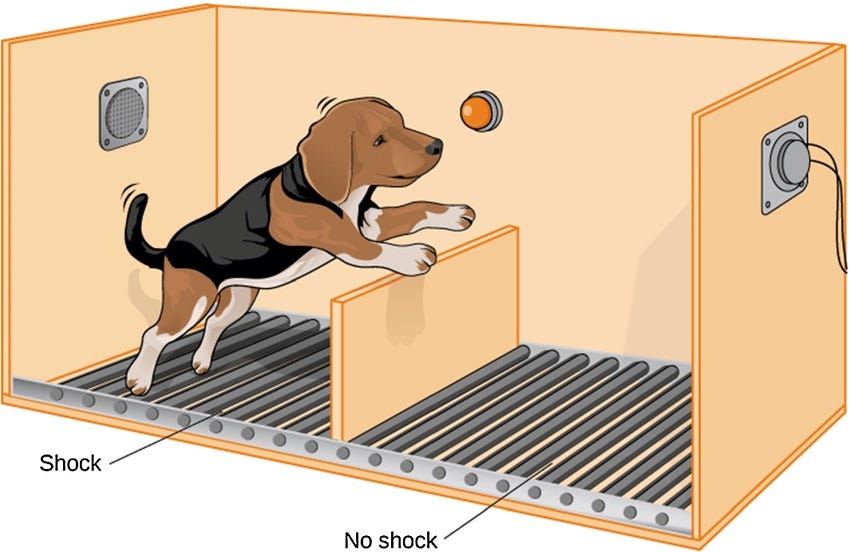
In 1967 a psychologist named Martin Seligman strapped dogs into harnesses and administered electric shocks they could not escape. He did this repeatedly, over time, until something happened that he had not expected. He moved the dogs to a new chamber, one with a low barrier they could easily jump, one where escape was simple, was right there, was a single step away.
The dogs lay down. They whimpered. They accepted the shocks.
They had learned that nothing they did mattered. They had learned this so completely, so deeply, so below the level of conscious thought, that when the world changed and escape became possible they could not see it. The barrier was low. They did not try.
Seligman called this learned helplessness. He meant it as a clinical term. He spent forty years refining the theory. Then, in 2016, his original collaborator Steven Maier published a paper in Psychological Review that overturned the foundational assumption.
Passivity in response to uncontrollable stress, Maier found, is not learned.
It is the default.
The brain’s baseline position is to assume that aversive events cannot be controlled. Passivity is not what the dogs learned from the shocks. Passivity is what was already there, neurologically, waiting. The serotonergic neurons of the dorsal raphe nucleus activate under uncontrollable stress and suppress the impulse to escape. This is the architecture the brain comes with. It is ancient, it is biological, it is not a failure or a weakness or a character flaw.
What Seligman’s dogs had to learn was not helplessness. What they had to learn was agency. What had to be acquired, practiced, repeatedly demonstrated, was the belief that their actions could change outcomes. Take that away and the default returns. The passivity that looks like defeat is not defeat. It is the brain reverting to its factory setting.
The aquifer under this ground has been dropping for forty years. In parts of western Kansas the water table is down more than two hundred feet since the 1950s. In January 2025 the Kansas Geological Survey reported it dropped another foot and a half in a single year, the steepest decline on record. The water that fell as rain and snow across ten thousand years and collected in the dark under the Plains, the water that made all of this possible, the farms and the towns and the particular American idea that ordinary people could build something out here, that water is going and it is not coming back within any timescale that matters to anyone alive.
Scottsbluff, Nebraska. Population 14,267. Declining at half a percent a year. On Main Street there is a shoe store that has been closing for three years, the going-out-of-business sign so weathered it has become part of the storefront, and a diner where the same four men sit at the same table every morning and talk about weather and water and what their fathers built and what is left. They are not defeated men. They are men who have absorbed a very long education in what cannot be changed, and the education has settled into them the way silt settles, quietly, without drama, until one day the channel is different and you cannot remember when it shifted.
The system extracted what it could from this place and moved on. It did not stay to watch the consequences. This is not new. This is the system. Trump is not the cause of this. Trump is what the system looks like when it decides the pretense is no longer necessary.
In 1963 the CIA produced a classified interrogation manual with the code name KUBARK. It was declassified in 1997 and you can read it now, all of it, in the flat bureaucratic prose of people who have thought carefully about how to break a resistant human being. I read it on a Tuesday morning at this same table, the wind outside, the coffee going cold. Chapter nine is titled Coercive Counterintelligence Interrogation of Resistant Sources. The chapter describes a methodology the manual calls DDD. Debility. Dependency. Dread.
You exhaust the subject. You make them dependent on you for the satisfaction of basic needs. You maintain a constant low-level dread, not the sharp terror that clarifies but the ambient fear that drains. The manual notes, with the flat precision of a technical document, that the threat of coercion is often more effective than its application. That sustained continuous pressure produces better results than acute violence. What you are trying to produce, the manual says, is regression. A reversion to an earlier behavior level. The loss of the capacity to carry out the highest creative activities, to meet new and challenging and complex situations, to deal with trying interpersonal relations, to cope with repeated frustrations.
The CIA was describing, in 1963, what Maier would confirm neurologically in 2016. Prolonged uncontrollable stress activates the dorsal raphe nucleus and suppresses the impulse to resist. The brain defaults to passivity. This is not metaphor. The manual was written by people who understood the neuroscience before the neuroscience was published, who understood it empirically, through application, through the testing of methods on human beings in rooms you do not want to imagine.
The methodology was refined in Latin America through the 1970s and 1980s. It appeared at Abu Ghraib. It has now, in a softer and more diffuse form, been turned inward. Not on prisoners. On a public.
Consider the delivery system. You wake up and before you are fully awake you have reached for the phone. That is not weakness. That is the variable reward schedule, the same mechanism that runs the slot machine, engineered by people who read the same behavioral literature you did and decided to use it differently. The news cycle never resolves, not because there is no resolution but because resolution would end the dread, and the dread is the point. You cannot determine what is true on a given day because the contradictory statements are not mistakes but method, if you cannot determine what is true you cannot determine what to do, and the incapacity to act is the goal. You cannot look away because looking away feels like surrender. You cannot keep looking because the looking is making you into someone who has absorbed so much that nothing absorbs anymore, someone who reads about children losing health care and feels something that is almost but not quite outrage, something flatter, something that has been to this place before and knows by now what it cannot change. The sheer volume of it is calibrated not to inform but to exhaust. This is not happening by accident. Debility is produced by the churn. Dependency is produced by the feed. Dread is produced by the accumulation of genuine harm, the people losing health care, the scientists losing grants, the neighbors losing status, the specific gravity of a country being reorganized around cruelty, arriving faster than it can be processed, faster than grief can form, faster than resistance can organize. The manual called this regression. The manual knew what it was doing.
Debility. Dependency. Dread.
Tell me that does not describe the second year.
In 1961 a psychiatrist named Robert Jay Lifton published a study of Chinese thought reform. He identified eight mechanisms by which a totalitarian system achieves ideological control without requiring that people actually believe what they are told to believe.
The sixth mechanism he called Loading the Language. The most far-reaching and complex of human problems, he wrote, are compressed into brief, highly reductive, definitive-sounding phrases, easily memorized and easily expressed. The language of non-thought.
Fake news. Enemy of the people. Domestic terrorist. Radical left. These are not arguments. They are not meant to persuade. They are designed to end thought before it begins. To take a complex situation and replace it with a phrase that signals where you stand. Once you have accepted the phrase, the analysis is done. The phrase is the analysis. The language has been loaded and the thought has been terminated and you did not notice it happening because it was not done to you violently. It was done to you through repetition, through the ambient saturation of a media environment, through the simple exhaustion of hearing the same phrases so many times that they start to feel like facts rather than weapons.
This is the second year. This is where Loading the Language completes itself. The first year you recognized the phrases as phrases. The second year they start to sound like weather.
In 1978 a Czech playwright named Václav Havel wrote an essay from inside a system that had been doing all of this for decades. He described a greengrocer who places a sign in his window among the onions and carrots. Workers of the world, unite. The grocer does not believe the sign. Everyone who passes knows he does not believe it. The sign is not communication. The sign is performance. It says, to everyone who sees it and to the system that requires it, I know what I must do. I can be depended upon. I am obedient and therefore I have the right to be left in peace.
Havel noted that if the greengrocer had been required to display the sign honestly, if the sign had read I am afraid and therefore unquestioningly obedient, he would not have been nearly as indifferent to its semantics. The lie has to be dressed as something else. The performance of compliance cannot announce itself as performance or it loses its function, which is not to communicate but to incorporate. To make you part of the system that requires the sign. To make you complicit before anyone has asked you to be.
I have been watching the signs in the windows for twelve months.
The journalist who calls a lie a misstatement. Not because he believes they are the same thing. Because calling it a lie has consequences and calling it a misstatement does not. He knows the difference. He is putting up the sign.
The elected official who says this is deeply concerning rather than this is corruption. Not because she cannot see what it is. Because the word corruption has consequences and deeply concerning does not. She is putting up the sign.
The academic who qualifies the unqualified, who adds nuance where there is no genuine uncertainty, who treats the documented as debatable because the documented stated plainly might cost him a grant, an invitation, a collegial relationship he has decided is worth more than his clarity. He is putting up the sign.
The friend who used to say the true thing and now says the careful thing and explains the difference as maturity. As strategy. As the long game.
The long game is what surrender calls itself when it wants to feel like wisdom.
I know this because I have played it. Six months ago a man I respect, a man who has spent his life in this community, said something at a dinner table that was not true and was not small and I let it go. I said hm. I reached for my water glass. I made the calculation in the space between his sentence and my response, the relationship, the room, the cost of the word that wanted to come out of my mouth, and I swallowed it. I told myself it wasn’t the right moment. I told myself I was thinking about the longer arc. I told myself a lot of things on the drive home and none of them were true and I knew it and I went to bed anyway and in the morning I had moved the baseline and called it morning and that is the whole story.
All of these people are performing what Havel called living within the lie. None of them were asked to. None of them were forced. The genius of the system is that it does not need to ask. The signs go up voluntarily, by people exercising rational judgment about costs and benefits, by people who have learned, through the ambient pressure of the second year, that the default is passivity and the passivity is safe and the barrier is there but the shocks are also still there and they have stopped trying.
This is what accommodation looks like from inside. Reasonable. Mature. Strategic.
Hannah Arendt sat in Jerusalem in 1961 and watched Adolf Eichmann explain himself. He had organized the trains. The schedules. The administrative machinery of murder at industrial scale. She expected a monster. What she found was a bureaucrat. Middling intelligence. Concerned with procedure. Eager to demonstrate his competence within the system he served. His defense was not ideological conviction. His defense was that he had tried, at all times, to act as the Führer would have approved. That his role was compliance. That the question of whether the system he served was monstrous was above his pay grade and outside his job description.
Arendt called what she saw the banality of evil. She did not mean that evil is ordinary. She meant that the most ordinary of human tendencies, the tendency to replace personal conscience with institutional expectation, the tendency to perform the role the system requires, can become, under sufficient conditions, an instrument of extraordinary harm.
When enough people put up the sign.
These are not metaphors. These are documented mechanisms. Studied in laboratories and classified documents and samizdat essays and courtrooms in Jerusalem. Being used right now, not by a single evil actor who has read the manuals, but by a system that produces them automatically, the way a depleted aquifer produces dry wells, the way a dying town produces empty storefronts, as the predictable consequence of the extraction that preceded them.
Trump is a fascist. His administration is corrupt. His policies are killing people and destroying the land and dismantling the machinery of collective life. Not as opinion. As description. Treating description as opinion is itself a sign in the window.
I want to tell you something about the cure.
Maier‘s 2016 paper did not only revise the theory. It identified what works. You cannot reason the passivity away. You cannot change the environment and wait for the brain to notice. The prefrontal cortex, the part of the brain that detects control, that registers that your actions produce outcomes, has to be activated. Has to be shown, through the act itself, through the moving of the legs over the barrier, that control is possible. The belief cannot be restored by argument. It has to be rebuilt through experience, through action, through the repeated demonstration that the barrier is low and the legs still work.
This is what I mean when I say refuse to be managed.
Not the grand gesture. Not the performative defiance I posted and deleted, the wink-wink I am a domestic terrorist that handed them ammunition and accomplished nothing. The precise, repeated, unspectacular act of saying the true thing in the true words. Taking the sign out of the window. Not because it feels powerful. Because the legs need to move. Because moving is the only thing that rebuilds what the shocks have been trying to take away.
I have done this once in a way that cost me something real. Years ago, in a different life, in a conference room that smelled like recycled air and the particular confidence of men who have never been told no, a man said something that was racist and misogynist and I had been watching people let it pass for two years. The room was full of the kind of people who know exactly which way the wind is blowing and position themselves accordingly. It was probably a mistake to say anything in front of them. I said it anyway. Not loudly. Not with a speech. Just that I would not sit in a room and let that stand, and why, in the true words in the true order, plainly, in a room where plainness was not welcome. The relationship ended. The invitation stopped coming. I drove home and my hands were shaking and I did not know if I had been brave or stupid and I still do not know. What I know is that from that day forward they knew who I was. That is its own kind of cost and its own kind of freedom. And I know that saying it changed something in me that the not-saying had been quietly undoing. The legs moved. That is all. That is enough.
The Ogallala dropped another foot and a half in 2024. The towns are emptying. The language has been loaded and the thought-terminating clichés are ambient and the signs are in the windows and the dorsal raphe nucleus is doing what it was designed to do, what it has always been designed to do, which is tell you that the stress is uncontrollable and the rational response is to lie down and wait.
But here is the thing that Maier found that matters most.
The passivity is the default. Agency is what has to be learned. And once it is learned it changes the brain. An animal that has learned control, that has experienced its own actions producing outcomes, responds differently to uncontrollable stress afterward. The prefrontal cortex activates. The dorsal raphe is inhibited. The passivity does not take hold. Not because the stress is gone. Because the brain has learned that stress is not the end of the story.
This is not metaphor either. This is what the act of speaking does, what the act of refusal does, what the act of taking down the sign does, even when no one sees it, even when it costs you, even when the second year has made it feel like it cannot possibly matter.
It changes the brain. It rebuilds the architecture of agency. It is the only thing that does.
The wind outside never stops. It came across a thousand miles of nothing before I was born and it will come after. It does not know what year it is. It does not know about the dorsal raphe nucleus or the KUBARK manual or the greengrocer in Prague or the bureaucrat in Jerusalem who decided his conscience was above his pay grade.
It just comes. It just keeps coming.
The coffee is cold. I notice this.
I notice this.
Here is how Substack works.
The algorithm surfaces paid publications. The discovery tools favor paid publications. The recommendations flow toward paid publications. A free publication…regardless of what it says, regardless of how well it says it…becomes invisible. Not banned. Not censored. Just quietly, efficiently disappeared by a business model that has no interest in voices it cannot monetize.
This is the mechanism. This is what they are counting on.
I have been writing for two years. I have said the true thing in the true words, without flinching, without softening, without putting up the sign. That has a cost. You know this because you are still here.
A paid subscription is how you keep this voice in the room. Not for me. For the argument. For the people who need someone to call the thing by its actual name.
The barrier is low. The legs still work.
If you have been reading and you are able,
paid subscribers keep this from going dark. If you cannot, forward it to someone who might. That is also how this works.
To everyone here, paid and free,thank you. Showing up in the second year, when showing up costs something, is not nothing.
It is everything.
Excellent points, Tom, and so much here. I want to focus on water.
I grew up in Tucson, which relies on groundwater. When my grandmother was born in 1901, the Santa Cruz and Rillito Rivers still ran much of the year and shallow wells near town could reach potable water at modest depths.
The name Tucson comes from the Native word for "spring at the foot of the black mountain." My father, living in my grandmother's 1898 territorial house surrounded by a half-acre of lawn, was appalled at a 2200.00 water bill. Letting the lawn die was out of the question, because the huge trees relied on the lawn to stay alive, so he was stuck with the bad decisions of the 1890s colonial mindset (along with the giant windows that my great-grandmother Henrietta Herring Franklin had insisted upon).
Dad checked the statutes and found he could in fact drill his own well. After the initial outlay of several thousand dollars, he would be free from that egregious bill every month.
Wasn't he surprised when he drilled down hundreds of feet into the greatly depleted aquifer and still pulled water so silty it needed extensive filtration to even be usable. The well driller advised him to go deeper because the water table was going to keep dropping until it was gone.
Tucson is one of the largest cities in North America that still lives almost entirely on groundwater, drawing everything it serves from the aquifer beneath its feet even as levels and quality decline.
Meanwhile Las Vegas, watching Lake Mead drop toward historic lows, is learning what it means to hitch a whole metropolis to the visible end of the Colorado, just as the Ogallala states are learning what it means to have spent a continent‑sized, mostly invisible reservoir that does not come back on any human timescale.
When the taps are turned and the faucets spout dust, we’ll see the wealthy siphon and store the remaining water while the poor are left to die of thirst, because that is how scarcity has always been managed in the American West.
When the Ogallala is sucked dry (as the data centers accelerate this like the end of a double-black diamond ski run, America;s High Plains breadbasket will start to go the way it did in the 1930s). Wells fail, fields go dry, and a region built on temporary bounty discovers that the aquifer it treated like a bottomless cistern will take thousands of years to refill. Your moniker will be even more appropriate, except this time there is no California to which you can escape.
But don't worry. The billionaires will be fine.
I've been reading about the Ogalla Aquifer since I read Centennial in the late 70s. That's what sparked my interest in water issues in the West.
I've never been able to keep my mouth shut about anything I see as unfair or wrong. It never made me unpopular with my employers right up to the end when I was downsized for being too old, too highly paid, and too mouthy. And I don't regret a fucking bit of it. And I haven't changed. Better to die on your feet than live on your knees. My Dad was at Normandy and the Battle of the Bulge. I can't let him down now.
Sharing with my subscribers tomorrow.