

The Product
On what was taken, who took it, and the man they made inevitable

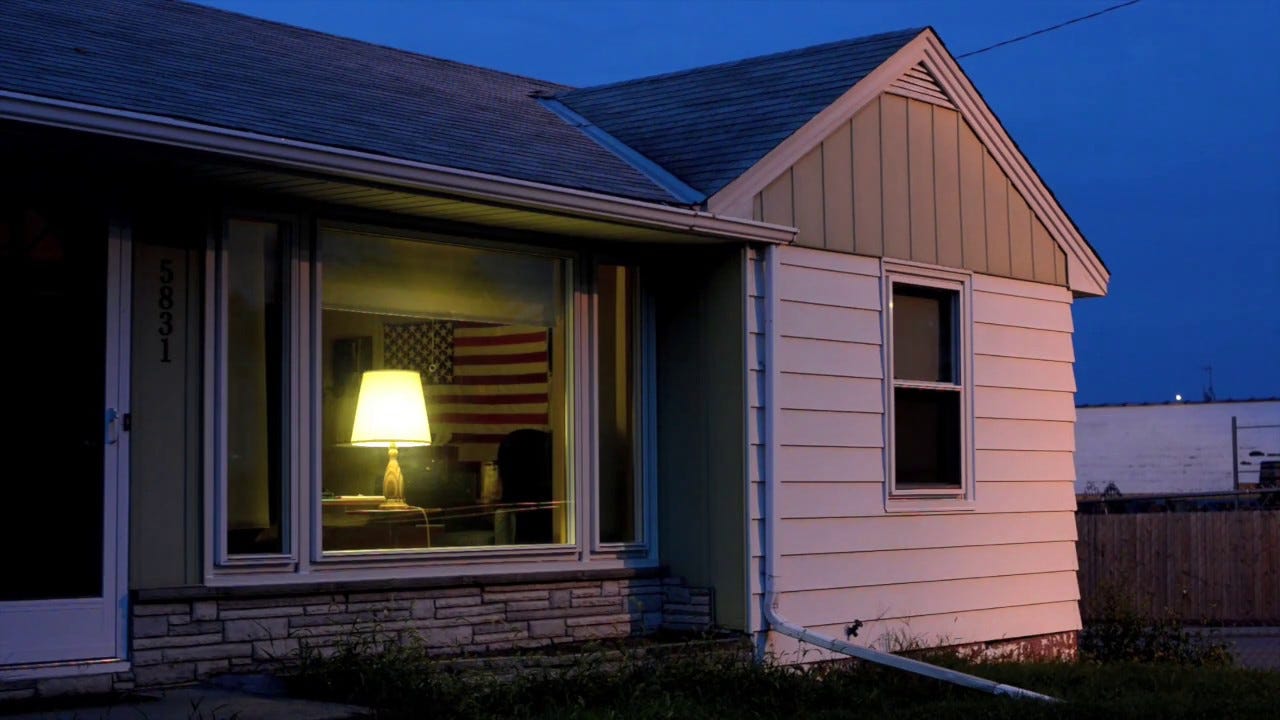
The urn is on the second shelf of the entertainment center, between a photograph of Christopher Jr. at his high school graduation and a Wilkes-Barre Penguins bobblehead someone gave him the Christmas before the last Christmas.
The tree is not there.
There ain’t no Christmas.
Christopher Jr. started smoking pot at thirteen. Graduated to harder drugs the way kids in Wilkes-Barre graduated,not with ceremony, not with choice exactly, but with the logic of a place that had been emptied of everything else. He went to rehab. He came back. He went again. Between the first time and the last time, Diane and her husband Christopher Sr. attended fourteen funerals of their son’s friends. Fourteen. One year. They’re dropping like flies, he said. Every day.
Christopher Jr. died.
I am not here to explain why Diane Kohler voted the wrong way or held the wrong beliefs or failed to understand her interests correctly. I am here to explain who put her son in that urn. Those are different stories. This country has told the first one for thirty years while the people responsible for the second one went to the fundraiser.
They had jobs. Real ones.
The kind that let a man without a college degree buy a house, send his kids to school, retire without eating dog food at seventy-three. The kind that came with a union, which meant there was somebody in the room when the decisions got made who was paid to give a damn whether you lived or died.
The jobs went to Mexico. Then to China. Then wherever the labor was cheapest and the laws were loosest and there was no one in the room.
This did not happen because of market forces. Market forces is what they were told, as if the market were weather, impersonal, inevitable, nobody’s fault. It happened because specific men made specific decisions to move specific operations across specific borders to pay specific workers less money with no benefits and no protections and then ship the product back and sell it to the people whose jobs they had just taken.
Those men are still alive. Most of them. They live in houses with gates. They sit on the boards of universities. They give money to both parties.
Not one of them has spent a night in a living room in Wilkes-Barre, Pennsylvania, with an urn on the shelf where the Christmas tree used to be.
Not one night.
The last factory in Luzerne County closed on a Thursday in March 2008. There is a man named Dale Kopecki who worked that plant for twenty-two years, started at nineteen, made $24.50 an hour with benefits, drove a Silverado, coached Little League on Saturdays. When the plant closed he was forty-one years old and the next job paid $11.75 and didn’t have benefits and was forty minutes away. He is fifty-eight now. He voted twice for Barack Obama and twice for Donald Trump and if you ask him about it he’ll say: I don’t know what else to do.
The pension disappeared. The union broke. The hospital closed, thirty-one rural hospitals closed between 2010 and 2020 in the places that were already the most damaged, because a hospital in a poor town is not profitable, and in this country if it is not profitable it does not exist.
Then the opioid came in.
Purdue Pharma knew. Their own researchers told them in 1999 that OxyContin was being abused at rates far higher than they were admitting publicly. They buried it. They hired more sales reps. They gave doctors gifts, junkets, the implicit assurance that the science was settled when the science was purchased.
Between 1999 and 2019 half a million Americans died of overdose. The majority of them were working-class men and women in the places that had been emptied. Luzerne County. Scioto County. McDowell County. The places with a Dollar General and a pain clinic and a cemetery that keeps getting bigger.
The Sackler family made thirteen billion dollars.
They have not spent one night in a living room with an urn on the shelf.
There is a product liability settlement and a bankruptcy filing and a family whose name is on museum wings that are being quietly removed. There is a son who is ash in a container in Wilkes-Barre, Pennsylvania, next to a Penguins bobblehead and a graduation photograph.
That’s not a market. That’s a theft.
And the people who did the stealing are still at the table.
Here is what they got in exchange for all of that.
Not money. Something cheaper to produce and in the short run more powerful: the assurance that no matter how bad it got, they were above somebody. The floor. The knowledge that the system, whatever else it did to them, was not designed specifically to grind them down. That they were on the right side of the line.
A man with nothing will defend the feeling of status the way a drowning man defends the one thing floating. He will defend it against the people one rung below him on the ladder because those people are the only proof the rung exists.
Do not make the mistake of treating this as nothing. For a man whose material world was being taken apart piece by piece, the job, the pension, the union, the hospital, the town,the feeling of status was the only wage left. Take that away too and there is nothing to grab on the way down.
But it was a con.
Paid in place of the real thing, security, power, investment, a future,because the real thing would have required giving it to everyone, and giving it to everyone would have threatened the people doing the robbing. So they gave the feeling instead of the substance. The identity instead of the life.
They built media properties specifically designed to sustain it. They told these men their enemies were the Black family down the street, the Mexican at the border, the coastal elite who laughed at their accent, their church, their flag. They broadcast this every day, with enormous sophistication, through channels that felt like home, in a language that felt like common sense, to people who were genuinely hurting and needed someone to blame.
Not once did they mention the man who closed the factory.
Not once did they name the board that broke the union.
Not once did they say: the people funding this broadcast are the people who took your pension and put the opioid in your town and have not spent one night in your living room and will not spend one night in your living room and do not know your name.
They aimed the anger carefully, away from themselves, at people who were also being robbed, and called it politics.
They did this for fifty years.
And in a living room in Wilkes-Barre, Pennsylvania, a boy who had no future and knew it started smoking pot at thirteen, and the anger was already loaded and aimed and waiting, and none of it,not the rehab, not the fourteen funerals, not any of it,was an accident.
Kevin Phillips was twenty-five years old when he designed it.
Harvard-trained. Precise. Not a racist in any operatic sense,a technician who looked at the Civil Rights Act of 1964 and saw not a moral achievement but a political opportunity. The Democratic coalition had cracked. Millions of white voters felt the ground shifting and didn’t know where to stand.
He knew where to put them.
In 1970 he told the New York Times: the more Black voters who registered as Democrats, the faster white voters would become Republicans. That’s where the votes are. He said it in plain English in the paper of record.
Nothing happened to him. Because it was true and useful and the people it served had the power to make sure nothing happened.
For fifty years the formula ran. Find the grievance. Name the target. Win the election. Cut the taxes of the people who funded the operation. Willie Horton. Welfare queens. Illegal aliens. The caravan. Each cycle a fresh target, identical mechanism: recruit the anxiety, aim it at the wrong people, harvest it on election day, go back to work for the Chamber of Commerce.
The men running this knew exactly what they were doing. They counted on the base never figuring it out.
The other party watched this happen for fifty years and made its own calculations. Bill Clinton signed NAFTA in 1993. I remember my father watching the signing on the evening news, the Datsun in the driveway, the Sugar Factory smell coming through the screen door. He didn’t say anything. He turned off the set and went to bed. Clinton signed the repeal of Glass-Steagall in 1999. Barack Obama bailed out the banks and the banks paid bonuses with the bailout money and not one of them went to prison and the people who lost their houses lost their houses and that was the end of it. The Democratic Party decided somewhere in the 1990s that the future was the college-educated professional class and the working class would have nowhere else to go.
They were half right. The working class had somewhere to go.
They went to Trump.
What they didn’t account for, either party, was two wars that solved nothing and killed the kids from Wilkes-Barre, not the kids from Georgetown. A base that had been told the system worked for them, and then watched it demonstrably not work, and finally ran out of patience with being told to wait.
The base looked at the establishment and understood.
The donor class was the enemy. The establishment was the protection racket.
They were not wrong.
They were catastrophically wrong about what to do next. But they were not wrong that something had been done to them. Not wrong that the system had been running against them while telling them it was running for them.
The crime was real. The verdict was wrong.
The sentence is all of us.
I live in Scottsbluff, Nebraska. Population: 14,323. Median household income: $53,448. Distance to Wilkes-Barre: 1,400 miles.
It is no distance at all.
The Sugar Factory is still running. Has been for a hundred years, processing beets pulled from the alkaline flats west of town. On certain nights you can smell it from the porch,sweet, industrial, wrong in a way you stop noticing after a while. The smell of a place that still has one thing left. Everything else is going. JCPenney closed in 2012. Herberger’s in 2018. The Albertson’s on Avenue B has been dark for years, the parking lot cracked and empty, the sign still up because taking it down would require admitting it isn’t coming back. There is a FOR SALE sign on the Millers’ house that nobody has bothered to remove in three years, because removing it would require believing someone was coming.
Nobody is coming.
I am sixty-six years old and I smoke Romeo y Julietas on the porch and I have watched this town empty the way you watch a man bleed, slowly, then all at once, and then you are standing there wondering when exactly it became too late. My father voted in every election from 1946 until he couldn’t. He believed in the machinery the way men of his generation believed in it,not with enthusiasm, with duty. He drove an ‘80 Datsun pickup. He didn’t talk about his feelings. He died in 1993 with $250,000 in medical debt that he had fought to pay until the day he couldn’t fight anymore.
He thought the machinery was going somewhere.
He thought if you kept your head down and did the work and voted and paid your taxes the machinery would eventually get around to you.
It didn’t get around to him. It didn’t get around to Diane Kohler. It didn’t get around to the fourteen families who buried their kids in one year in Luzerne County while the Sackler family counted the money and the men who closed the factories sat on the boards of universities and the political class went to the fundraiser.
I am not writing about Wilkes-Barre from a distance.
I am writing about Wilkes-Barre from a town that is Wilkes-Barre with a different name, fourteen hundred miles west, where the anger has been recruited and aimed and nobody in a position of power has spent one night on this street trying to understand what was taken and who took it.
Diane Kohler is not an abstraction to me.
She is my neighbor with a different zip code.
Trump walked in and turned on the lights.
He didn’t build the room. He didn’t wire it. He didn’t spend fifty years filling it with people who had lost everything and been handed a story about who to blame. He walked in, read it in thirty seconds, and understood something that every credentialed political professional had somehow missed:
These people were not looking for a policy platform.
They were looking for a man who would fight.
Not fix. Fight. You fix a problem when you believe the system can be made to work for you. You fight when you have concluded it can’t,when you have watched it be fixed repeatedly and each fix made the fixers richer and your town emptier, and you are done believing in the fixing.
He named their enemies and attacked without apology. He broke every norm the establishment held sacred and each breaking was a proof. Every outrage from the media class was a demonstration that he was in the right fight. Every indictment was a credential.
None of this was true. He was a con man running a protection racket for the same donor class they hated. His tax cut gave $1.7 trillion overwhelmingly to corporations and the wealthy. The factories did not come back. The towns did not fill. The opioid kept arriving. The shelf is still in the living room.
But he said their name.
He stood in front of the people the country had emptied out and said: I see you. I know who did this. I will make them pay.
Nobody else had. Not in a long time. Not without the careful managed language of people who had a donor call at six and needed to be home for the fundraiser.
He said their name, and in Wilkes-Barre, Pennsylvania, in a living room with an urn on the shelf, that was almost enough.
Almost.
Tom Welkey is retired, Wilkes-Barre. He voted for Trump and then said quietly: I like what he’s done with the military but around here I haven’t seen anything change. There haven’t been any new jobs.Saying it the way a man says a thing he already knew would be true and voted anyway because at least someone was swinging. He voted for the fire and the fire didn’t warm him. He is still in the cold. He will probably vote again the same way because the cold is still there and the man is still swinging and nobody else is even in the room.
There is a veteran who did two tours in Kandahar and came home to Wilkes-Barre in 2011 and found the job gone and his father’s house underwater and the town hollowed to the studs. He is sleeping in the second bedroom of his sister’s place on Carey Avenue. The opioid was already there when he arrived, already in the medicine cabinet, already in the circle of people he grew up with, already waiting the way the place had been waiting,patient, ready, with nowhere else to be. It found him in about four months. Nobody was surprised. That’s the part that should haunt us. Nobody was surprised.
There is a woman in Youngstown working two jobs who cannot afford the insulin her husband needs and votes against her interests, they say. Which assumes she miscalculated. Which assumes she hasn’t been lied to, systematically, for decades, about what her interests are and who serves them. She knows what the system has done for her. She is not confused about it. She is making a different bet. You can think the bet is wrong without thinking she is stupid.
Learn to code. That’s what they said. The columnists, the Twitter accounts, the people with the right opinions and the right credentials and the apartments in the right cities. Learn to code. Said to a fifty-three year old man whose father worked the same plant for thirty-one years, said with the absolute confidence of people whose towns were not empty, whose kids were not in the spare bedroom, whose hospitals had not closed. Learn to code. It was the most honest thing they ever said. It said: we have decided you are not our problem.
The people reading this, if they are honest, know which side of that line they were on.
These people were owed something. Not charity. Not sympathy. The basic return on the work they did and the country they built, which is the only contract democracy actually makes: that the place you live will not be stripped and abandoned for someone else’s profit while the people doing the stripping use your anger to win their elections.
They did not get what they were owed.
They got Trump instead.
Which is what you get when you rob people long enough and aim their anger carefully enough and give them nothing real for long enough.
You get the man who says their name.
You get the fire you spent fifty years building.
The people who should answer for what is happening right now are not the people in the MAGA hats. The people in the MAGA hats were worked. The people who built the operation,who funded the media, recruited the anxiety, aimed the anger, ran the con for fifty years, and then looked at January 6th with genuine surprise as if they had not built every single thing that made it possible,those are the people the history should name.
It probably won’t.
The people who run the operations rarely end up in the accounting.
But Diane Kohler is in the accounting.
She is in it whether she wants to be or not, whether anyone in a position of power ever spends one night in her living room or not.
The entertainment center is fake wood laminate, the kind sold at Walmart, the kind that swells at the corners if it gets wet. The photograph is a five-by-seven in a metal frame. Christopher Jr. is wearing a blue tie, too short, the way young men wear ties when they’re not used to them. He is smiling like he knows the picture is being taken.
The urn is next to him.
There ain’t no Christmas.
The men who put him there are at the fundraiser.
The bobblehead still has his head.
If this piece meant something to you, the most useful thing you can do is become a paid subscriber. Not because the work is going away…it isn’t…but because independent writing about the things that actually matter to people who actually matter requires someone to pay for it, and I’d rather that someone be you than anyone with a different agenda. There’s no algorithm here. No advertiser. Just the work, and the people willing to fund it.
Excellent as always Tom!
The thing I can't figure out is why so many people couldn't see through him immediately like I did. I've lived many of the stories in this piece. In 1980, 2 weeks before getting married the company broke our union and laid us off. The company that took over the warehouse operation offered me my old job back at half what I'd been earning. I drew unemployment and worked under the table for several months before I found another job. In 2006 the same thing happened again with a much larger company. 600 Operating Engineers out of work overnight. Then came 2008 and it wiped out 30 years of building and remodeling houses in addition to my regular job. Along with a divorce I got to start over at 50. But I never fell for the republican propaganda that blamed everything on immigrants and non white people. Maybe because I always read extensively and only watched TV for entertainment and listened to the radio for music. I'd always voted for the person, not the party until Trump came along and turned the GOP into a modern day Nazi party. Now I'll never vote anything but Blue. They sure as hell aren't perfect, but compared to the alternative they're the only choice.
I want to send this to friends who say they’ll never forgive Trump’s base for voting for him. It’s not an excuse… but maybe it’s a window into how this could happen.