

The Permission
This is about men. It has always been about men.

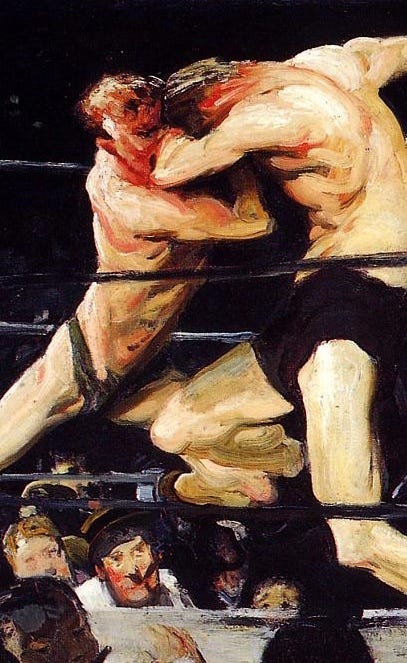
I was a young boy when I first felt it. My sister was ten years older than me, old enough to seem fully grown to a boy my age, and I remember being afraid someone would hurt her. I could not have told you who. I could not have told you how. Nothing had happened that I knew of. I was just afraid, the way a boy is afraid of the dark, except this fear had a shape and the shape was a man I would never meet, doing something to my sister that I would never see.
I did not have words for it then. I am not sure I fully have them now. But I have carried that fear for sixty years, and the terrible thing is that it was never wrong. Not about her specifically, as far as I know. But about the world. The fear was accurate. It just took me decades to understand why a boy would feel it before anyone taught him to.
I have lived a long time since that boy stood in that house worrying about his sister. Long enough to have known a lot of women well enough to know the truth about what happens to them. Most of the women I have loved, known, paid attention to over sixty-six years have been hurt by a man. Not all of them. Most of them. I am not talking about rudeness or the ordinary damage of ordinary relationships. I am talking about real damage. The kind that does not fully heal.
I have five daughters now. I think about that boy at the window of his own fear every time I think about them.
I am not writing this to explain anything to women. They know. They have always known, long before they had words for it either. I am writing this to talk about men. What we built. What we allow. What we profit from. What we owe.
This is not about women.
This is about us.
I
This is happening to boys right now, in houses all over the country. It starts somewhere ordinary.It starts with a boy and a search bar.
Fifteen, sixteen, alone at eleven at night, typing something into Google because he is lonely and confused and looking for a way to feel less like he is failing at being a person. The algorithm receives him like a gift. What comes back is more than he asked for. Fitness. Discipline. Cold showers. He watches. It adjusts. Within weeks the language has shifted into alpha and beta, winners and losers, and women have become the subject. Not people. A problem to be managed.
He does not notice the shift because it happens the way all the important shifts happen. Gradually. One day he wants his life together. The next he has a theory about why women are what’s wrong with it.
The forums finish the job. Loneliness gets renamed weakness. The cure for weakness is contempt, because contempt feels like power and loneliness does not. An enemy is easier to carry than confusion.
We built that pipeline. Men did. Men profit from it. Men look the other way while it runs. And somewhere a different boy, a better one, is standing in a house afraid for his sister and doesn’t yet know that the fear and the pipeline come from the same place.
II
In 2015 a man came down an escalator and told the country that Mexico was sending rapists across the border, and the men who would later hold microphones on White House lawns were watching.
You know what he is. What matters here is what he proved. That a man could say anything about women, do anything to women, be found liable by a jury for sexual abuse, be credibly accused by more than twenty women, and still win. Win twice.
What does a boy learn from that. He learns the pipeline was right. He learns the rules are for losers. He learns the permission is real because the man at the very top has it and uses it and is rewarded for using it.
The permission travels downward. It always does. From the man at the podium to the influencer to the boy in the forum to his younger brother watching what goes unpunished. And then a fighter wins a bout on the White House lawn on the president’s birthday and says into a held microphone, Michelle Obama is a man, am I right America, and some of the crowd cheers and the President smiles and by morning ten thousand boys have learned the lesson again.
I think about the fear I carried for my sister before I had a name for it. I think about how that fear is still correct, decades later, just aimed at different women now. My daughters. Somebody else’s sister.
III
The target was not random. Michelle Obama is the particular kind of woman this machine has spent years teaching boys to resent. Tall. Brilliant. Unapologetic about taking up the space she earned. The insult is not a sincere claim, nobody saying it believes it, it is a tool for putting a woman back into a category small enough to manage.
Men have done this to her for eighteen years. It did not start on that lawn. It will not end there.
I am not going to describe what it costs her to carry it. That is not mine to describe. What I will say is this: men did that. Men built the lie, circulate the lie, reward the men who repeat it, and have done so for eighteen years without consequence. That is on us.
IV
Here is what actually happened, plainly, in case you missed it. Josh Hokit, a heavyweight fighter, won a bout on the White House lawn during a UFC event held for America’s 250th birthday. He had just beaten Derrick Lewis. He was handed a microphone, the same microphone Joe Rogan holds after every fight, and instead of talking about the win he looked at the crowd and said Michelle Obama is a man, am I right America. This was not his first time saying it. He said something nearly identical after a fight in May of last year, and he called Brittney Griner a man back in January. Dana White knew this about him beforehand and put him on the card anyway, telling a reporter that bad things were going to be said, he could almost guarantee it. They were said. The crowd’s reaction was mostly stunned quiet, some boos, some cheers. The President was nearby and was seen smiling. Nobody pulled the microphone away. Nobody walked him off the stage. The White House communications director, asked about it afterward, said the fighter had a great win and showed toughness.
That is the whole incident. A man said something cruel and false about a private citizen who has done nothing to him, on federal property, at a presidential event, and the worst consequence he faced was that some reporters wrote about it. He will fight again. He will get another microphone. He will say something like it again, and the reaction will tell him the permission still holds.
V
The boys in the pipeline are not villains. They were lonely and were handed an enemy instead of an answer. They deserved better than what men gave them. Maybe, somewhere underneath the contempt they’ve been taught, some of them are afraid too, the way I was, and just don’t have the words yet either.
The villains are the men who built the machine and run it and profit from it, and the man who made all of it presidential by standing at the top of the permission structure and smiling and calling it strength.
They know what they are doing. They are doing it anyway. They will keep doing it until the cost lands on them instead of on the women paying it now.
VI
I have never been able to fully explain that old fear, even to myself. My sister was never harmed, not that I know of, not in the way the fear imagined. But the fear was not really about her. It was about the world she was walking into as a young woman, a world I could sense even as a boy without anyone explaining it to me. Boys know more than we give them credit for. We just don’t always know what to do with what we know.
I have known women my whole life since then. A large majority of the ones I have known well enough to hear the truth have been hurt by a man. I am sixty-six years old and that number has not gone down.
I do not know if it is getting worse. Maybe the media just shows us what was always there in the dark. I have tried to be fair to that possibility. But here is what I know. It is not getting better. The boy who was afraid for his sister sixty years ago would not be surprised by a single thing happening now. Better would not look like a White House lawn with a microphone and a smile and a crowd that did not know what to do with its own silence.
This is not new ugliness. It is old ugliness with a bigger stage, a louder microphone, and a profit margin nobody is ashamed of anymore.
Somewhere tonight there is a boy standing in a house, afraid for his sister or his mother or a girl he has not met yet, and he does not have words for it either. I hope someone teaches him what to do with that fear besides carry it quietly for sixty years the way I did.
I have five daughters. I think of that boy I was every time I think of them.
I am not proud of my gender’s record on this. I am not proud of how long I carried that fear without ever turning it into anything. I have been turning it into something now for a long time. For my sister, all these years later. For my daughters. For every woman I have known who deserved better than what men gave them.
It is not enough. But it is no longer quiet.
A note on paid subscriptions
I have written close to two thousand words tonight that started with a boy standing in a house sixty years ago, afraid for his sister, and ended with that same fear, still correct, still unresolved, aimed now at my five daughters and every woman like them. I did not write it for clicks. I wrote it because the alternative was staying quiet, and I am done with that.
This newsletter will stay free for anyone who needs it to be free. I am not going to lock the hard pieces behind a wall, because the people who most need to read something like this are not always the people who can pay for it.
But if you are able to, a paid subscription is what lets me keep writing the pieces that take this long to get right. Not the quick takes. The ones I sit with for days, rewrite five times, throw out and start over when the first version isn’t honest enough. Eight dollars a month, less than what most people spend on a single coffee run, goes directly toward the time it takes to write something true instead of something easy.
If this piece cost you something to read, even a little, consider letting it cost you something small in return. It keeps this place independent, ad-free, and accountable to nobody but the readers who choose to support it.
Subscribe if you can. Share it either way. That matters just as much.
If this piece mattered to you, share it with a man.
Great post, Tom. Generational misogyny is a relay race, with men handing off the same batons. Stories, laws, aesthetics, “traditions” all while pretending to be surprised when women keep getting bruised by them. Hemingway is an example of how a male writer can be both formally brilliant and structurally incurious about women at the same time. His female characters are often vividly sketched yet weirdly under-souled, defined by how reliably they orbit male damage rather than by interiority of their own. You can always tell what the writer thinks of women when he starts with her appearance. Hemingway's best-realized woman character was Lady Bret Archer, and she was a vapid and pathetic party girl seemingly grafted from Fitzgerald's Daisy: an icon to be worshipped, but with the writer's scorn baked in.
I think of Alison Bechdel's test, a comic that became a diagnostic tool. Two named women who talk to each other about something other than a man. It's an excellent Geiger counter for background levels of male-centered storytelling that we’ve normalized, and it's alarming how in 2026 how few of the movies and books pass it.
The awkward truth is that an enormous swath of the canon from Hemingway to prestige TV fails even this low bar, which shows the narrative pipeline that still assumes men as protagonists and women as atmosphere.
Stieg Larsson’s original Swedish title is not The Girl with the Dragon Tattoo but Män som hatar kvinnor—Men Who Hate Women. American publishers softened that into something quirky and marketable, sliding the emphasis from a culture of male violence to the body art of the one woman trying to survive it. They changed Salander from a woman to a girl, and while the character is deep and nuanced, Larsson uses the POV of the men around her to show how she's perceived. They always start with how she looks. The retitling is a confession that even when a man finally names the thing straight on, the market flinches and re-centers the male gaze in an attempt to sell misogyny as edgy entertainment rather than an indictment.
The Equal Rights Amendment was written in 1923, passed by Congress in 1972, and then left three states short of ratification when the deadline expired in 1982. A century after it was drafted, women can be President or Speaker but still lack explicit constitutional protection against sex discrimination. Women are paid less in virtually every job outside of the porn industry. Women have always written, painted, organized, and governed; the archive is full of them if you bother to look. What we call “greatness” is often just the residue of which men got to decide whose work mattered, whose books got preserved, whose signatures made laws.
The contemporary tradwife aesthetic is a reactionary fantasy layered over misogyny. Instagram softness blurring over the entrenched legal and economic order where male authority and female dependence remain structurally rewarded.
It dresses hierarchy up as choice, as if multigenerational female disposability is a lifestyle brand. Erika Kirk is a prime example, but in Trump's orbit women are wholly interchangeable just as they are on Fox News.
Men built the systems that treat women as supporting characters and raised daughters and sons inside those systems. The hard-coded misogyny feels like weather instead of design.
Calling this out is the first step in refusing to carry the baton any farther.
Thank you for using your voice to decry oppression and violence. It’s not easy to call out a powerful group that you belong to, but the people that share the identity of an oppressor are the best ones suited to make a dent. Its why Christians, straight people and white people also need to stand up and speak out in defense of our fellow human beings. ❤️