

The Passing
East Orange, New Jersey February 1961

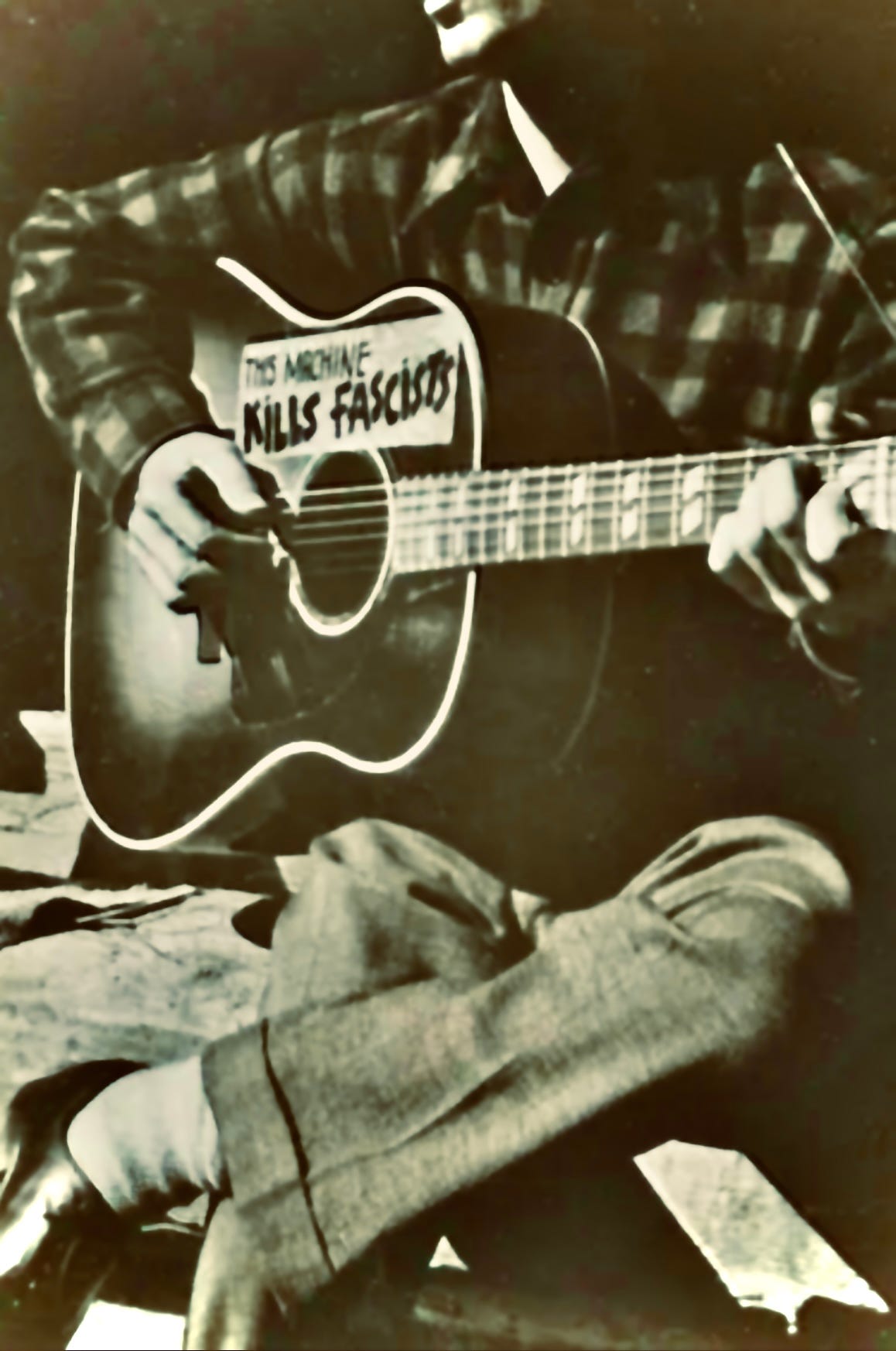
The apartment in East Orange smelled like instant coffee and cigarettes and something else, something medicinal that clung to the furniture. It was a Sunday in February 1961, though it could have been any Sunday that winter, the kind of gray afternoon when the light came in weak through the windows and stayed that way until it gave up entirely. Bob Gleason had left the door unlocked because people knew to come on Sundays. They came for Woody.
The kid showed up around two. He was nineteen but looked younger, with that baby face and the consciously rumpled clothes, the jacket too thin for the weather, the kind of thin that said something about where you came from and what you wanted people to think about where you came from. His hands were red from the cold. He carried a guitar case covered in stickers and grime, and when Sidsel Gleason let him in she noticed the way his face changed when he asked if Woody was awake. Something naked in it, something that looked like need.
Woody was in the chair by the window.
This is what you need to understand about Huntington’s: it makes you into something you didn’t ask to be. The involuntary movements, the jerking limbs that looked like restlessness or impatience but were neither. Woody’s hands shook on the armrests. At forty-eight he looked seventy, all angles and hollows, the flesh burned away by something working inside him like weather on wood. But his eyes were still good. His eyes found the kid across the room and his whole face changed, lit up in a way that the disease usually didn’t allow.
“Brought the Gibson,” the kid said, and his voice cracked a little on the second word. “Thought maybe we could”
Woody made a sound that was yes, that was always yes when the kid walked in. The kid understood. That was the thing about them,they’d developed a language that didn’t require words to be complete, that worked in the spaces between speaking.
He set the guitar case down and took off his jacket. Underneath he wore a flannel shirt that had seen better days, the elbows worn through. He smelled like the subway and tobacco and youth, that particular scent of someone whose body is still building itself. He pulled the chair close to Woody’s, close enough that their knees touched, and opened the case.
For a moment he just sat there, looking at Woody. Really looking. The way you look at someone you love when you think they might not be here much longer. Woody’s head was doing that jerking thing it did now, that motion that looked violent but that the kid had learned wasn’t painful, was just the disease speaking in its own language. The kid reached out without thinking and put his hand on Woody’s knee, steadying, grounding. Woody’s shaking slowed under the touch.
“Missed you this week,” the kid said quietly. “Played the Gaslight on Tuesday. Kept thinking about what you’d said. About the spaces between the notes mattering as much as the notes.”
Woody’s mouth worked. The disease had taken his voice down to a register of grunts and approximations, sounds that his wife Marjorie said she could still understand but the rest of them mostly couldn’t. The kid understood. Or had learned to. He’d spent enough Sundays here now that he could read Woody’s face, could hear what the broken sounds were reaching for.
“Miss,” Woody managed, and then his hand came up, shaking, and touched the kid’s face. The gesture was tender and violent at once, the fingers trembling against the kid’s cheek, and the kid closed his eyes and leaned into it.
“Yeah,” the kid said. “Me too.”
They sat like that for a moment, the kid’s hand on Woody’s knee, Woody’s hand on the kid’s face, and what passed between them was the thing that had no name. It was bigger than music and smaller than music at the same time. It was the way the kid had started showing up every Sunday without being asked, the way Woody’s face changed when he heard the kid’s footsteps in the hall. It was the way they’d sit for hours sometimes not even playing, just being in the same room, breathing the same air.
The kid opened his eyes and Woody’s hand fell away, the shaking too much to sustain the gesture. But the kid caught the hand and held it, laced their fingers together even though Woody’s fingers were jerking, even though it wasn’t comfortable, even though it would have been easier to let go.
“Learned a new one,” the kid said. “One of yours. The one about the plane crash.”
Woody’s mouth worked. The kid waited, his thumb rubbing small circles on the back of Woody’s hand. This was something else he’d learned, that touch could say things that words couldn’t, that Woody responded to it the way a plant responds to water.
“’Plane Wreck at Los Gatos,’” Woody finally managed.
“Yeah. That one.” The kid’s voice got softer. “But I want to play you something else first. If that’s okay.”
Woody nodded, and the kid picked up the guitar. His fingers found the chords almost without thinking,he’d played this song so many times now, in coffee houses and on street corners and alone in his tiny room on Fourth Street. But this was different. This was for Woody.
He started playing “This Land Is Your Land,” and something happened in the room. The winter light seemed to change, or maybe it was just that everything got very still. The kid sang it the way Woody had taught him, not the sanitized version that the schools taught, but all of it, the verses about the relief office and the private property signs, the ones that said what the song was really about.
Woody’s face did something complicated. His eyes filled up and the tears started running down the creases from his eyes to his jaw, and the kid’s voice cracked but he kept going. He sang it for Woody, sang it like a prayer, like a promise, like the closest thing to I love you that he knew how to say.
When he finished, neither of them moved. Woody was crying openly now, not sobbing,his body wouldn’t let him control it enough for that,but weeping in that helpless way that said the feeling was bigger than the disease, was pushing through despite everything. The kid set the guitar down and pulled his chair closer, so close their knees were pressed together, and he took Woody’s face in his hands, gently, like you’d hold something precious and breakable.
“Hey,” the kid said softly. “Hey, it’s okay.”
Woody’s mouth worked and finally he got it out: “Yours now.”
The kid shook his head. “It’s everybody’s. That’s what you taught me.”
“Yours,” Woody insisted, and his hand came up and grabbed the kid’s wrist, the grip weak but desperate. “Keep it. Alive.”
And the kid understood then what this was. Not just a song, not just a Sunday afternoon. This was Woody giving him something, trusting him with something, and the weight of it was enormous. The kid was nineteen and stupid and terrified, but he was also the one Woody had chosen, the one sitting here in this apartment in East Orange holding a dying man’s face while they both cried over a song about America.
“I will,” the kid whispered. “I promise. I’ll keep it all alive.”
Woody pulled the kid closer, and the kid went, bent down until his forehead was pressed against Woody’s, until they were breathing the same air. Woody smelled like medicine and cigarettes and something else, something human and warm and fading. The kid breathed him in, tried to memorize it, this moment, this man, this love that didn’t have a name but was more real than anything else in his life.
“Love you,” Woody said, the words slurred but clear enough.
The kid’s breath caught. Nobody had said that to him in so long. Not his father, not before he died. Not his mother who he’d left behind in Minnesota. Not any of the girls or boys he’d been with in the city, those brief encounters that were about need more than feeling. But here was Woody Guthrie, voice of America, dying in a chair in East Orange, saying it.
“Love you too,” the kid said, and he meant it with everything he had.
They stayed like that until Sidsel came in with coffee, and even then they didn’t really pull apart. The kid sat back in his chair but kept hold of Woody’s hand, and Woody kept his eyes on the kid’s face like he was memorizing it, like he was storing it up for whatever came after.
The kid pulled out his Lucky Strikes and lit one, then held it to Woody’s lips. This was something they did now, this ritual. Woody would take a drag and the kid would pull it away before the shaking hand could knock it loose, and they’d pass it back and forth like that, sharing the smoke and the silence and the slow dissolution of the afternoon.
“Played the Gaslight on Tuesday,” the kid said again, needing to fill the space with something. “This guy heckled me, said I was a Woody Guthrie wannabe. Like it was an insult.”
Woody’s face did something that might have been a smile. His mouth worked. “Are you?”
The kid thought about it, took a drag of the cigarette. “I don’t know. Maybe. Is that wrong?”
“No,” Woody said, and the word came out almost clear. Then: “Everyone. Wants to be. Someone.”
“Who did you want to be?”
Woody’s eyes went distant, like he was looking at something the kid couldn’t see. “Better. Than I was.”
The kid understood that. The wanting to be better, to be more, to be worthy of the songs that came through you. He squeezed Woody’s hand and Woody squeezed back, and it was like they were having a whole conversation without words, the way people who love each other can.
Marjorie came in around five, stamping snow off her boots in the hallway. She had groceries and that brisk energy she carried everywhere, the energy required to keep moving forward when everything was pulling you back. She saw them by the window, the kid and her husband, their hands still clasped, and something in her face went soft.
“Bobby,” she said, because that’s what she called him. “You staying for dinner?”
The kid looked at Woody, and Woody’s head jerked yes, emphatic, like the idea of the kid leaving was unbearable.
“Yeah,” the kid said. “If that’s okay.”
“It’s always okay,” Marjorie said, and she meant it. She’d watched this thing develop between her husband and this boy, had seen how Woody came alive when the kid was there, how the kid looked at Woody like he hung the moon. She knew what it was even if they didn’t have words for it. It was love, plain and simple, the kind that transcends age and circumstance and the fact that one of them was dying.
Over pot roast and soft potatoes, they talked about small things. The cold. Kennedy. The leak in the bathroom. Normal things, domestic things, the kind of things that make up most of life even when you’re dying. Woody couldn’t really eat anymore but he tried, and when he got frustrated the kid would quietly take the fork and help, holding food to Woody’s lips like it was the most natural thing in the world.
After dinner, the kid helped Woody to the bedroom. Woody’s arm was heavy across the kid’s shoulders, his weight pressing down, and the kid held him close, took his time, let Woody set the pace. In the bedroom, he helped Woody sit on the edge of the bed and knelt down to take off his shoes.
Woody’s hand came down and rested on the kid’s head, fingers tangling in the curly hair, and the kid froze. The gesture was so tender it hurt, so full of love that the kid felt his throat close up. He finished with the shoes and looked up, and Woody was looking down at him with those clear eyes, and the kid saw everything there,gratitude and love and sadness and pride, all of it mixed together.
“Don’t,” the kid started, but Woody shook his head.
“Thank you,” Woody said. “For coming. For staying.”
“I’m not going anywhere,” the kid said fiercely. “I’ll be here every Sunday. As long as you want me.”
“Always want you,” Woody said, and the kid had to look away before he started crying again.
He helped Woody lie down and pulled the blanket up, tucked it around him the way you’d tuck in a child. Woody’s hand found his and held on, and the kid sat there on the edge of the bed, holding the hand of a man he loved, watching the shaking slowly quiet as sleep came.
“Bobby,” Woody whispered, almost asleep.
“Yeah?”
“You’re going to be.So good.Better than me.”
“That’s not”
“Promise me. You’ll be brave. You’ll tell the truth. In the songs.”
The kid’s vision blurred. “I promise.”
“And you’ll remember. This. Us.”
“Every day,” the kid said. “Every single day.”
Woody’s eyes closed. His hand relaxed in the kid’s but didn’t let go. The kid sat there in the dimming light, listening to Woody breathe, feeling the pulse in his wrist, storing up this moment like treasure.
When he finally stood to leave, Marjorie walked him to the door. She handed him the paper bag with leftovers and something else,a photo of Woody from years ago, young and vital, guitar in his hands, that crooked smile on his face.
“He wanted you to have this,” she said. “So you’d remember him like this too. Not just”
“I’ll remember all of it,” the kid said. “Every version.”
She kissed his cheek, this woman who was watching her husband die in slow motion, who had to be strong for everyone. “He loves you very much, you know. You’ve given him something to care about besides dying. That’s a gift.”
The kid couldn’t speak. He just nodded and took the photo and his guitar and went out into the cold.
On the bus back to the city, he took out a notebook and started writing. Not a song exactly, not yet. Just words, trying to capture what had happened in that apartment, what kept happening every Sunday. The way love could exist in the smallest gestures,the passing of a cigarette, the holding of a hand, the playing of a song. The way you could love someone you barely knew but understood completely. The way dying and living could happen in the same room, the same moment, the same breath.
He wrote: Woody cried when I played his song back to him. Told me to keep it alive. Told me he loved me. I’m nineteen years old and a man who changed America just told me he loves me and I don’t know what to do with that except promise to be worthy of it. Promise to carry what he’s giving me. Promise to remember that this is what matters,not the fame or the records or any of it. Just this. Two men in a room, loving each other, passing the songs from one hand to another like a flame.
The bus rumbled through the streets and the kid looked out at the city, at all the lights coming on against the dark, and he felt it settle into him,the weight and the privilege and the terrible responsibility of being loved by someone like Woody Guthrie. Of being chosen. Of being trusted with something bigger than himself.
He’d come back next Sunday. And the Sunday after that. For as long as Woody was here. And then for all the Sundays after, he’d carry what they had, what they were building in those small afternoons in East Orange. He’d carry it in every song, every word, every time he picked up a guitar.
This is what it means to love someone: to show up, to stay, to hold their hand while they shake, to sing them their own songs back and watch them weep. To promise you’ll remember. To promise you’ll keep going.
The kid promised. And he would keep that promise for the next sixty years, long after Woody was gone, long after that apartment in East Orange had faded into memory. He’d keep it in every song he wrote, every stage he stood on, every time someone asked him where he came from.
He’d say: I came from a man who loved me enough to give me everything he had. I came from Woody Guthrie’s hands, shaking but still capable of touching my face with tenderness. I came from those Sundays in February when we sat knee to knee and learned how to say I love you without words.
He came from love. And that was enough.
Thank you for reading “The Passing.” Stories like this take time to write and even more time to get right. If this story moved you and resonated with you, please consider supporting this work by becoming a paid subscriber,it makes all the difference and keeps these stories coming. Your support makes it possible for me to continue writing fiction like this.
And I’d love to hear from you in the comments,what moments landed for you? What stayed with you after reading? If you enjoyed it, maybe share it with someone who’d appreciate it.
Thank you for being here.
What a beautiful piece, Tom. As the country devolves into chaos, cruelty, and corruption at the whim of a demented wannabe king, it's important that we remember those whose work embraced love and inclusiveness, not hate.
I'm speechless, Tom. This is a masterpiece.