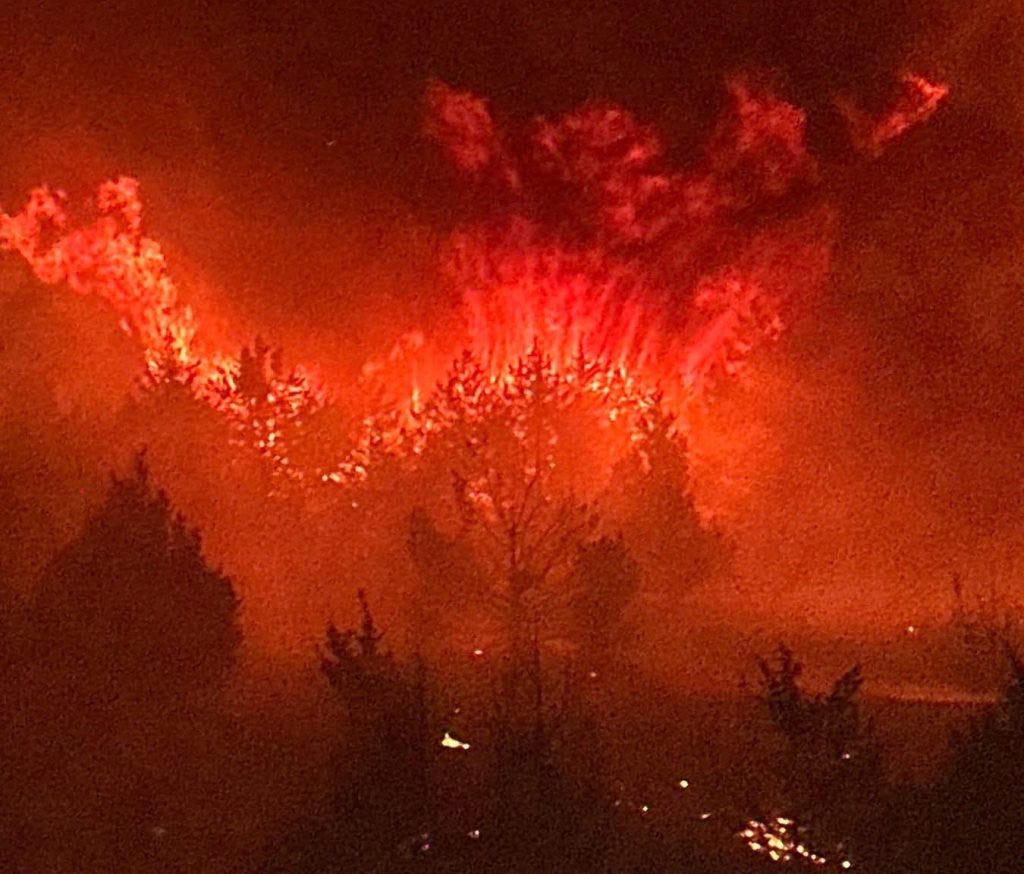
The Fires in Nebraska

The Smoke From Here
I can smell it this morning. Standing on the porch with the Padrón at 6:47, the wind out of the east for once, carrying what used to be someone's pasture. Carrying it here. Depositing it in my lungs.
The Sandhills are burning. The grass that holds the sand together, that soft, particular, almost useless grass that nobody outside this state has ever thought about, is gone. Where it was, there is a crust. Black and gray and still. The sand beneath it will go next, in the next good wind, which is tomorrow.
Rose White is dead. She was a grandmother in Arthur County who could not get out in time. The governor said she was unable to escape the blaze. He said it hurts. Then he said everything else can be rebuilt.
Everything except Rose White.
The Fire
It started near Angora on March 12, when 70 mph winds snapped a power pole and the line hit the grass. That is how it begins here. Not a campfire, not a careless cigarette. An infrastructure failure in a place the infrastructure barely reaches. A pole in the ground in the middle of nothing, and then the nothing caught.
By Thursday night the Cottonwood Fire had burned a path 30 miles long. Thirty miles. The distance from here to Torrington. The distance a man used to be able to drive and still call home.
The Morrill Fire spread across Morrill, Keith, Arthur, Grant, and Garden Counties. These are the counties where men get up at 5 a.m.and pull on the same Carhartt jacket and do the same work their fathers did and quietly hope their children will come back from wherever college took them.
By Sunday night, the Morrill Fire alone had burned more than 572,000 acres. The Cottonwood Fire: more than 122,000 acres. The Anderson Bridge Fire, south of Kilgore: a home gone, livestock gone, hay gone. The Road 203 Fire: 37,000 acres, containment at zero percent.
Zero percent. Four days. The same number it was the night it started.
What It Looks Like From the Ground
Drive up through the hills and you can see a football field of grass still standing, just black all around it. Cattle standing inside that green square, chewing their cud, not wanting to move. Islands. The cattle don't know they're on islands.
The momma cows are walking across burnt ground to reach the water tanks. Their hooves on the char. The tank still there. The grass around it not.
A firefighter named Alan Oberg, retired, Farnam Rural Volunteer Fire Department, said: "Uncontrolled wind blowing. No way to get it stopped because there's no way to drive through where it was at. So we just basically had to watch a lot of it just burn."
Had to watch it burn. Think about what that costs a man. What he takes home to dinner.
Heidi Pieper, south of Farnam, was out of town when the evacuation came. She and her husband were up most of the night. She said it was frightening at first, before she knew her kids were safe. She came away with a deeper appreciation for first responders. That is a woman trained by this place to turn terror into gratitude in the same breath.
The Machinery Responds
Garden County Sheriff Randy Ross lost his own house. He got his family out and then he went back to work. Nobody held a press conference about that.
Governor Pillen declared an emergency. He mobilized the National Guard. He issued a statewide burn ban through March 27. He flew over the damage in a helicopter, 35 to 40 miles of blackened Sandhills passing below him, and he said things were better than expected. He said he saw momma cows walking to water.
High winds above 50 mph kept the aircraft grounded through Sunday.
The Blackhawks sat on the tarmac at the Keith County Fairgrounds. The pilots watched the anemometer. The number didn't come. The fire didn't wait for the number.
The Rocky Mountain Complex Incident Management Team assumed control of the Morrill and Cottonwood fires Saturday evening. They came from outside. They brought systems, protocols, clipboards. The volunteer departments who had been working since Thursday, the men who also ranch, who also have mothers in Arthur County, stood along the perimeter and showed them where the lines were cut.
What Remains
The Sandhills are 20,000 square miles of grass-covered dunes in the middle of this country. Older than the state. Older than the people who named them. The grass is what keeps them from being a desert. The roots hold.
The ranchers are already calculating. Assess the fencing losses. Move parts of the herd to neighboring operations. Sell off cattle because the feed is gone. Sell cattle in a down market because there is no choice. Take whatever the buyer offers. Drive home. Start the calculation over.
The fences are the quiet catastrophe. Miles and miles of post and wire, gone. To re-fence what burned will cost more than most of these families can absorb. They will not ask for help easily. They were not raised to ask for help easily. They will stand in what's left of their pastures in the same Carhartt jacket and look at the black ground and figure out the numbers in their heads and not say anything about it at dinner except that things will come back. The grass grows back. It always has.
They are not wrong about the grass.
They are not entirely right, either.
From the Porch
The sky to the east has a color it didn't have last week. Not quite brown, not quite orange. The color of something that used to be something else.
The Sugar Factory is still there. The empty mall is still there. Scottsbluff is still here, Population 14,323, holding on the way the Sandhills grass holds the sand, by the roots, with effort, against the wind.
Somewhere east of here, Rose White's house is ash. The sheriff's house is ash. Eight hundred thousand acres of Nebraska are ash. And the momma cows are walking across the black ground to reach the water tanks, and the water is still there, and they drink.
The Padrón is down to the band.
The wind doesn't stop.
To help ranchers who lost livestock, feed, and fencing: Nebraska Cattlemen's Relief Fund at nebraskacattlemen.org. The Salvation Army Western Division at salvationarmyusa.org. If you have hay or fencing to donate, contact your county's emergency management office directly.