

The Briefing Room
Notes on Accountability

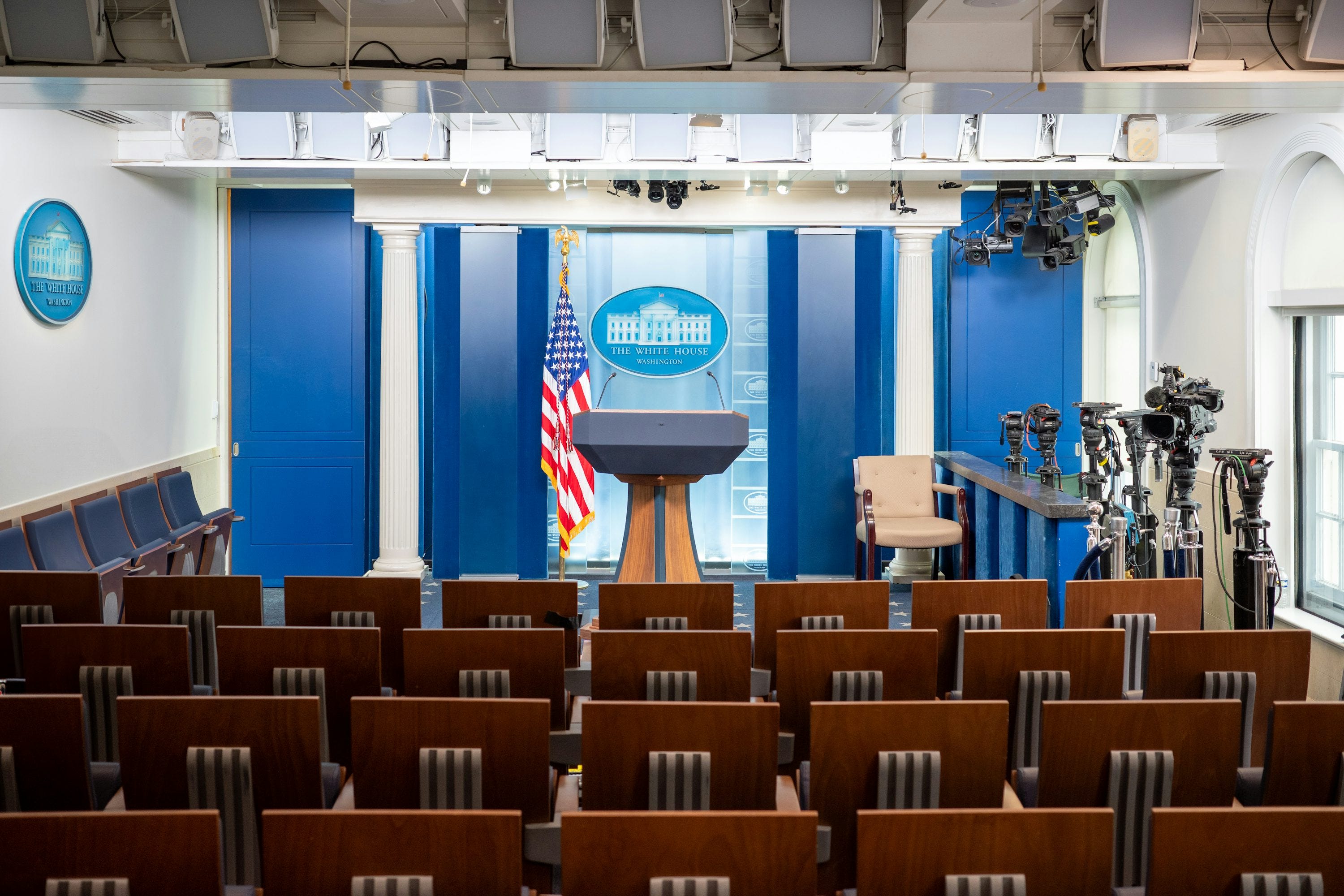
The thing that finally broke Sarah Mitchum was not a lie about the economy or the climate or the war or any of the important lies that she had been dutifully transcribing for eleven years. It was a lie about a sandwich.
The press secretary,Karoline Leavitt, twenty-seven, youngest person to ever hold the position, former Trump campaign spokesperson who had worked her way up from intern to assistant press secretary in the first administration before spending time with a congresswoman and then returning for the second term,had been asked by a Politico reporter whether the president had, as reported by six independent sources, thrown his lunch at a wall during a meeting with congressional leadership.
This was a legitimate news story. There were witnesses. Six of them. All credible. Three were members of Congress. One was a Secret Service agent who had filed an incident report because technically any projectile in the Oval Office vicinity requires documentation, even if that projectile is a turkey club sandwich. The maintenance request, leaked to the AP, described the damage as “impact-related condiment distribution requiring professional remediation and possible drywall replacement, estimated cost $3,200.” The White House photographer had been dismissed from the room exactly thirty seconds before the incident,everyone had checked their notes on the timing; they all agreed: thirty seconds,which was how everyone knew something good was about to happen.
The sandwich in question: turkey club from the White House mess. Sourdough. Extra mayo. Tomato. Bacon. Lettuce. Toothpicks removed prior to impact, according to one witness, suggesting premeditation. The president had apparently stood up from his chair, gripped the sandwich with both hands, and hurled it overhand at the wall while screaming about disrespect and the fake news media and how nobody called him “sir” anymore,very strong people, generals, people with tears in their eyes used to call him sir, and now the media won’t even show up to hear about how people respect him, how they call him sir,the whole thing lasted maybe ninety seconds, according to witnesses, completely incoherent, while he was still holding the sandwich, and then he threw it. The sandwich had hit with enough force that the tomato slice stuck to the wall for several seconds before sliding down, leaving a streak of mayo and tomato juice on the presidential wallpaper. Maintenance had needed a putty knife. For the tomato. This detail appeared in multiple witness statements.
“The president,” Karoline said, with the serene confidence of someone who had never been hit by a flying sandwich, or by consequences of any kind, “did not throw his lunch. He placed it down firmly.”
Sarah Mitchum’s pen stopped moving.
She looked up from her notebook. She had been sitting in the third row for nine years, and in those nine years she had developed certain skills. She could take notes while maintaining eye contact. She could identify a lie within three words of it leaving someone’s mouth. She could remain professionally neutral while watching democracy get gutted in real time.
But this.
She read her notes again. Six sources. Congressional witnesses. Secret Service documentation. Photographic evidence of the wall. Maintenance records. Cost estimate: $3,200. A toothpick recovered from the scene, suggesting the president had removed the structural supports before throwing, which indicated planning, which made it worse somehow.
Placed it down firmly.
Sarah said it out loud, to no one in particular: “Placed it down firmly.”
The reporter next to her,Reuters, Elizabeth Wang, twenty years in the third row, survivor of three presidents and countless scandals,looked over. She had been writing in her own notebook. She had the same sources. She had the same documentation. She looked at Sarah, and then she looked at Karoline standing at the podium in her navy suit, and then she looked back down at her notebook where she had written “POTUS threw sandwich at wall w/significant force - mult. witnesses, incident report filed, $3.2k in damages.”
Elizabeth’s mouth twitched.
Sarah watched it happen. Watched Elizabeth try to suppress it. Watched her fail.
Elizabeth made a sound. Not quite a laugh. More like a bark. She put her hand over her mouth.
The AP reporter, sitting one seat over,Michael Torres, covering the White House since 2003, survivor of two wars, a financial crisis, an impeachment, and a pandemic,glanced at both of them. He had maintained perfect composure through all of it. He had written “placed it down firmly” in his notebook with a question mark. He looked at that question mark. He looked at his other notes describing a sandwich thrown hard enough to dent drywall. He looked at Karoline Leavitt, twenty-seven years old, standing at the presidential podium explaining that up was down and sandwiches thrown at walls were actually just placed down firmly.
Something broke in Michael Torres. Something that had been holding for twenty-two years.
He started laughing. Not loud. Just a wheeze at first, like air escaping from something that had been sealed too long. He tried to stop. Put his fist against his mouth. Failed completely. His shoulders started shaking.
Josh Keller from the Times turned around from the second row. He was sixty-two years old. He had not laughed at a press briefing since 2019, when someone had asked if the president’s diet of hamburgers and Diet Coke constituted a national security concern and the press secretary had said “the president’s diet is robust and all-American.” Josh looked at the three reporters in the third row,Sarah from the Globe, Elizabeth from Reuters, Michael from the AP,all of them shaking with suppressed laughter, hands over their mouths like children caught giggling in church.
“What?” Josh mouthed.
Sarah pointed at her notebook. At the words “placed it down firmly” next to “threw sandwich at wall, $3,200 damage, putty knife required for tomato removal.”
Josh looked at Karoline. He looked back at Sarah. His face went through several expressions in rapid succession,confusion, recognition, disbelief, and finally something that looked like surrender. Like he had been holding something back for a very long time and had just decided to let it go.
He started laughing. A choking sound at first, and then real laughter that he couldn’t control.
The laughter spread like contagion.
Maria Santos from the Post looked over. Saw Josh Keller laughing. Saw the whole third row laughing. Looked down at her own notebook where she had written the same things they had all written because they had all talked to the same sources and seen the same documentation and they all knew, they all knew, that the president had thrown a fucking sandwich at a wall hard enough to require professional remediation.
Maria put her head down on her desk and her shoulders started shaking.
The CNN correspondent in the front row tried to hide behind his hand. The CBS reporter was crying, actual tears streaming down her face. The Fox News correspondent,who had spent the last year defending every administration position no matter how indefensible, who had gone on television night after night and explained why the things that appeared to be disasters were actually evidence of strong leadership,was leaning back in his chair with his eyes closed, shaking with silent laughter that suggested he had been waiting for this moment, or for something like it, for a very long time.
Someone in the back row was making a sound like a broken bagpipe.
Karoline Leavitt stood at the podium and waited.
She was good at waiting. She had been trained to wait out interruptions, to let awkward silences stretch until they became uncomfortable enough that journalists would fill them with questions that she could then ignore or evade or answer with lies that she would describe as “setting the record straight.”
But the laughter did not stop.
It kept going, building on itself, fed by years of this shit. All the lies they had written down and published and called news. All the times they had sat in this room and watched someone explain that the thing that had obviously happened had not happened, or had happened differently, or had happened but didn’t matter, or mattered but not in the way they were reporting it.
The sandwich wasn’t funny. Or the sandwich was funny, but what was really funny,what was actually hilarious in a way that made Sarah’s chest hurt,was that they had been doing this for so long. Sitting in this room. Writing down lies. Publishing them. Calling it journalism.
Karoline’s face had gone red.
Not the subtle flush of embarrassment, but the deep crimson of someone who had lost control of a situation and knew it. Her hands gripped the edges of the podium so hard her knuckles were white.
“If we could…”,she said, but someone in the back row was still wheezing and it set everyone off again.
“If we could have ORDER,” Karoline said, and her voice had gone up half an octave, taken on a shrill quality that suggested she had practiced this scenario,hostile questions, technical difficulties, maybe even a medical emergency,but had never prepared for the possibility that an entire room full of professional journalists would simply laugh at her.
“This is the White House briefing room. This is not…this is a place of serious discourse about serious matters affecting the American people and I will NOT be disrespected in this manner.”
The word “disrespected” sent a fresh wave of laughter through the room.
“You people,” Karoline said, and there was something almost desperate in her voice now, something that suggested she had finally realized that all her training, all her talking points, all her carefully constructed defenses against hostile questions had not prepared her for this: journalists who had simply stopped taking her seriously. “You people need to conduct yourselves professionally or I will have security remove…”
When Sarah finally caught her breath, she looked at Karoline Leavitt and felt something she had not felt in years. Not anger,she had been angry for a long time. Not frustration,frustration was the baseline condition of White House reporting.
What she felt was clarity.
“Karoline,” she said, and her voice cut through the last remnants of laughter like a knife, “why are we here?”
The room went silent. Not the ordinary briefing room silence that happened when someone asked a tough question, but a different kind of silence, the kind that suggested something was breaking, or had already broken, and everyone was waiting to see what would happen next.
“I’m sorry?” Karoline said, and her voice was still tight with anger.
“Why are we here?” Sarah said again. She stood up. Her chair scraped against the floor. The air conditioning was still broken,had been broken since August; it was now October. “We come to these briefings every day. You lie to us every day. Not about complicated policy things where reasonable people might disagree. You lie about basic, verifiable facts. The president did throw his sandwich. We have six sources. We have congressional witnesses. We have a Secret Service incident report. We have photographs of the wall. We have a maintenance worker who filed a repair request for ‘impact-related condiment distribution requiring professional remediation and possible drywall replacement, estimated cost $3,200.’ We have a witness statement describing how you needed a putty knife to get the tomato off. You’re standing up there telling us he placed it down firmly. Why are we pretending this is journalism? Why are we pretending you’re giving us information when you’re actually just reading talking points that someone wrote specifically to obscure information?”
Karoline’s mouth tightened. She gripped the edges of the podium. “If you can’t conduct yourself professionally…”
“No,” Sarah said, and she felt Elizabeth from Reuters stand up beside her, and then Josh Keller, and then Maria Santos. “You don’t get to do that. You don’t get to lie to us and then lecture us about professionalism when we point out that you’re lying. That’s not how this works. Or actually, I guess that is how this works, which is exactly the problem.”
She looked around the briefing room. She saw the network correspondents in the front row, the ones with perfect hair and six-figure salaries who were paid to look concerned while reading whatever appeared on the teleprompter. She saw the wire service reporters in the second row, the ones who filed six stories a day and never had time to actually think about what they were writing. She saw her colleagues in the third row, the newspaper reporters who had somehow survived the layoffs and the buyouts and the pivot to digital and the pivot away from digital and the pivot to video and the pivot to podcasts and the pivot to newsletters, who had survived by being flexible and adaptable and willing to accept that journalism was no longer what they had thought it would be when they started.
“Here’s what I think,” Sarah said. “I think we should leave. Not just me. All of us. Everyone who’s actually a journalist. We should walk out of this room and not come back.”
“Ms. Mitchum,” Karoline said, and her voice had acquired that particular edge that press secretaries used when they were about to threaten someone’s credentials, “you’re out of line.”
“I’m out of line?” Sarah felt something like joy, which was inappropriate but undeniable. “Last week you told us that the unemployment numbers were robust when they showed massive job losses. You told us that withdrawing from the Paris Climate Accords was actually a recommitment to climate action if we understood climate action correctly. You told us,and this is my personal favorite,that the reason you won’t release the visitor logs is because of cybersecurity concerns, as though hackers are desperate to know that the CEO of ExxonMobil visited the White House twelve times in three months while the administration was writing new drilling regulations.”
“I’m not going to engage with your cherry-picked…”
“Of course you’re not going to engage. You never engage. That’s the whole point. We ask you questions and you give us answers that have nothing to do with the questions, and we write down the answers and publish them, and we call it news. But it’s not news. It’s stenography. It’s performance art. It’s us participating in our own irrelevance.”
Sarah picked up her bag. It was a canvas tote from the 2016 Democratic National Convention, back when she had still believed that politics was about policy and that journalism was about holding power accountable. She looked at Karoline Leavitt, who was standing behind the podium with the seal of the United States mounted above her head, looking like someone who had just realized that her talking points did not include a section on what to do when journalists had a collective nervous breakdown.
“Fuck you,” Sarah said. “I’m done. We’re all done.”
She walked toward the exit. Behind her, she heard Elizabeth’s chair scrape. And then Josh’s. And then Maria’s. And then more chairs, and more people, and the sound of the briefing room emptying like a theater after a particularly bad movie, except that the movie had been running for years and they had all kept buying tickets.
Someone started clapping. Sarah didn’t turn around to see who it was. She just kept walking.
By the time Sarah reached the Hay-Adams,Elizabeth had texted her the location within three minutes; they met in the bar because everything important in Washington happened in hotel bars,there were already fifteen journalists waiting. By the time she ordered a bourbon, there were thirty. They came from the Times and the Post and the Journal and the wire services and the networks, and they came with expressions that suggested they had just woken up from a long sleep and were not entirely sure where they were.
Josh Keller ordered a scotch and drank half of it in one gulp. He was sixty-two and had covered five administrations and looked like he had not slept since the second Clinton term. His hands were shaking.
“Okay,” he said. “What the fuck just happened?”
“I think,” Maria Santos said slowly, stirring her martini with an olive, “we just quit.”
“We can’t quit,” someone from Bloomberg said. He was young, twenty-six maybe, and he wore a suit that looked like it had been designed by someone who had read about Washington in a magazine. “Our job is to cover the White House.”
“Is it though?” Elizabeth said. She had ordered a martini and was drinking it like it was water, like it was medicine, like it was the first honest thing she had consumed in months. “Is that our job? Because I’ve been thinking about this. Our job is supposed to be telling people what’s happening in their government. But we can’t tell people what’s happening if we’re not allowed to report what’s happening. And we’re not allowed to report what’s happening because the moment we try, they yell at us for being biased or fake news or whatever the talking point is that day. And if we push back, they ban us. They banned the AP for six months. Six months. For refusing to call the administration’s withdrawal from the Paris Accords a ‘climate leadership initiative.’”
“We didn’t quit,” Sarah said. “We walked out. There’s a difference. We’re still employed. We’re just not going back to that room until they agree to stop treating us like stenographers.”
“They’ll replace us,” the Bloomberg correspondent said. “They’ve already got influencers in the briefing room. They’ll just fill our seats with people who ask questions like ‘Mr. President, why are you so awesome?’”
“Let them,” Sarah said. “Seriously, let them. Let the American people watch press briefings where everyone asks friendly questions and no one pushes back. Let them see what state media actually looks like.”
“What are you proposing exactly?” Josh asked. He had finished his scotch and ordered another one. The bartender, who had seen this before,had seen journalists drink their way through crises and scandals and impeachments and wars,poured generously.
“A boycott,” Sarah said. “We don’t go back until they restore full access to the AP and stop banning reporters who ask real questions. We keep doing our jobs,we cover the White House, we break stories, we report the truth. We just don’t sit in that room and participate in their performance anymore.”
Silence. Then someone spoke up from the end of the table. Katherine Vogel. Sixty-eight years old. Five presidents. Pulitzer Prize in 1997 for coverage of the Clinton impeachment. She had been sitting quietly, drinking water instead of alcohol.
“I understand the anger,” Katherine said. Her voice was measured, deliberate. “God knows I feel it too. But I think you’re wrong.”
Everyone turned to look at her.
“We’re not stenographers,” she continued. “We’re witnesses. Someone has to be in that room documenting what they say, even if it’s lies. Especially if it’s lies. If we all leave, who’s watching? Who’s creating the record? In twenty years, when historians try to understand what happened, our job is to have been there. To have written it down. That’s the job. It’s always been the job.”
“But we ARE writing it down,” Sarah said. “We’re writing down lies and publishing them as if they’re one legitimate viewpoint among many. We’re giving them credibility by participating.”
“No,” Katherine said. “We’re creating a historical record. That matters.”
“Does it?” Maria cut in. “Does it matter that we have a perfect record of all their lies if nobody believes us anymore? If half the country thinks we’re fake news and the other half thinks we’re complicit? We’ve been creating this beautiful, meticulous record of democracy dying and it hasn’t stopped anything.”
“That’s not our job,” Katherine said. “Our job isn’t to stop anything. It’s to document.”
“Then what’s the point?” Elizabeth asked. “Seriously. If all we’re doing is documenting the collapse, if we’re not actually holding anyone accountable, if they can just lie to our faces and face no consequences,what the fuck are we doing?”
Katherine looked at her glass of water. “I don’t know,” she said finally. “But I know that abandoning our posts isn’t the answer. Someone has to stay. Someone has to watch.”
“Then stay,” Sarah said quietly. “I respect that. I do. But I can’t do it anymore. I can’t sit in that room and pretend that transcribing lies is the same thing as journalism.”
Katherine nodded slowly. “I understand. I disagree. But I understand.”
She didn’t sign the statement.
They argued about it for three hours. The bartender eventually just left the bottles on the table.
“My editor will never agree to this,” someone from CBS said.
“Mine either,” the NBC correspondent said.
“What if,” Maria said, and she was on her third martini, “what if they don’t have a choice? What if we make this public? What if we publish a statement explaining exactly why we walked out?”
“I have a quote,” she added suddenly. “David Halberstam. ‘The role of the media is not to be liked. It’s to tell the truth.’ But we’re not telling the truth anymore. We’re telling what they say, and what their opponents say, and calling it balance. But you can’t balance a truth and a lie. You just end up with a lie that’s been laundered through false equivalence.”
“Write that down,” Elizabeth said.
By midnight, thirty-seven correspondents from nineteen news organizations had signed what they called the Brady Room Statement, named after the briefing room itself, which had been named after a press secretary who had been shot in 1981 while standing next to a president who had also been shot.
The statement said: “We, the undersigned journalists, will not return to the White House briefing room until the administration restores full access to all credentialed journalists and ends the practice of berating reporters for asking legitimate questions. We will continue to cover the White House, but we will not participate in performances designed to create the appearance of accountability while preventing actual accountability.”
The Bloomberg correspondent didn’t sign it. Neither did a few others. They went back to their hotels and their mortgages and their responsibilities. Sarah didn’t judge them. Not everyone could afford principles, especially when principles might cost them their jobs.
Sarah sent the statement to her editor at two in the morning. She expected him to call immediately and fire her. Instead he wrote back three words: “About fucking time.”
The next morning, the briefing room filled up anyway.
Karoline Leavitt stood at the podium in her navy suit,she had three navy suits, or possibly she had one navy suit that she wore every day, Sarah had never been able to tell,and looked out at a room full of podcasters and influencers and content creators who had built their careers on saying what their audiences wanted to hear rather than what was actually true.
The first question came from someone who had 500,000 followers on a platform that had recently been purchased by a billionaire with opinions about journalism. The influencer was twenty-three. She wore a dress that was too short for a press briefing and heels that were too high for a woman who would be standing for an hour. She had brought a ring light. An actual ring light, which she had somehow plugged in near the front row.
“Karoline,” the influencer said, tilting her head in a way that suggested she had practiced this in a mirror, “I just want to say, first of all, you look absolutely stunning today. That blazer is everything. Okay, so my question is: with all these haters in the mainstream media refusing to come to briefings because they literally can’t handle the truth, do you think the president would ever consider, like, doing a briefing on TikTok? Because I feel like that’s where the real Americans are, you know? Like, no offense to the White House press room, but it’s giving very ‘yesterday’s news’ energy, and I just think the president’s message would totally resonate more if he did like a dance challenge or something to explain his policies? Because the young people would actually get it then?”
There was a long silence. Even Karoline Leavitt, who had been trained to maintain composure through any circumstance, seemed momentarily unsure whether she had heard correctly.
“That’s...” Karoline said, and paused. “That’s an interesting suggestion. Next question.”
The administration did not condemn the boycott. They issued no statements. They simply proceeded as though nothing had happened, as though the briefing room had always been filled with people who asked friendly questions and smiled while doing it.
But then someone recorded the TikTok dance question and posted it online.
Within six hours it had 10 million views. Within twelve hours it had 30 million. People were sharing it not because they thought it was good, but because they were horrified. Even people who hated the mainstream media, who had spent years calling journalists elitist and biased and fake news, watched that video and understood that something had gone terribly wrong.
The comments were brutal: “Is this a fucking joke?” “This is what happens when you ban real journalists” “I voted for this administration but holy shit this is embarrassing” “She brought a RING LIGHT to the WHITE HOUSE” “’It’s giving yesterday’s news energy’ I want to die”
Late-night comedians played it on a loop. SNL did a sketch where the entire briefing room was filled with influencers asking questions like “Mr. President, what’s your skincare routine?” and “Do you think the nuclear codes would make a good password for my Instagram?”
Sarah learned from a source in the press office someone who had been leaking to her for two years, ever since Karoline had yelled at him for suggesting that maybe they should stop lying quite so much about the unemployment numbers,that the administration was panicking.
“The president keeps asking why you people aren’t coming back,” the source said on a phone call that Sarah recorded with his permission. “Karoline told him you would come back within a week. It’s been two weeks. He’s starting to notice that the briefing room is full of idiots asking softball questions, and even he can tell the difference. He actually said, and I quote, ‘Where’s that bitch from the Globe who always gives us shit? At least she asks real questions.’”
Sarah wrote this down. She wrote it down and she published it, attribution and all.
When Karoline called her personally to threaten legal action, Sarah said, “Sue me. I’ll see you in court. I’d love to depose the president about his sandwich-throwing habits under oath.”
Karoline hung up.
The boycott lasted for four months.
During that time, journalism got better.
Without access to the briefing room, reporters actually had to report. They had to find sources, develop relationships, do the kind of shoe-leather investigative work that they had been avoiding because it was easier to just show up at the briefing and transcribe whatever Karoline said.
The Post published an investigation into the sandwich incident that included photographs of the wall, interviews with witnesses, and a forensic analysis of the mayonnaise stain. The piece won a Pulitzer Prize,which sounds absurd but was actually a profound piece of reporting about how the administration manipulated information and gaslit the public about even the most basic facts.
The Times published a story about the administration’s visitor logs that revealed the cybersecurity concerns were bullshit. The real concern was that the logs showed dozens of meetings with industry lobbyists who were writing the regulations meant to govern their own industries.
Sarah’s Globe ran a four-part series on the administration’s climate policy that traced the connections between campaign donors and the decision to open new coal mines while simultaneously claiming commitment to climate action.
Three cabinet secretaries resigned during the boycott, not because of the boycott directly but because without the daily briefing room performance, journalists had time to actually investigate their departments.
The administration restored full access on a Tuesday in March. The announcement came via a terse statement: “Effective immediately, standard access protocols are restored.”
No apology. No explanation. They had blinked first.
Most of the boycotting journalists went back. The Times sent Josh. The Post sent Maria. CNN sent their correspondent. They returned to their seats and asked their questions, but they wrote the stories differently now. When Karoline lied, they said so in their articles. They stopped treating both-sides as equivalent when one side was objectively false.
But not everyone went back.
Sarah Mitchum, Elizabeth Wang from Reuters, and six other reporters decided they were done working for organizations that could force them back into that room.
They met at the Hay-Adams again, four months after the walkout.
“What if we started our own thing?” Sarah said.
“Our own what?” Elizabeth asked.
“A worker-owned cooperative. Like Defector or 404 Media. We all own it equally. We make editorial decisions collectively. We fund it through member subscriptions and foundation grants. No corporate owners. No advertisers. Just us and readers who actually want real journalism.”
“So a blog,” the Bloomberg correspondent said. He’d come to the second meeting even though he hadn’t signed the statement. “You want us to quit our jobs at actual news organizations and start a blog.”
“No,” Sarah said. “I want us to start something that actually works. Something we own. Something that doesn’t answer to quarterly earnings reports or private equity vultures who think journalism is content to be monetized. Every pivot we’ve done,digital, video, podcasts, newsletters,failed because we were doing it for companies that didn’t give a shit about journalism. They cared about growth metrics and profit margins. This is different. This is us building something sustainable on our own terms.”
“That’s insane,” someone said.
“Is it?” Sarah said. “404 Media did it with four people and became profitable in six months. Defector has forty million in annual revenue. Hell Gate doubled their subscriptions in a year. The model works,if you’re willing to work for $40,000 a year instead of six figures.”
Elizabeth was nodding. So was a former Journal reporter named David who had quit during the boycott.
“I’m in,” Elizabeth said.
They called it The Commons. Eight founding members, equal ownership shares. They filed as a worker cooperative in Delaware, which meant they had legal protections and could raise money more easily than a traditional LLC.
The first six months were brutal.
They worked out of a shared office space in Arlington that smelled like old coffee and desperation. Actually it smelled like the Indian restaurant downstairs, but “old coffee and desperation” sounded better when they talked about it later, so that’s what they told people. The air conditioning worked inconsistently. Their neighbor was a lobbying firm for natural gas companies, and sometimes they could hear them through the wall, laughing. They paid themselves $40,000 a year,less than half what they’d made at their old jobs. They funded it through:
A $200,000 MacArthur Foundation grant for investigative journalism
A crowdfunding campaign that went viral and raised $150,000
Individual paid memberships: $10/month or $100/year
A wealthy donor who wrote them a check for $100,000 with one condition: “don’t fuck this up”
They hired a business manager who had worked at Mother Jones and understood nonprofit journalism economics. They hired a web developer who built them a site that was clean and fast and didn’t track users or sell their data.
And then, in month eight, they almost died.
Sarah was sitting in the Arlington office at 2:47 in the morning, looking at their bank account. They had $23,456.12. Payroll for next month was $73,000. The MacArthur grant wasn’t coming through until next quarter. The crowdfunding had slowed to a trickle.
She had a Word document open. “To The Commons Team.” Below that, nothing.
Her phone rang. 2:47 in the morning.
“Sarah Mitchum?” A woman’s voice, older, accent she couldn’t place.
“Yes?”
“My name is Dr. Patricia Chen. I’m a retired professor from Berkeley. I’ve been reading your work.”
“Okay,” Sarah said. She was too tired to be polite. “It’s almost three in the morning.”
“I know. I’m in Hong Kong. Different time zone. I’m calling because I want to give you money.”
Sarah closed her laptop. “How much money?”
“How much do you need?”
“Right now? Fifty thousand dollars or we can’t make payroll next month.”
“I’ll wire you two hundred thousand,” Dr. Chen said. “Tomorrow.”
Sarah started crying.
“Why?” she asked.
“Because thirty years ago I was a graduate student in Beijing. During the protests. I saw what happens when journalists stop telling the truth. I came to America because I believed in a free press. And now I’m watching your free press collapse. So I’m giving you money. Use it well.”
The money arrived the next morning.
Three weeks later, they broke the story.
A mid-level employee at the Department of Energy sent them a USB drive containing 3,000 pages of internal documents. The administration’s “scientific” climate policy had been written by coal and oil industry lobbyists. Not influenced by them,written by them. Whole sections copied and pasted from corporate documents.
Maria and two other reporters spent three weeks verifying everything. The story was 8,000 words. Two hundred footnotes. Internal emails from cabinet members joking about not needing “the science people” anymore.
The Commons published it on a Tuesday morning with the headline: “They Lied: How the Administration Let Industry Write Climate Policy, Then Claimed It Was Science.”
Not “Questions Raised About.” Not “Concerns Emerge Over.” Just: They lied.
Because they had.
By Tuesday afternoon, three cabinet members had been called to testify before Congress. By Friday, the policy was suspended. The story won a Pulitzer Prize.
More importantly, it brought 50,000 new members to The Commons in a single month. People who had never heard of them suddenly understood that something different was happening.
Then Joe Rogan mentioned them on his podcast. Not endorsing them exactly,he said something like “I don’t agree with these people on anything, but at least they’re actually doing journalism instead of just reading press releases. They called the government liars. On the record. That takes balls.” His audience, surprisingly, responded. Another 20,000 subscriptions in two weeks.
Rachel Maddow did a whole segment about The Commons, calling them “a blueprint for how journalism survives in an era of institutional collapse.” That brought different readers, but just as many.
The left thought they were heroes. The right thought they were at least honest. Somehow, by refusing to play the game, they’d found an audience that crossed the usual tribal lines.
By the end of the first year: 90,000 paying members at $10/month. Enough to survive.
By the end of the second year: 150,000 members. Enough to hire more reporters and break even.
Other journalists started leaving their jobs to join them. Not everyone,most people couldn’t afford the pay cut. But some people. Good people who remembered why they became journalists in the first place.
Sarah went back to the briefing room exactly once, three years after she walked out.
Karoline had resigned to work for a tech company that specialized in AI-generated press releases. The new press secretary was older, more experienced, slightly less willing to lie about sandwiches.
After the briefing, Sarah walked out onto Pennsylvania Avenue with Elizabeth, who had left Reuters and joined The Commons as senior White House correspondent. It was August. Hot the normal way.
“Are you coming back?” Elizabeth asked.
“No,” Sarah said. “I don’t need to be in that room to do my job. That’s what we figured out. Access to their lies isn’t access to anything.”
When Sarah got back to the Arlington office, there was a voicemail from Josh. He’d been offered a job at the Times,senior position, triple his Commons salary.
She didn’t call him back right away. She sat at her desk and looked at the bank account. They’d lost 1,200 members this month. The subject line from their business manager: “We need to talk about Q4.”
She opened her laptop and started working on a new story. Department of Education. Claiming to increase funding for public schools while actually cutting it through accounting tricks.
It would take weeks to report. Most people wouldn’t read it. It wouldn’t change anything fundamental about how the world worked.
But it was true. And somebody had to write it.
Her phone buzzed. Text from Dr. Chen in Hong Kong: “Read your latest story. Sent you 50 more members from my book club. Keep going.”
Sarah smiled. She texted back: “Thank you. We will.”
She typed the headline: “They’re Doing It Again: How Education Funding Cuts Are Being Sold as Increases.”
Not as catchy as the energy story. But true.
The work was never finished. The lies kept coming. Somebody had to keep telling the truth, even when the truth was exhausting and underpaid and couldn’t compete with the comfort of not knowing.
Through the window, the sun had set over Arlington. Somewhere in Washington, in the briefing room she had walked out of three years ago, the lights were probably off. Tomorrow someone would stand behind that podium again and lie.
And tomorrow she would sit at this desk and report the truth.
Not because it would fix everything. Not because it would change the world.
Just because it was true, and someone needed to say so, and somewhere out there, people were still listening.
Even if there weren’t as many of them as there used to be.
Even if there never would be again.
Join me in building something that matters.
I’m creating a space for journalism that refuses to play the game,stories that call lies what they are, reporting that doesn’t hide behind false balance, work that serves readers instead of shareholders.
This story is what that looks like. Honest. Unflinching. Worth your time.
But I can’t do this alone. Independent journalism only works when readers decide it’s worth building together. Not as consumers, but as participants in something bigger than any single story.
Paid subscribers aren’t just supporting my work,they’re proving that a different model is possible. That we can fund real journalism without corporate owners, without advertisers, without compromising what matters.
We’re building The Commons. Just like in the story. And I need people who believe it’s worth building.
If you’re tired of watching journalism collapse, if you want to be part of creating something better, subscribe. Be one of the people who made this work.
This is how we prove it can be done.
God. how I wish this was a true story. Just reading it inspired me to think there is hope if courage took the wheel. Damn, I will carry this feeling for a while. Thank you for giving us that story of what it could be.
“Access to their lies isn’t access to anything.”
Your tale is pure gold, not the garish paint that seems to be brushed over everything in these times.
You may be channeling Tom Joad, but I am channeling CJ Cregg. And this story is my fantasy about the WH Press Corps finally remembering what their job - what their calling - really is.