

TȞAŠÚŊKE WITKÓ
A Story About What a Promise Weighs
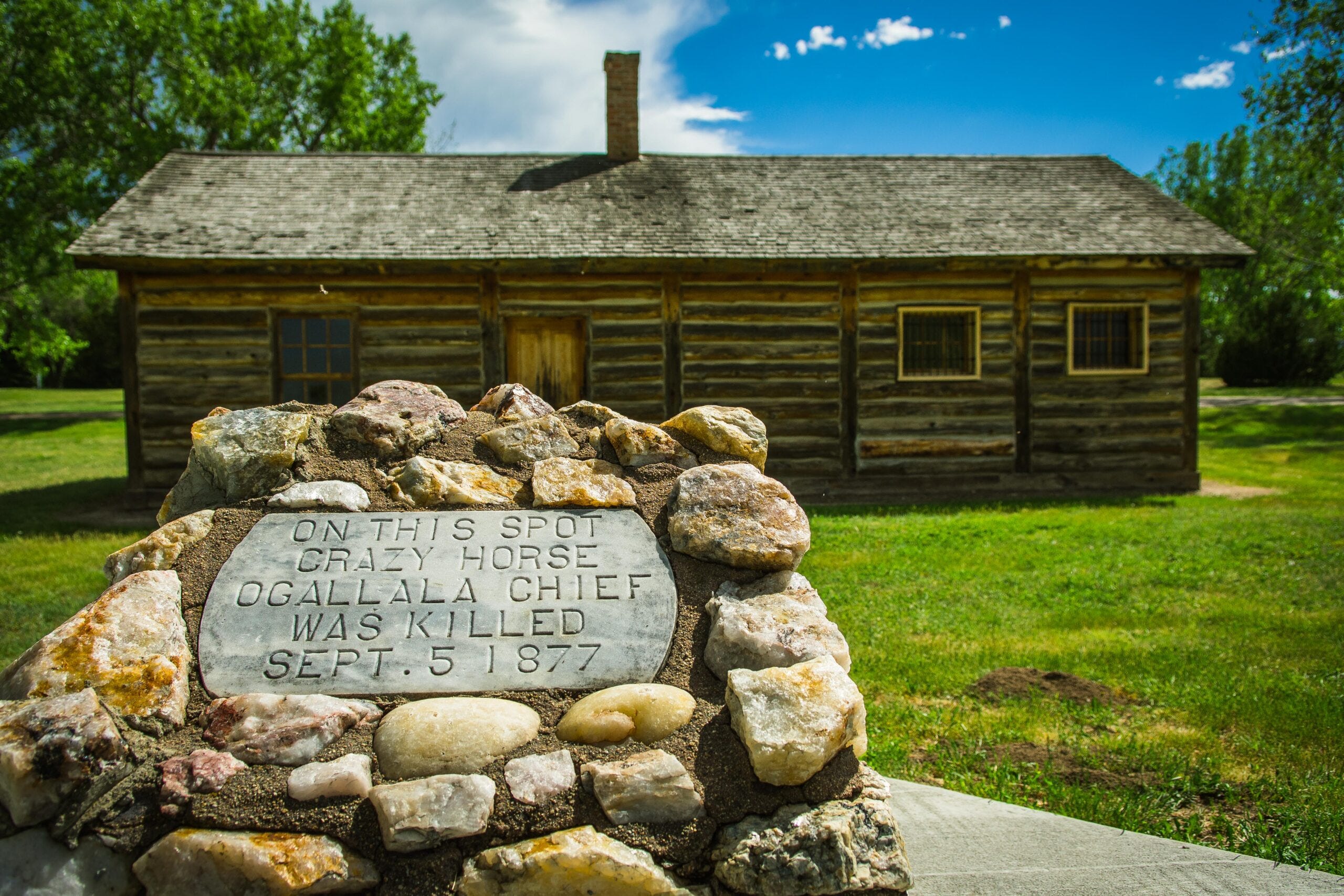
Author’s Note: Fort Robinson, Nebraska is seventy-five miles from my back porch. Fifty-five miles as the crow flies.
I am going to tell you how this works.
Not how it worked. How it works. Because nothing about the machinery has changed, only the names of the men who operate it and the language they use to describe what they’ve done when it’s over.
You think I’m talking about the past.
I’m not talking about the past.
I. THE COMING IN
I surrendered my horses on May 6, 1877.
Nine hundred and forty horses. I counted them myself. The soldiers counted again and arrived at the same number. None of this matters now but I remember it. Nine hundred and forty.
My people numbered roughly the same. Give or take the old ones, the very small ones, the ones the last winter had taken and left no number to count.
We gave up the horses. We gave up the guns. I put on my best clothes because I understood this moment would be the last beautiful thing for a long time, and I was right about that. We rode in singing. Lieutenant Clark,White Hat, the Lakota called him,stood before us and I could see in his face that he did not know what to do with what he was seeing. We were not a defeated people riding in. We were a people choosing, for the first time, to stop.
He told me later, through the interpreter, that it was one of the most impressive things he had ever witnessed.
He said it the way men say things they mean but cannot use.
General Crook had sent word ahead. He made a promise. An agency in the Powder River country. Our own land. The land we were born on. We would not have to live among Red Cloud’s people or Spotted Tail’s people. We would find our own way in the new thing, whatever the new thing was.
I believed him.
This requires explanation, because it is not a thing I can defend with logic. I believed the promise of a man whose army had spent three winters burning our food and killing our horses in the deep cold. I believed him because I was exhausted and my wife was sick and my people were hungry and the buffalo were already fewer than the year before and I understood, finally, the arithmetic.
The arithmetic was simple.
The world I had known was ending. The question was only whether I would fight it to the last man, or find a way to carry some piece of it forward into what came next.
I chose to carry.
I was wrong to trust the promise.
But I was not wrong to try.
There is one more reason I have not told you.
Her name was Black Shawl. She had been coughing since the fall before. A cough that came from somewhere deep and did not go. In the last winter I would lie awake counting the times she coughed between dark and first light, the way you count a thing when you cannot stop it and counting is the only thing left to do. I was doing this the morning I decided to surrender. I had reached forty-one when the sky began to go gray. I got up and went outside and stood in the cold and that was the moment.
Not the buffalo. Not the soldiers. Not the arithmetic.
Forty-one.
Here is the thing they will never put on the monument. What got me killed was not my violence. I had laid that down at the agency gate with the horses. What got me killed was that I would not become something the system could understand, translate, or absorb.
I would not be useful in the right way.
That was my crime.
II. THE AGENCY
The Red Cloud Agency sat forty miles east of where I was born.
Forty miles is nothing on horseback. A morning ride. But on the agency it was a different country,a country where everything that had made us Lakota, the movement, the hunt, the open sky in every direction, had been replaced by waiting.
Waiting for rations. Waiting for permission. Waiting for the next council that would produce nothing.
On my third day at the agency, I watched the officers walk across the parade ground toward my lodge. Red Cloud was standing outside his own lodge, thirty yards to the east. He was wearing good clothes. The kind of clothes a man wears when he has spent years learning that clothes are a language. He watched the officers walk past him. He watched them arrive at my door. He stood there for a long time after they went inside, not moving, not speaking to the men around him, just watching the closed flap of my lodge.
Then he turned and went inside his own lodge and I did not see him again that day.
Red Cloud had been at the agency for eleven years. He had fought the army to a standstill along the Bozeman Trail in 1866, forced the abandonment of three forts, and the government had smiled and given him a reservation and then spent every year after that making it smaller. He had been to Washington. He had met the President. He had learned, over eleven years, how to be the kind of man the machinery could work with.
He had made himself indispensable.
And now here I was, four days at the agency, and the officers were walking past him.
I had been there four weeks before I understood the Powder River promise was not being kept. I asked about it. They said arrangements were still being made. I asked again. They said these things took time.
I heard you.
I heard you like a door closing.
III. THE INTERPRETER
His name was Frank Grouard.
Born in the Pacific Islands to a missionary father. Brought to Montana Territory as a boy. At eighteen or nineteen, captured by a Crow war party who stripped him and left him in the forest. A Sioux hunting party found him and took him in.
He lived among us for seven years. He married a Lakota woman. He learned the language the way you only learn a language when it is your only means of survival. He took a Lakota name. He was, for a time, in some real sense, one of us.
Then he left and became a scout for Crook.
I tell you this not to make you feel something about Frank Grouard. I tell you this because Frank Grouard is not unusual. Frank Grouard is a type. He is the man who lived among the dispossessed long enough to learn their language and then sold that fluency to the people doing the dispossessing. He understood both sides of the wall and he chose the side with the salary.
You have seen Frank Grouard. You will see him again.
In August of 1877, the army received word that Chief Joseph and the Nez Perce had broken from their reservation in Idaho and were moving north through Montana toward Canada. The army wanted Lakota scouts. They came to me.
Lieutenant Clark sat across from me and said they needed my help. That I had agreed, in surrendering, to assist the government. That this was what assistance looked like now.
I did not want to go. I had promised peace. I was not a man who unmade promises.
But the pressure built. The council stretched into the afternoon. Outside the lodge I could hear the wind off the White River. I could feel, as I had felt all summer, the thing that was happening to me at the agency,,the slow erasure, the daily shrinking of the world to the size of a government ration.
Finally, impatient with the whole performance of it, I told them I would go. I would fight until not one Nez Perce was left.
Frank Grouard stood up.
He delivered my words to the officers.
What he said was: Crazy Horse will fight until not one white man is left.
One word. One people changed to another. The Nez Perce becoming the whites.
I did not know this had happened until it was too late to matter. No one corrected him loudly enough. The words were already in the air. Already believed. Already becoming the reason for what came next.
The edited clip. The sentence without the sentence before it. The answer divorced from the question. The meaning reversed between the speaking and the reporting. One Frank Grouard who knew exactly what was said and said something else.
Grouard later denied the mistranslation.
Of course he did.
He had lived among us seven years. He knew our language the way he knew his own heartbeat.
He knew exactly what I had said.
IV. THE MACHINERY
Here is how the machinery worked.
Grouard told the officers I had threatened to kill white men. The officers told Crook. Crook, who had never fully trusted the surrender, who had an entire military career built on the belief that I was dangerous and ungovernable, accepted the translation without question.
Because it confirmed what he already believed.
The machinery does not require lying. It requires only that people believe the version of events most convenient for their existing beliefs. The lie and the truth arrive at the same desk and only one of them gets read, and this is not an accident, it is a selection, and the selection is made by people with interests, and the interests are not yours.
Red Cloud’s people spread the rumor outward. Crazy Horse was planning to break out. Crazy Horse was going to lead an uprising. Crazy Horse had never truly surrendered. Spotted Tail…my own uncle…sent word to the military. American Horse. Others whose names I do not need to say. Men who had chosen the agency long ago and built their small power within it and who understood, very clearly, that my existence made their accommodation look like weakness.
These were not white men. These were Lakota men. Men who had, over eleven years, become fluent in the logic of the system that was crushing them. Men who had learned to be useful to it. Men who had curved themselves to fit the space the machinery allowed.
And I would not curve.
This made me dangerous not to the army, particularly. I had given up my guns. I had given up nine hundred and forty horses.
I was dangerous to the men who had given up less and were trying not to think about it.
The machinery did not need a conspiracy. It needed only people with interests.
Each person with an interest said the thing their interest required them to say.
The story assembled itself.
There is a concept in Lakota for what was being done to me. Something close to: the way a trap is set not by one hand but by the shape of the ground itself. By the time the animal arrives, no one is to blame. The ground is just the ground.
They do not call it a trap. They call it a situation that developed.
I was the animal.
On September 4, 1877, two columns of soldiers moved on my village at dawn.
I had already left. I had taken Black Shawl to the Spotted Tail Agency forty miles east. She sat in front of me on the horse because she was too weak to ride alone for long and I held her with one arm the whole way and felt her breathe. It was a four-hour ride. I counted her breaths for a while and then I stopped counting because some numbers you don’t want to know.
I wanted her with her parents, where she would be safe while I figured out what came next.
The soldiers found the village empty.
They followed me.
V. THE PROMISE ON THE ROAD
Lieutenant Jesse Lee was the Indian agent at the Spotted Tail Agency. He was an honest man. I believe this. I believed it then and I have no reason to stop.
He came to me at Camp Sheridan, the military post adjacent to the agency. He sat across from me and spoke carefully. He said if I returned to Fort Robinson, I could meet with General Bradley, the post commander. I could explain the situation. I could tell them the translation had been wrong. I could tell them I had never threatened anyone. I could tell them I wanted only what I had been promised,a place in the Powder River country, my own agency, a way to live.
He said I would have a chance to speak.
He said I would be heard.
I looked at Lieutenant Lee for a long time. I had become, by then, a man who measured promises carefully, who turned them over the way you turn over a stone to see what lives underneath. I had been promised the Powder River agency. I had been promised fair treatment at the surrender. I had been promised a man’s words would be translated truly.
I had been promised a great many things.
But Lee’s face was the face of a man who believed what he was saying. He was not lying. He had been told what he told me, and he believed it, and he came to me with it in good faith, and I could see all of that in his face, the complete sincerity of a man being used.
You don’t send a liar to tell the lie. You find someone who believes it. You find Lieutenant Jesse Lee. You wind him up with the truth as you have constructed it and you send him forty miles east and you let his honest face do the work that your dishonest intention requires.
The honest man does not know he is a weapon.
This is what makes him effective.
I told Lee I would return.
That night I sat outside the lodge for a long time. The stars were thick. The air had the first edge of fall in it, not cold yet but thinking about becoming cold. Touch the Clouds sat with me for a while and then he went inside and I sat alone.
I thought about whether I was wrong.
I want to be careful here, because I have told you this story as a man who sees the machinery clearly, who knows how the pieces fit. But that night I was not certain. Lee’s face had been honest. General Bradley was a man I did not know personally. Maybe Crook had overreached and Bradley would hear me out. Maybe the Powder River promise was still alive somewhere in a file I had not seen. Maybe the translation had been corrected up the chain. Maybe I had been reading shadows and the light was different than I thought.
I sat with this until it was not useful to sit with it anymore.
In the morning I got up and put on my best clothes again. The same clothes I had worn riding in on May 6th. The last beautiful thing. I put them on again because I thought: if I am wrong about what is waiting for me, I want to be wrong in the right clothes.
I went and woke Touch the Clouds.
We rode.
VI. FORT ROBINSON
The fort sat on the White River in western Nebraska, in the shadow of the Pine Ridge. It was not an impressive place. Barracks, a parade ground, a flagpole. The kind of place that is exactly what it looks like and nothing more.
I had been here since May. I knew every building. I knew the distance from the adjutant’s office to the guardhouse. Thirty yards, roughly. I had never measured it with any intention of needing to know.
We arrived and Lieutenant Lee went inside the adjutant’s office. I waited on the parade ground with Touch the Clouds and the others. Word spread fast, the way it always spread at the agency. Within minutes there were Lakota people on all sides, a thousand of them, maybe more. Friends, enemies, people who had come simply to see what would happen. I could feel the watching the way you feel heat.
Lee came back out. His face had changed.
He said: General Bradley will not see you.
He said: You are under arrest. You are to be taken to the guardhouse.
He said: I am sorry. I tried to argue it. Bradley would not hear it.
Bradley had received orders from Division Headquarters. The orders said Crazy Horse was to be arrested and transported, under cover of darkness, to Fort Jefferson. It sits on an island off the southern tip of Florida, surrounded by salt water, a thousand miles from the nearest prairie. A place for men the government needed to remove from the conversation.
Not punish. Remove. There is a difference.
Punishment requires a trial. Punishment requires the articulation of a crime. Punishment is at least nominally visible, subject to appeal, open to argument.
Removal requires only distance.
Fort Jefferson in 1877. A black site in 2004. A deportation flight in 2025. The destination changes. The principle does not. When the system cannot break you, cannot use you, cannot absorb you, it moves you somewhere far enough away that the problem of you dissolves into logistics.
What I knew, standing on the parade ground at Fort Robinson on the evening of September 5, 1877, was this: the promise had been filed.
Lee had believed it himself, which made him not a liar but a tool. A man through whom a lie travels far enough from its origin that the origin achieves a kind of innocence.
Crook had ordered my arrest and then left the post. Left before the columns went to my village. Left before I came back from Spotted Tail. Left so that a lieutenant colonel named Bradley would carry out the order while Crook was somewhere else when the outcome arrived.
The man who sets the trap does not have to watch.
VII. LITTLE BIG MAN
Captain Kennington took me by the arm.
I walked with him toward the guardhouse. There was no way not to walk. There was a crowd on all sides…my people and Red Cloud’s people and the soldiers. I could see Touch the Clouds somewhere to my left, trying to get closer. I could hear someone weeping.
I felt a second hand take my other arm.
I turned.
It was Little Big Man.
I had known this man for years. He had ridden with me. He had been among the loudest voices against the sale of the Black Hills, standing in council and saying any man who signed that paper was signing away his children’s lives. He had been a hard man and a true one.
He was wearing a blue coat now.
He was an Indian policeman.
He held my arm the way you hold something you intend to keep.
I do not know what Little Big Man told himself in that moment. I have thought about it in the way you think about things when there is nothing else to do. He may have believed I was dangerous. He may have believed he was preventing something worse. He may have been afraid. He may have been paid. He may have been all of these at once, which is the condition of most men in most difficult moments.
But understand what Little Big Man is, because he is not a villain in a simple story. He is something worse. He is the man who was once right and then, slowly, over years, found reasons to accommodate. Found reasons to take the blue coat. Found reasons to tell himself that working inside the system was the only realistic path. Found reasons to hold the arms of the man he used to ride with.
The conversion of the formerly committed is one of the machinery’s most reliable tools. It is more convincing than any argument. When the man who used to stand beside you is now standing behind you, holding your arms, when Little Big Man is wearing the blue coat,it communicates something very specific to everyone watching.
It says: this is what reality requires.
It says: I was like him once, and I learned.
It says: there is no other way.
There is always another way. Little Big Man just couldn’t see it anymore.
When I saw the bars of the guardhouse, when I heard the chains inside, when I understood finally and completely that there was no General Bradley waiting to hear my words, no fair hearing, no Powder River agency, nothing,I pulled away.
I reached for my knife.
Little Big Man grabbed for my arms. I cut his wrist. Not deep. I was already being pulled backward by the soldiers, by hands coming from every direction.
Someone behind me.
The bayonet entered my lower back on the right side and then again, the same wound, deeper.
Private William Gentles. This is the name in the military records. He is described as a member of the post guard. That is the entirety of what the records say about him.
I did not fall immediately. I remember that. I stayed on my feet for a moment in the crowd of soldiers and friends and enemies and the evening light and the sound of my people on the parade ground and the White River somewhere in the distance, still going wherever it went regardless.
Then I went down.
VIII. THE DYING
They carried me to the adjutant’s office and laid me on the floor.
Dr. McGillycuddy came. Not yet thirty years old. He had ridden with Crook’s column the year before. He had once sat in my lodge and listened to me describe the battle at Little Bighorn with the careful attention of a man who understood that both sides of a story are made of the same material.
He knelt beside me and looked at the wounds and his face told me what I needed to know.
My father, Worm, sat with me. They let him in. He held my hand and said nothing, and this was the right thing because there was nothing to say.
Touch the Clouds came later. He stood over me for a long time. He said: It is a good day to die. The old thing we said.
I did not answer. The pain had become very large.
Outside, I could hear the thousand people on the parade ground. I could hear them the way you hear weather from inside a lodge. The distant weight of it. At some point the sound changed.. lowered, spread out… and I understood that whatever was going to happen had been decided. That my death would not become a war. That my people had looked at the soldiers and the soldiers had looked back and both sides had made the same calculation about what survival required.
The night came in through the single window.
Lee sat in the corner. He was a small man and he sat with his arms on his knees and his head down, the posture of a man who has understood something about himself that he will spend the rest of his life rearranging. He would write about this night for thirty-seven years. He would never stop.
The machinery does not run on villains. Villains are easy. You see a villain, you resist him, you build a monument to the people who resisted him. Villains are clean.
The machinery runs on Lieutenant Jesse Lees. Men of genuine conscience and limited power who are given just enough information to be convincing and just enough authority to be useful and not enough of either to stop what is already in motion. Men who go home after and feel terrible. Men who, if you asked them, would tell you they were one of the good ones.
And they would not be entirely wrong.
They would just be describing a smaller picture than the one that killed me.
General Crook was not in the room.
General Crook was not at the fort.
What matters is the distance. What matters is that he had calculated, precisely, how far away a man needs to be.
I died around midnight. The surgeon’s notes say before. The military records say after. The discrepancy has never been resolved.
This too seems right. I could not even die at a time everyone agreed on.
IX. THE GROUND
My father took my body at dawn.
He and my mother carried me to Camp Sheridan, forty miles east, and placed me on a burial scaffold the way we had always placed our dead…above the ground, in the open air, held up where the sky could find them.
When the Spotted Tail Agency moved to the Missouri River the following month, my parents moved my remains to a location they told no one.
There are at least four possible sites marked on a state highway near Wounded Knee, South Dakota.
No one knows where I am.
They had planned Fort Jefferson. They had planned an island, a prison at the end of the earth, a managed disappearance with a forwarding address. They did not plan for my parents. Two old people in the dark, carrying what remained of me somewhere no surveyor would ever mark, no soldier would ever find, no government would ever file.
They put me on a mountain anyway. Sixty years after they killed me, a man named Korczak Ziolkowski began carving my face into a mountain in the Black Hills. The largest mountain carving in the world. Thirty dollars admission.
The system that killed me is now charging admission to remember me fondly.
This is how it ends for people like me. Not with defeat, not with victory…with a gift shop. With the slow conversion of a threat into a symbol, a symbol into a brand, a brand into something you put on a t-shirt and sell to the people whose ancestors built the fort where I was bayoneted.
Martin Luther King had a 63 percent disapproval rating among white Americans in 1966. He was surveilled, called a communist, a troublemaker, a man who had gone too far. He was killed at thirty-nine.
We wait until they are dead and then we get generous.
X. THE ACCOUNT
Here is what the records say.
Crazy Horse resisted imprisonment and was mortally wounded in the attempt to escape. September 5, 1877. Fort Robinson, Nebraska. Lieutenant Colonel Luther P. Bradley, commanding.
General Crook’s name does not appear in the incident report.
Frank Grouard’s name does not appear in the incident report.
Red Cloud’s name does not appear in the incident report.
Spotted Tail’s name does not appear in the incident report.
Little Big Man’s name does not appear in the incident report.
Private William Gentles is listed as a member of the post guard. No further notation.
The promise of the Powder River agency does not appear in any official record as having been made, or withdrawn, or broken. There is no document. There is the Fort Laramie Treaty of 1868, which the government had already been violating for nine years. The treaty is in the records. The violation is not.
The land I was promised,the Powder River country, the Black Hills, the last good ground,was parceled out to settlers and miners and ranchers over the following decades. Homestead claims, mining licenses, grazing leases. Properly filed. Properly recorded. The machinery protects what it has taken by writing down that it was freely given.
Look at this list of absences. Not negligence. Not sloppy recordkeeping. A document engineered to describe an outcome without describing the process that produced it. The official record of a thing designed to produce an official record that tells the least possible amount of the true story.
Every institution does this. Every government does this. The meeting that wasn’t a meeting. The decision that emerged organically. The outcome that no one specifically intended. The result that happened to happen.
Crazy Horse resisted imprisonment.
They are not wrong. I did resist. I resisted from the first moment I understood what the new world required of me and I never stopped and it cost me everything.
But the record does not say I had given up my horses and my guns. It does not say I had ridden in singing. It does not say I had come back voluntarily on the word of an honest man who had been used dishonestly. It does not say the general who ordered my arrest was on horseback between here and somewhere else when the bayonet went in. It does not say the man who held my arms had once ridden beside me. It does not say the translation that started everything was one word wrong in a way that could not have been an accident.
The record says: he resisted.
Technically that is true.
That is the thing about the machinery. It doesn’t have to lie outright. It just has to tell a small enough piece of the truth that the truth becomes the lie.
CODA
I did not die because I was dangerous. I died because I could not be translated.
Not into something useful, not into something manageable, not into something the machinery could file. I would not become the approved dissenter, the official opposition, the resistant face in the photograph that proved the system was fair. I would not perform the kind of resistance that powerful people can tolerate…the kind with clear edges and a proper channel and a form to fill out.
Watch for the word dangerous. It is almost never about what the person has done. It is almost always about what they represent to people who need them to fit.
Watch for the moment… it always comes…when the man who used to stand beside you is wearing the blue coat.
The ground still keeps what we give it.
My parents knew this. Two old people in the dark, carrying what remained of me somewhere no government would ever file.
The location is still unknown. One hundred and forty-eight years.
You have seen paintings of my face. Drawings. The mountain carving that has been going since 1948 and is not yet finished.
None of them are me.
No authenticated photograph of me exists. Every image you have ever seen called by my name belongs to someone else. The system that could not translate me could not record me either. The machinery that reduced everything else to a document, a file, an incident report,never got my face.
The ground holds me.
I remain, in this one way, unprocessed.
AFTERWORD
Crazy Horse was approximately thirty-five years old when he died on the floor of the Fort Robinson adjutant’s office on September 5, 1877.
The promise of an agency in the Powder River country was never kept.
Frank Grouard died in 1905. He never admitted the mistranslation.
Red Cloud lived until 1909. He met five Presidents of the United States.
Little Big Man’s later years are poorly documented.
General George Crook died in 1890 of a heart attack in Chicago. He is remembered by historians as one of the more humane and effective Indian fighters of his era.
The land where Crazy Horse was killed is now Fort Robinson State Park, two miles west of Crawford, Nebraska, on US Highway 20. Museum admission is four dollars for adults.
Korczak Ziolkowski began carving the Crazy Horse Memorial in 1948. It is not yet finished. The Lakota Sioux were not consulted when it was designed. The Ziolkowski family declines all federal funding.
His parents never told anyone where they put him.
The ground kept the secret.
One hundred and forty-eight years.
The ground always keeps what we give it.
End.
If this story stayed with you, consider becoming a paid subscriber. It’s how this work keeps going…the reading, the writing, the long afternoons on the porch trying to figure out what’s true and how to say it. The button is right above.I’m grateful either way.
Fantastic piece. In the wake of the unanimous approval of a new hyper-scale data center in a nearby Utah Valley - advocated for and pushed through with obvious dishonesty - your piece illustrates clearly that the county commissioners, the machinery, the craven pursuit of profit, and all that's unfolding around it are just another chapter in the same story.
That is superb, Tom. And right now, it resonates. It really resonates. Thank you.