
Nine Miles
He called Trump an idiot before I finished my first drink. Then he told me why he voted for him.

A note before you read this.
This is not a defense of MAGA. It is one story. One man. One piece of ground.
What you do with it is up to you.
The call came on a Tuesday. Calving season.
He does not call to talk. He calls to fix things, a part number, a question about equipment, once to tell me my sister had fallen and was fine before I could hear it wrong from someone else. He is efficient on the phone the way men are efficient when the phone is a tool and not a comfort. So when his name lit up I knew before I answered.
He said seven words.
Trump’s fucking going to kill me with this Argentina beef horseshit.
I listened for twenty minutes. At the end he said he had to go check on a heifer and hung up. I sat with the phone in my hand for a while. The next day I grabbed a bottle of Jameson and drove nine miles.
Nine miles on roads that don’t show up on most maps.
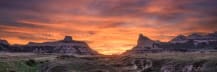
The Nebraska Panhandle in late February is a particular kind of place. Not empty,people who call it empty have never paid attention to it. But stripped. The grass gone brown and flat, the sky coming all the way down to the ground at the edges, nothing between you and whatever weather is moving in from Wyoming. The Wildcat Hills rise dark to the south, cedar-choked and rough, the only real topography in a hundred miles of table land. I have driven this road my whole life. I know every place it rises and every place it dips. I know the spot where the fence line ends and the cottonwoods start and the smell of the air changes… just slightly, to something cold and animal and open…and that means I am almost there.
His place sits back from the road. You see the lights before you see anything else. Then the shop. Then the house behind it, smaller than the shop, the way it always is out here. The house an afterthought, the shop the point.
His dogs came out before I got to the door. Three of them, low and fast across the frozen ground, the kind of working dogs that have never needed names shouted at them from a porch. They checked me in under a second. One sniff at the Jameson. Satisfied. Gone.
He was standing in the shop doorway when I got there.
He looked at me. He has his grandfather’s eyes…the color of October sky out here, when the light goes flat and everything gets very clear and very still.
“Jesus Christ,” he said. “When did you get so fat.”
“I’ve been fat since Clinton and I can still kick your scrawny ass any day of the week.”
“Good to see you too.” He almost smiled. “You doing okay?”
“Pour the glass. I need something to carry.”
He turned and went back inside.
This is how it goes with us. Has gone for thirty years. He says the same thing every time,some variation of alarm at my condition, some assessment of what the years have done to me and he is not wrong to be alarmed. I am older than I look, which is already old. I drink more than I should, which tonight I intend to prove. I have two cigars in my coat pocket and fully plan to smoke them inside, which he will not mention because he will be smoking too. We are two men of a certain age in a warm shop in February and we are going to drink Jameson and say things we cannot say anywhere else and that is the whole plan.
I say something back, and we go inside.
I want to tell you what a working ranch shop actually is. It is the size of a small warehouse. The concrete floor is stained with oil so deeply it looks painted, a dark record of every engine that has ever been opened on this place, going back to his grandfather. Along the east wall, a parts shelf runs floor to ceiling. Bins of bolts and fittings and gaskets and O-rings, every one labeled in his handwriting, which is the handwriting of a man who learned to write so he could make lists and has never needed it for much else.
A John Deere 6R tractor sits in the middle of the floor. Green and enormous and currently in pieces, its components laid out on a tarp with the patience of a surgeon’s table. It has been down for three weeks. There is a reason for that, which we will get to.
A calendar from an implement dealer that is three years old has not been taken down because nobody in the shop cares what year the calendar says.
The smell is oil and metal and cold air that has crossed five hundred miles of open ground to get here. It is the specific smell of the Panhandle and I have known it my whole life and it still does something to me when I walk in.
In the corner, two chairs. Oak. Straight-backed. Built to last, and they have. They have been in that corner since before he was born, since before his father was born, since his grandfather put them there and sat in them through whatever the Panhandle was doing that required sitting.
I have sat in those chairs more times than I can count. So had my father. So had my sister…his mother,though she and Scot’s father had long since gone their separate ways by then, the way some people do after the hard years.He is in Phoenix now. He had sold out a few years before that. Not because the bank came for him. Not because the ground beat him. He just decided he was done. A hundred-year-old family ranch, his grandfather’s ground, and he looked at it one day and decided it had asked enough of him and he was ready for something else. Flat and warm and no February in it. You cannot argue with a man who has made that kind of peace. Scot was in his twenties. He did not make the same peace. He spent the next decade buying it back, piece by piece, on margins so thin they should not have worked. He did not talk about any of that. He just did it.
He set the jelly glasses on the workbench. He looked at the Jameson. Nodded once.
I poured. He found a cigarette from somewhere with the air of a man who doesn’t smoke but has decided tonight is different.
“Let’s look around first,” he said.
We went to see the horses. They belong to his girlfriend …three of them in a small paddock off the barn, a bay, a roan, and a gray that watched us come through the gate with an expression that had opinions in it. He maintains them with the patient tolerance of a man who has accepted something he didn’t choose.
He filled the grain bucket from a fifty-pound bag of sweet feed,a mix of oats and corn and molasses that smells, even in the cold, like something a child would invent. Warm and thick, cutting through the February air. The horses came to it immediately, the bay shoving past the roan, the gray hanging back and then moving in when there was room.
“That one,” he said.
“What about her.”
“Don’t turn your back.”
“She bite.”
“Not yet.” He watched her eat. “Ask me in the spring.”
He topped off the water trough, breaking the thin ice that had formed across the top with the heel of his boot. Matter-of-fact. The ten-thousandth time he has done this exact thing in this exact cold. Steam rose off the water. The last light went orange across the Wildcats. It would have been beautiful if we were in the mood for it. We weren’t. But there it was anyway.
Then we went to look at the calves.
A calving barn in February is a long low building, usually metal, divided into pens. Each pen holds a cow and her calf or a cow about to have one. The floor is packed dirt and straw,ranchers put down fresh straw because a newborn calf needs to be dry and warm within the first hour or it will not make it through a Panhandle night. The smell is hay and warm animal and milk and underneath all of it the iron-and-salt smell that is just birth, the same smell it has always been.
In calving season he checks these pens every two to four hours. Around the clock. For weeks. This is not a metaphor. It is the actual schedule. Miss a check, miss a heifer in trouble, lose a calf. So he checks. At ten and two and four and six, whatever the weather, whatever else is happening in the world.
There is a quality of attention he has in here that I have never seen him have anywhere else. He goes quiet in a different way. Moves slower, more deliberate. He has been doing this since he was eight years old …forty-three years,and he does it without ceremony, without complaint, with the focus of someone who understands that what is happening in front of him is the whole point.
He checked four pens without saying a word.
On the fifth he stopped.
A heifer…a young cow, first calf,was lying on her side, her flanks moving with an effort that wasn’t getting anywhere. When a heifer can’t deliver on her own you have maybe an hour before you lose the calf and possibly the cow. There is no calling for help at this hour nine miles from anywhere. You go in and you do what needs doing.
“How long,” I said.
“Hour. Maybe more.”
He was already climbing into the pen.
What happened next I will not describe in detail because it is not mine to describe. It is old work and it belongs to the people who do it. Twenty minutes, maybe twenty-five, him on his knees in the straw, talking to her in a voice too low for me to hear.
At the end the calf was on the ground. Wet. Shaking. Looking at the world with the expression all newborn things have,not wonder exactly, but something before wonder.
The heifer got up. Turned around. Found the calf with her nose.
He stayed on his knees a moment, watching. Making sure she knew what to do. She did.
He stood up. Wiped his hands on his jeans.
“Okay,” he said.
Forty-three years of doing this and it still gets one word from him, and the word is okay.
Part Two: The Conversation
Back in the shop. I poured more Jameson. The two oak chairs. The tractor in pieces on the tarp. The Wildcat Hills disappearing into the dark outside the door.
He sat down. Lit the cigarette that had gone cold in his pocket. Looked at it like he was mildly surprised it existed.
I waited. With him you wait. He has his own clock and keeps to it and there is no use trying to move it.
“Trump’s fucking going to kill me with this Argentina beef horseshit.”
“Hello to you too.”
“You drove nine miles for small talk?”
“I drove nine miles because you sounded like you were going to put your head through a wall.”
“I’m fine.”
“You called me at eight in the morning on a Tuesday during calving season. You’re not fine.”
“The man is an idiot.”
“We agree on that.”
“Then why does your side keep acting like the people who vote for him are idiots too.”
“I don’t think you’re an idiot.”
“You think I’m confused. You think if I just understood things better I’d come around. That’s worse than thinking I’m an idiot. An idiot can’t help it.”
He turned the glass in his hands. Wide hands, scarred at the knuckles. His grandfather’s hands. Still wet from the calving pen.
“Tell me about the Argentina beef,” I said.
“He opened the market to eighty thousand metric tons of Argentine ground beef. Tariff free. You know what a tariff is?”
“I know what a tariff is.”
“A tariff is a fee the government charges on goods coming in from other countries. Makes foreign product more expensive, helps American producers compete. No tariff means Argentine beef walks into my market at a price I cannot match. My cattle price drops.”
“The argument is lower grocery prices.”
“For who.”
“For people buying food.”
“I buy food. I also just watched my cattle price move the day that announcement came out. The market doesn’t wait for the beef to arrive. It moves on the news. My margin got thinner before a single pound of Argentine beef crossed the border.”
“By margin you mean…”
“The gap between what I earn on a steer and what it costs me to raise him. Feed, fuel, medicine, equipment, land payments. That gap is how this place survives. It has never been wide. The Argentine beef just made it narrower.”
“He’s trying to bring down food costs. People are genuinely stretched.”
“I am genuinely stretched. My being stretched apparently doesn’t count.”
“That’s not…”
“He ran on America First. Whose America? Because the American family rancher just got told the problem was not enough foreign beef. That’s America First?”
“He’s an idiot.”
“We covered that. The problem isn’t that he’s an idiot. Plenty of idiots have been president. The problem is he’s an idiot who is specifically making my life harder right now while I watched him specifically make my life better in his first term. So I have to hold both of those things and decide what to do with them.”
“And what are you deciding.”
“I’m deciding right now. That’s why I called you.”
Outside, the Panhandle night had settled the way it settles in February,not gradually but all at once, the last light gone and the dark complete and the cold sharpening at the edges of everything. Somewhere in the calving barn a new calf was figuring out its legs.
He stood and walked to the shop door and looked out at nothing for a moment. The kind of looking a man does when he is organizing something inside himself. Then he came back and sat down and picked up the glass.
“Fuel,” he said.
“Okay.”
“Everything on this operation runs on diesel. Tractors, trucks, equipment. When diesel goes up, every cost on this place goes up at the same time with no warning and no way to pass it along until fall when the calves sell. Last year I spent forty-two thousand dollars on fuel. Under Trump’s first term, before Ukraine, I was at twenty-six thousand.”
“The war drove global energy prices. That wasn’t a policy…”
“Canceling the pipeline on day one was a policy.”
“The pipeline wasn’t going to be online for years. It wouldn’t have changed your fuel costs in any near-term…”
“I know that. I’m not saying the pipeline fixes my bill tomorrow. I’m saying I watched him make a choice about what mattered on the first day he had the chance to choose. And it wasn’t me.” He turned the glass. “Fifty six thousand dollars is my note payment. That’s what I owe on the equipment that runs this place. I felt every dollar of that gap.”
“Climate is real, Scot.”
“I know fucking climate is real. I watch the weather closer than anyone in this conversation. I’m not arguing with the science. I’m telling you I am the one paying for the solution while the people who designed the solution are not. The cost of fixing the problem lands on the people who had the least to do with causing it.”
He let that sit.
“Walk me through the first term,” I said. “Beyond the fuel. What else got better.”
“The antibiotic rules.”
“Explain the antibiotic rules to somebody who’s never set foot on a cattle operation.”
“Pink eye. Cattle get pink eye. It moves fast,eye swells, clouds over, you don’t treat it in a day or two the animal can go permanently blind. Blind cow can’t calve right, can’t find her calf, production drops, you end up cutting her from the herd. One untreated case costs me a thousand dollars when you account for everything downstream.”
“And you treated it how.”
“Eight dollar tube of antibiotic ointment. Kept it in the glove box of my truck. Animal gets pink eye, I’m there in twenty minutes, eye is treated, animal is fine. Eight dollars and twenty minutes.”
“Simple.”
“Simple. Then the FDA made it prescription only. Now I need a licensed vet to prescribe it. Nearest large animal vet is ten miles away.Books three days out. By the time I get a prescription, I may have already lost the eye.”
“Why did they change the rule.”
“Feedlots.”
“Explain feedlots.”
“Industrial cattle operations. Tens of thousands of animals crowded together in confinement. The big ones were mixing antibiotics into every animal’s feed whether it was sick or not. Not treating sick animals,dosing whole populations as routine practice because it was cheaper than monitoring individual animals and it kept them from getting sick in close quarters. Do that across millions of animals and the bacteria develop resistance. Medicines stop working. Not just for cattle. For people too.”
“So the FDA had a reason.”
“A completely legitimate reason. The feedlots were causing real harm. The science was correct. The problem needed to be fixed.”
“But.”
“But I am not a feedlot. I run three hundred and fifty head on open ground. I treat a sick animal when it is sick with a specific medicine for a specific condition. That is the exact opposite of what caused the problem. The rule doesn’t know that. It treats me the same as a fifty-thousand-head confinement operation in the Texas panhandle.”
“Can’t the rule be written to make that distinction.”
“It could be. It wasn’t. Because making that distinction requires somebody to care enough to do the work. Nobody did the work. So last year I spent four thousand dollars on a problem that used to cost me eight dollars. That’s the result.”
“And Trump rolled that back.”
“Rolled back the most aggressive proposed rules. First term. I felt it. In actual dollars, I felt it.”
“He did it because the agriculture lobby…”
“I don’t care why a doctor gives me medicine that works. I care that it works.”
“You absolutely should care why. Because if he did it for the lobby and not for you, he’ll undo it the minute the lobby changes its mind.”
He looked at me. Took a long drag of the cigarette that had gone cold again.
“Which is exactly what is happening right now with the Argentina beef. The meatpacking lobby wants cheap foreign product to process. Costs them less. He’s delivering it. I don’t have the lobby the packers have.”
“So you know you’re getting played.”
“I have always known I’m getting played. The question is who’s playing me for less.”
He stubbed out the cigarette on the arm of the old chair the way men have been stubbing cigarettes on that arm for eighty years. He looked at the tractor sitting in pieces on the tarp. The John Deere. Green and enormous and wrong.
I had noticed it when we came in and hadn’t asked. Now I did.
“Tell me about the tractor.”
“My 6R has been down three weeks.”
“What’s wrong with it.”
“I know exactly what’s wrong with it. I’ve known since the second day. I have the part. I have the skill. I have fixed machines like this my entire life.”
“So what’s the problem.”
“The software. Modern equipment runs on diagnostic software. You can’t fully repair the machine without accessing it. John Deere owns the software. John Deere says only authorized dealers can use it for repairs.”
“You’re kidding.”
“Nearest dealer is in town and backed up six weeks. It is February. Calving season. I need this tractor.”
The weight of that sat in the air for a moment. A man who can birth a calf in the dark on his knees in the straw, who can read weather and soil and the behavior of animals and machinery the way most people read nothing, who has spent his life knowing how to fix whatever breaks, told by a corporation that he cannot fix what he owns.
“So a company is telling you that you can’t repair something you own.”
“I own the machine. I do not own the right to repair it. John Deere decided ownership and repairability are two different things and they own the second one.”
“That’s insane.”
“Welcome to my world.”
“There’s legislation…”
“There has been right-to-repair legislation for ten years. It keeps almost passing. John Deere keeps making voluntary commitments to expand repair access. The commitments keep meaning nothing. My grandfather could fix anything on this place with a wrench and a parts manual. I have forty years of mechanical knowledge and a machine I legally cannot repair.”
“What did you do.”
“Found a guy in Wyoming with a workaround.”
“Is it legal.”
“It is not.”
“You’re doing an illegal repair on your own tractor.”
“I own the tractor.”
“I’m not arguing with you…”
“You were going to tell me there are legitimate channels.”
“There are legitimate…”
“There are legitimate channels that have produced no result in ten years. My tractor has been down for three weeks during calving. The legitimate channel is ten miles away and six weeks out. The illegal channel is a guy in Wyoming who will have me running by the weekend. You tell me which channel I use.”
“The system failed you.”
“The system failed me because John Deere has lobbyists and I have a broken tractor. That is not a Republican failure or a Democratic failure. That is the failure of every elected person who has taken John Deere money and declined to make their lives hard. Both parties. All of them.”
We sat in the chairs his grandfather had put there a hundred years ago. His father had sat in them too, and then decided he was finished, and drove south. Scot had sat in them alone after that, for years, working to get it back. Some men are done with a place. Some men cannot be. The chairs do not care which kind you are. They just hold you. The Jameson was getting low. The cigar I’d brought had burned down to its last inch. Outside, somewhere in the distance, a coyote said something and something else answered it.
“Tell me about the packers,” I said.
“Four companies. JBS, Tyson, Cargill, National Beef. Four buyers for every beef animal raised in this country. I produce a steer, those are my options. I take their price or I haul my cattle home and lose money on the fuel.”
“Obama’s USDA proposed rules to fix that. GIPSA regulations. Basic protections against price manipulation, transparency in how cattle are priced…”
“You’re going to use Obama to defend the Democratic Party to me.”
“I’m saying there was an attempt.”
“There was an attempt that the same administration killed when the packers pushed back. You want credit for trying?”
“I want you to acknowledge it’s more complicated than one party helps you and one doesn’t.”
“It is more complicated. The complication is that both parties have failed me and one of them has at least occasionally produced a result I could use. That is a low bar. I know it’s a low bar. That bar is what I have.”
“Biden put serious money toward independent processing. Breaking the bottleneck.”
“I know about the money.”
“And.”
“The processing facility that might one day exist doesn’t help me sell cattle today. The vision is good. The vision does not write my note payment.”
“Long-term structural change takes time.”
“I’m fifty-one years old. How long-term are we talking.”
“That’s not a fair…”
“The packer consolidation happened over forty years with the full knowledge and approval of the federal government. Every merger waved through. Democrats, Republicans, didn’t matter. Now there are four buyers and the solution is a processing facility that will be built sometime in the future if the grants come through and the permits clear and the processor survives long enough to actually compete. I’m not saying the vision is wrong. I’m saying I am selling cattle now. Into the market that exists.”
He poured more Jameson without asking, which meant we had moved somewhere real.
“The damage was done while everyone was looking the other way,” he said. “Now the fix is a decade out if it happens at all, and in the meantime I sell into a market controlled by four companies who know I have no choice. That is not a Trump problem. That is not an Obama problem. That is a forty-year problem that nobody in Washington cared about until ranchers started going broke in large enough numbers to be a talking point.”
“Tell me about the estate tax.”
He looked at his hands. Set down the glass.
“You know what this place is worth on paper.”
“Walk me through it.”
“The ground under this operation is worth what hedge funds and investment firms decided it was worth when they started buying western land as an asset class. Not because I sold anything. Not because I got rich. Outside money has been flooding into western land for a decade, treating it like a portfolio, and the price has gone to numbers that have no relationship to what the ground actually produces.”
“So the land is worth a lot but you’re not wealthy.”
“Land-rich and cash-thin. I own something worth millions on paper and I run on margins that would embarrass a restaurant. When I die, the federal government looks at the paper number and sends my kids a bill.”
“There’s an exemption.”
“Trump raised the exemption to eleven million per person. That covers what I’ve built, barely, at today’s prices. Barely.”
“And if that exemption drops.”
“If it goes back to five million per person, my kids inherit a tax bill they can only pay by selling part of the ranch. My great-grandfather built this place. My father decided he was done with it and sold his part.I was not done with it. I spent thirty years getting it back and putting it right. I am not going to watch my kids lose it to a tax bill.”
“The Democratic position wasn’t a straight estate tax hit. It was a stepped-up basis reform…your kids hold the land, no tax. They sell it, they pay tax on the profit.”
“Which means they sell it to pay the tax on the sale.”
“Only if they sell enough that…”
“Let me tell you what my kids are going to need to sell in a bad year. Drought hits, prices drop, they’ve got debt and a capital improvement that needs to happen and now a tax bill sitting behind every sale they make. They’re not selling because they want to. They’re selling because the year broke bad and the tax broke bad at the same time. And on top of the hard year, they’re paying tax on land appreciation they didn’t create. That appreciation happened because rich people decided land was a good investment. My kids pay for it.”
“The intent is to tax accumulated wealth, not working farms.”
“The intent is fine. The result is my kids might lose this place. I live in results.”
“You sound like you’re defending a tax break for millionaires.”
“I sound like a man whose family will lose three generations of work because the government will look at a number that has nothing to do with what we earn and write a bill based on it. Call it what you want. I call it what it is.”
“The high exemption also protects people who are actually wealthy. People who inherit fortunes and do nothing.”
“Then close the god damned loopholes that protect the idle rich. Don’t close the exemption that is currently the only thing standing between my kids and a forced sale. If you can write a rule that tells the difference between a working ranch and a dynasty, write it. Pass it. I’ll support it. That rule does not exist. The exemption exists. I’ll take the thing that exists.”
The bottle was most of the way down. The shop had gotten warm enough that neither of us was thinking about the cold anymore. The tractor sat in its pieces and the calendar that was three years old said whatever month it said and the parts shelf ran floor to ceiling with every labeled bin that had kept this place running through everything the last fifty years had thrown at it.
He looked at the door for a while without saying anything.
“You know what I can’t say out loud,” he said.
“Say it anyway.”
“I knew what he was in 2016. I know what he is now. A fraud. A man who has never done a hard physical thing in his life and never will. A man who would sell me to Argentina if the deal was right.” He paused. “I know all of that.”
“And yet.”
“And yet the other side has been telling me for thirty years that what I do is a problem to be managed. Not fixed. Not helped. Managed. Reduced. Phased out like something obsolete.”
“That’s not…”
“Obama. Guns and religion. I’ve read the full quote. I know what he was trying to say.”
“Then you know he wasn’t calling you…”
“I know what he was trying to say. I know what I heard. A smart man explaining to people who agreed with him why people like me are the way we are. Explaining our attachments like they were symptoms. Like what I do and how I live is a reaction to something instead of a choice I made with my eyes open because this is who I am and this is what I love.”
“That’s a misreading. He was talking about how economic anxiety gets displaced into cultural grievance. It’s actually a sympathetic…”
He looked at me.
Just looked at me.
I heard myself. What I had just done. The clinical language. The explaining. Sitting in his shop with his grandfather’s chairs and a calf still wet in the barn and a tractor I couldn’t legally fix and I had just described his life as an economic anxiety displacement mechanism.
“Yeah,” I said. “Okay.”
“You just did it.”
“I know.”
“Right here. In this chair.”
“I know.”
He let it sit for a moment. Not cruel about it. Just letting it be what it was.
“That’s what I’m talking about,” he said. Not angry. Tired of a thing that keeps happening. “That’s the whole thing right there.”
“I know.”
“Maybe. But it’s the misreading you keep producing. Every time. The words leave your mouths and land on me and that’s what they feel like. You don’t get to tell me what I heard.”
“Fair.”
“Hillary. Deplorables. I know the context there too.”
“She was talking about a specific…”
“I know who she was talking about. What I heard was a candidate for president sorting Americans into the ones who count and the ones who don’t. And I was in the pile that doesn’t.”
“And Trump said you count.”
“Trump looked at what I do and said it matters. Said people like me are what’s right with America. He was lying. I knew he was lying the first time he said it.”
“How did you know.”
“Because a man who has spent his whole life in towers and casinos does not give a fuck about a rancher in the Nebraska Panhandle. He said the words because the words were useful. I knew that.”
“And you voted for him anyway.”
“I voted for the words. Because I had not heard anything like them from anyone who wanted my vote in twenty years. You want to beat him out here? Stop explaining to me why he’s wrong for me. Start making me feel like I’m right for you. Those are different conversations and your side has only ever wanted to have the first one.”
The cigar was out. The glass was empty. Neither of us moved to change either of those things.
“What would make me worth your vote,” I said.
He looked at me.
“You’re asking.”
“I’m asking.”
“Country of Origin Labeling on beef. Bring it back. You buy beef at a grocery store, the label says where it came from. Simple. Let me compete on being American. On being from here.”
“We had that. The WTO ruled it a trade barrier.”
“Renegotiate the trade agreement.”
“The retaliatory tariffs on other American exports would…”
“Would hurt some industries to help others. Like every trade decision ever made. I’m not saying it’s free. I’m saying it’s worth doing and nobody has prioritized it because ranchers don’t have the lobby that grain exporters have.”
“What else.”
“Break up the packers. Actually break them up. Use antitrust law for what it was designed for. Four companies cannot control the entire beef supply of this country. That is a monopoly problem with a legal solution that has existed for a hundred years.”
“That would take years of litigation…”
“Then start. The forty years already happened. You want to fix it, start. I’ll still be here.”
“What else.”
“Right to repair. Pass the law. I should be able to fix my own equipment. This one has broad public support. The only reason it hasn’t happened is John Deere has better lobbyists than I do.”
“What else.”
“Protect the estate tax exemption. Or build something better. But don’t take away the one instrument that exists to keep working ranches intact while you’re designing the elegant solution. Build the elegant solution first. Then we’ll talk.”
He picked up his glass. Put it down again. Empty.
“Those are four specific things,” I said.
“Four specific things with specific policy mechanisms that have been proposed, blocked, or abandoned. I didn’t invent any of them. I just watched them fail.”
“And if a Democrat ran on all four.”
“I’d vote for the Democrat.”
“You’d vote for a Democrat.”
“I’d vote for whoever would actually do those things. I’m not sentimental about party. I’m sentimental about this place.”
“Then why aren’t Democrats talking to you.”
He looked at me for a long moment.
“That is the question. That is the only question.” He turned the empty glass in his hand. “You drove nine miles with a bottle of Jameson and sat in my shop, and that is more direct engagement with my actual situation than I have received from a Democratic candidate in twenty years. When is the last time one knocked on a door in this county.”
“I don’t know.”
“I do. I remember it. My father was still farming”He set the glass on the workbench. “So you tell me whose fault it is that I vote the way I vote. I’m not hard to find. I’m right here. I’ve been right here my whole life. I will tell anyone who asks exactly what I need and why. No one asks.”
Jack had brought Jackson out the month before. My son, his cousin, and the boy,three years old, no fear, walked straight into the calving barn and tried to pet everything he could reach. Jack nearly had a heart attack. Scot let him touch the gentle ones.
He had not said much at the time. Now he picked up the empty glass and turned it.
“That boy,” he said.
“What about him.”
“He walked in here like he owned it.” He set the glass down. “Three years old and he walked in here like he already knew what it was.”
“He’s your blood too.”
“I know whose blood he is.” He looked at the door of the calving barn, just visible through the shop opening. “I want there to be something here when he’s old enough to ask about it. That’s the whole thing. That’s all this is.”
He didn’t say anything else about it. He didn’t need to.
We were standing outside when he said the last thing. The dogs came from somewhere, three of them breathing steam in the cold. The Wildcats were invisible now, just the place where the stars stopped. The sweet-feed smell drifted from the paddock. Somewhere in the calving barn, the new calf was figuring out its legs.
“He’s still going to hurt you,” I said. “The Argentina beef is not the last thing.”
“I know that.”
“He doesn’t care about ranchers. He cares about deals.”
“I know what he is.” He said it the way he says everything…flat, patient, a man who has accounted for a thing and filed it somewhere useful. “That’s why I called you.”
“Help me understand. Really.”
“I have two options. A man who occasionally does something useful and is currently doing something stupid, who at minimum says out loud that what I do matters, even if he doesn’t mean it. Or a party that means it, maybe, but hasn’t shown up here in twenty years, and when they do show up, shows up to explain to me why my concerns are complicated.”
“Those can’t be the only options.”
“They’re the options on the ballot.”
“Then change who’s on the ballot.”
“I have been waiting for someone on your side to give me a reason to. Not a reason to hate the other guy. A reason to vote for you. Those are different things and you keep confusing them.”
“He’s an idiot,” he said. “I want that on the record.”
“It’s on the record.”
“Drive safe.” He looked at me once more…that look he always gives, fond alarm, the whole thirty years of us in it. “And lay off the Jameson.”
“One of those is going to happen,” I said.
He went back inside.
I stood at the truck for a while. The cold was serious now, the kind that gets into your collar and stays. I got in, put the key in, and sat there. Then I took the key back out.
I called Patricia.
It rang four times. She picks up on four rings because she looks at who it is first and makes a decision. My wife has been making decisions about me for a long time. She is good at it.
“It’s eleven-thirty,” she said.
“I know what time it is.”
“Are you at Scot’s.”
“I’m in Scot’s driveway.”
A pause. “How much did you drink.”
“Enough that I’m calling you instead of driving.”
“That’s the most self-aware thing you’ve said in a month.” Another pause, shorter. “Stay there. Don’t go back inside or you’ll drink more.”
“I won’t.”
“You will. Stay at the truck.”
She hung up.
I stayed at the truck. The shop light was still on inside, yellow through the gap in the door. I could hear him moving around in there, back to whatever the evening still had left to ask of him. One of the dogs came and sat near my feet for a while, then decided I wasn’t interesting and left.
I thought about everything he’d said and everything I’d said and the distance between them, which was nine miles and also something else, something that doesn’t reduce to miles. I thought about the calf in the straw finding its legs. I thought about two oak chairs that had held three generations of this family through whatever the Panhandle was doing, and what it said about a place that the chairs were still there and still being used.
Forty minutes later Patricia’s headlights came down the road.
She pulled up next to the truck. She was in her coat over her pajamas, her hair pulled back, not angry exactly but not warm either, the expression of a woman who has done this before and made her peace with doing it again.
“Get in,” she said.
“I can get the truck tomorrow.”
“I know you can. Get in.”
I got in. She turned around in his driveway, the gravel crunching under the tires, and headed back down the road. The shop light got small in the mirror. Then it was gone.
“Was it worth it,” she said.
I thought about that. I thought about him on his knees in the straw, talking to a heifer in a voice too low to hear. The calf on the ground, wet and shaking, looking at the world before it had categories for anything. Him standing up and wiping his hands on his jeans and saying okay like that was all it needed.
“Yeah,” I said. “It was.”
She didn’t say anything. She drove. The Panhandle dark was total around us, just the headlights and the road and nine miles back to where we started.
He just wanted someone to know it was real.
Now you know.
I drove nine miles in February with a bottle of Jameson to sit in my nephew’s shop and actually listen. That’s what I do. I show up to the places most people only argue about from a distance, and I try to tell it true. If that’s worth something to you, a paid subscription is eight dollars a month or eighty dollars a year. It keeps this going. If you can’t swing it, read anyway. But if you can, I’d be grateful.
My main takeaway is that the US government has failed the people. For decades.
We should absolutely have country of origin labeling on ref and lamb. This is why I only buy meat at Whole Foods, even though it’s more expensive. And, while I’ve never understood the desire to be courted for votes, I think Biden and even Kamala would have been happier to sit with him in his shop than Trump would.