

Be Happy With Yourself, With What You Have
Some mornings the math finally comes out right.

I counted it up once, on a legal pad, the way my father used to sit at the kitchen table at night going over the books for his business. Not because I doubted it. Because I wanted to see it written down.
Two hundred and eighty dollars a month for the truck, paid off in eleven more payments. A garden that gives back roughly four hundred dollars of vegetables a summer for maybe sixty dollars of seed and sweat. Five grandsons who show up loud and leave the house quiet in a way that has a shape to it. A wife who still comes to the doorway when she hears the truck, thirty years of that same walk, unhurried, like she has already decided what she’ll find and has decided it’s good.
None of that is wealth. I want to be plain about that before I go any further, because plain is the only register I trust. We are not a rich family. The roof needs work I keep pricing and not doing. The Dodge has 140,000 miles on it and a sound in the front end I have decided not to listen to too closely. I have a pension and Social Security and a porch, and some months the math is tighter than I’d like to admit even here, where I’ve admitted worse.
But I have stopped doing the other kind of counting. The kind where you measure your life against a life you don’t have, and come up short on purpose, because coming up short is easier than sitting still with what’s actually in front of you.
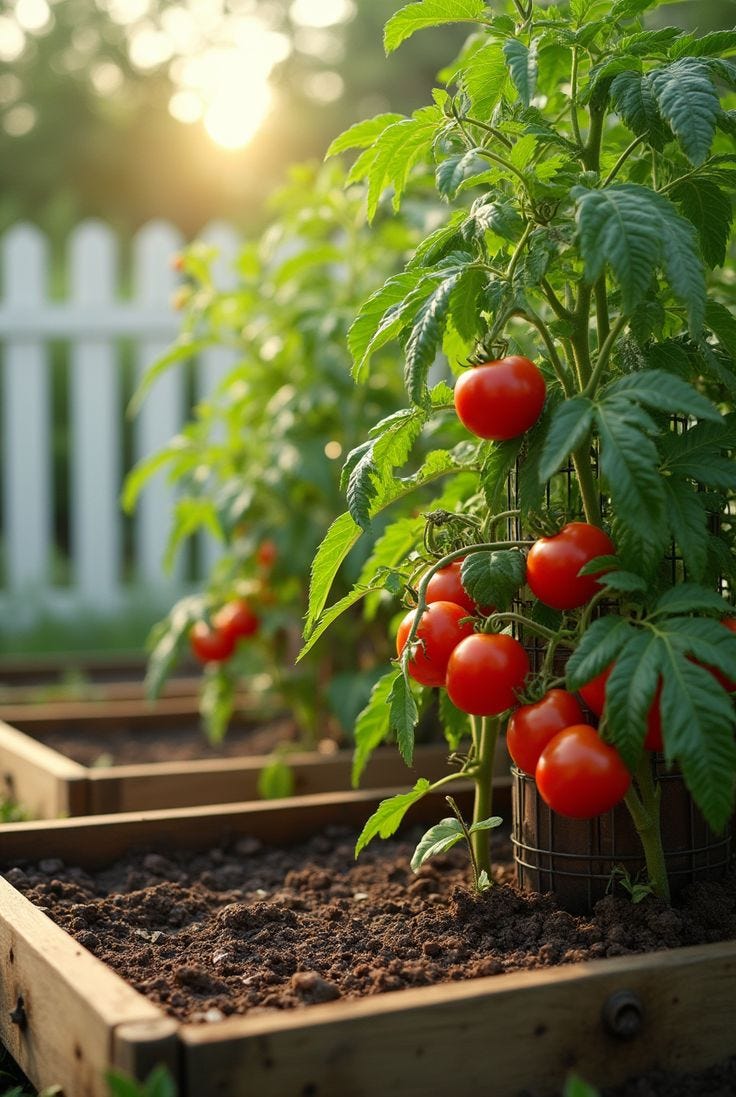
This morning: coffee, black, on the porch at 6:40. Already warm enough that the coffee cools faster than I’d like. The first tomatoes are coming in off the vine. Patricia’s nasturtiums are still going strong along the fence, orange and yellow, doing exactly what she said they’d do back in February when she put them in with more faith in them than I had. Stella, our dog, is asleep in a patch of shade she found herself, because nobody showed her where the shade would be at 6:40 in July, she just knew, the way dogs know things we’ve stopped bothering to know.
That’s the whole ledger for the morning. Coffee, ripe tomatoes, orange flowers, a dog who found her own shade. It doesn’t add up to much on a legal pad. It’s not the kind of thing you could take to a bank. But I have started to believe it’s the only accounting that was ever going to balance, because the other kind never balances. There’s always a later. There’s always a number just past the one you’re standing on. I spent enough years chasing that number to know it doesn’t have an end, and I’m grateful, honestly grateful, to have figured that out while there’s still enough runway left to enjoy not chasing it.
The rest of the day had its own ledger too. Five boys came through here yesterday. Ages three to ten, which is its own kind of weather system: loud, unpredictable, gone before you’re ready. They ate things the color of no food that occurs in nature. Lucky Charms straight from the box, a bag of Doritos gone in twenty minutes, a stack of corn dogs that Patricia had ready before they even walked in, because she always has them ready, because she’s learned over the years exactly what five boys need the second they cross the threshold.
The three-year-old found the garden hose and turned the whole afternoon into something involving water and mud and a level of joy that a grown man forgets is available until he watches a three-year-old rediscover it for him. The ten-year-old, who has appointed himself the leader of this particular expedition without anyone voting on it, organized a game with rules I never fully understood, something involving the porch steps as a base and the garden fence as enemy territory, and the middle three fell in line the way younger siblings and cousins always do, thrilled to have been given a rule at all, even one that changed every four minutes.
I sat in my good chair and watched most of it. This is one of the real luxuries of being sixty-six, one nobody tells you about when you’re younger and still in the middle of the chasing. You get to sit in the good chair and watch, and the watching itself has become one of the better parts of the day, better in some ways than the doing ever was.
Stella lost her mind three separate times. Once when the hose went on. Once when the youngest one, Jackson, fell down laughing and she thought something was wrong and ran to check on him, nose first, tail going, and once for no reason I could identify at all, just a dog deciding the afternoon called for a full sprint around the yard, ears back, tongue out, doing laps for the sheer animal pleasure of having legs that worked and a yard to use them in.
By five o’clock they were gone, loaded back into three different cars by three different sets of parents, waving out the windows the way kids wave, with their whole arms, like the waving itself is the point. The house went quiet in that particular way it gets after they’re gone. Not an empty quiet. A quiet that still has their shape in it, the way a pillow holds the shape of a head after you’ve gotten up.
I sat on the porch a long while after that. The afternoon wore on the slow way a July day does, in no hurry to let go of its light, and it was a few hours before the Wildcat Hills started going dark to the south the way they do every single evening, twelve million years old, not asking anything of anyone, not impressed by anything I’ve done or haven’t done, just being there the way they’ve been there since before there were people around to notice. Cigar going by then too. I did not think about the roof. I thought: this is a lot. Right here. This is already a lot.
I think the trick, if there is one, isn’t getting more. I’ve had years with more and years with less and the feeling in my chest on a Tuesday morning didn’t track the difference nearly as closely as I expected it to. I spent thirty years in a career where the number was supposed to be the whole point. A bigger number every year, a bigger title, and I chased all of it the way you’re supposed to, and I got some of it, and some of it was genuinely good, work I was proud of and people I was glad to stand next to. But none of it, not one bonus check, not one good year, felt the way this porch feels on an ordinary Tuesday with a dog asleep in a patch of shade she found on her own.
I don’t regret the career. I want to say that plainly, because I don’t want this to sound like a man tearing down a life he actually enjoyed living. It fed this family and it taught me patience and it gave me friends I still call on the phone. But somewhere in there I started paying closer attention to one ledger than the other, the one with the number on it, the one that always had a next number waiting, and I let the other ledger, the one with the porch and the dog and the boys and the garden in it, run quietly in the background like it would always be there whenever I finally got around to looking at it properly.
It was always there. That’s the good news, the genuinely good news, and I think it’s worth saying out loud for anyone reading this who’s still in the middle of chasing the other number. The good chair was on this porch the whole time. The garden bed by the east fence has been there since 2009. Patricia has been standing in that doorway for thirty years, and I just wasn’t always looking up in time to see her.
Patricia came out with two fingers of Jameson and handed me the glass without asking if I wanted it, because after thirty years she doesn’t have to ask. She stood there a minute looking at the garden and the fence and the light going down orange over the fields, one hand resting on the porch rail, and neither of us said anything for a while. We didn’t need to. That’s a thing that took me most of a lifetime to learn how to sit inside of without feeling like something was supposed to be happening. The silence used to make me restless when I was younger. I’d fill it with plans, with the next thing, with some number I thought I was supposed to be moving toward. Now it’s just Tuesday evening, and the silence is the good part, not the waiting room before the good part.
“You’ve got dirt on your hands,” she said, which was the whole conversation, and it was enough. I looked at my hands. I did have dirt on them, from the garden, from turning beds that morning before the boys came, and I looked at that dirt the way you’d look at a good report card, with something close to pride, because it meant I’d used the day for something real.
We sat like that as the light went from orange to gray to whatever color the sky turns when it’s decided the day is finished asking anything of you. Stella found a new spot near my feet, not the shade anymore, just wherever felt right, and settled into it with the total unbothered confidence of an animal who has never once in her life worried about whether she’s doing enough with her time.
I think about my father sometimes on evenings like this one. He ran small businesses his whole life, and I remember him at the kitchen table after we were supposed to be asleep, the adding machine going, that mechanical stutter and the thin curl of paper tape spilling over the edge and onto the floor. He’d run the same column of numbers three times some nights. Not because he didn’t trust the first two. Because running it a third time was the only way he knew to feel like he’d actually finished a day. I never once saw him sit on a porch with nothing in his hands. Not a paper, not a pen, not a tape. I used to think that was just who he was, a fact about him like his height or the color of his eyes. I think now it was closer to a habit he never got around to breaking, and one I very nearly inherited whole, right down to the same restless hands, before I noticed what I was doing and made a different choice.
That’s the whole secret, if you want to call it a secret. It’s not a discovery. It’s a choice, made over and over, morning after morning, the same choice my father never quite got around to making. Some mornings I still forget to make it and catch myself halfway through the old arithmetic before I remember there’s a better one available. That’s fine. Nobody makes the good choice every single day. You just have to make it more days than not, and let the days add up on their own.
The cigar burned down to nothing. Full dark now, the kind where the Wildcat Hills stop being visible and just become a place you know is still out there, indifferent and beautiful at the same time, which I’ve come to think might be the same thing the older I get. Stella breathed slow next to my boot. Patricia’s hand was still on the rail, and mine found its way over to rest on top of it, and neither of us made anything of that either, because after thirty years you don’t have to make something of every good thing that happens. Sometimes the good thing is just allowed to happen, undecorated, unremarked on, exactly as much as it needs to be and not one word more.
It was enough. It was already enough. It had been enough the whole time, and I’m glad, genuinely glad, to finally be a man who knows it while he’s still got the porch to sit on and the hands to hold.
A man on a porch with everything he needs already sitting there.
Somewhere across town, an adding machine that hasn’t run numbers in thirty years sits in a drawer. Nobody’s plugged it in for a long time. Nobody needs to.
If a piece like this one is worth something to you, consider becoming a paid subscriber. It doesn’t change what I write or how often, it just means I get to keep doing it. Thank you for reading, and thank you to everyone who’s already chipped in. It matters more than you know.
And if you haven’t yet, my book, Nine Miles, is out now and available on Amazon. Most of what’s in this newsletter grew out of the same soil as that book.
“Coffee, ripe tomatoes, orange flowers, a dog who found her own shade”….that, sir, is absolute wealth. The kind of riches that warm our souls and spark our spirits, bring quiet joy and meaning to our days. I wouldn’t trade my version for more money. My adult kids are making lives full of experiences, the red bee balm is in its glory, the pantry is full and the house was 70 degrees this morning after a night of open windows— my porch chair and book are calling.
You make a good point, Tom. I was struck by the use of the whiskey in your narrative. I spent spent years wanting to use alcohol in that way. It was almost always impossible.
In my case, two fingers of anything always led to endless drinking.
The physiological aspect of alcoholism, which generally misunderstood by everyone (including and especially those who are afflicted) is that alcohol radically and instantly resorts the mental model so that the only thing that matters is more alcohol. This only happens when we drink; otherwise it's just an obsession with the idea we can instantly feel better (though after a time we generally don't, so we'll settle for feeling nothing).
This fundamental difference between the alcoholic and non-alcoholic can usually be determined by a simple question: at any point in your life, did you attempt to drink less than you wanted and fail?
This one foxed me for years. I thought everybody had that feeling when they drank, but somehow were better at controlling it.
When I asked my non-alcoholic wife if she ever had that experience, she looked at me as if I asked her if she ever ate her own shit.
The feeling the alcoholic has when they drink is wholly foreign to most people, but not to us. I have heard it described as "the off switch freezes open." Doctor William Silkworth deemed it an allergy, and wrote that possessing this chronic condition singled alcoholics out as a distinct entity.
All this to say that, as a sober alcoholic dedicating a fair portion of my life to working with others who wonder what the hell is wrong with them, I am still often challenged to look on the bright side of anything. I have read too much of history to have sunny feelings about our prospects, but am fortunate enough to have witnessed individuals whose lives were destroyed by greed, lying, violence, and general selfishness but somehow did the the work and changed into decent, caring human beings.
If that can happen with the individual, it can also happen with the culture at large. I tell the guys I work with to "be where your hands are," to do as Teddy Roosevelt advised: what you can with what you have, where you are.
But also as Calvin (of Calvin and Hobbes) added, "Of course he wasn't sitting in the tub when he said it."
Be well my friend. Thanks for the cheer.